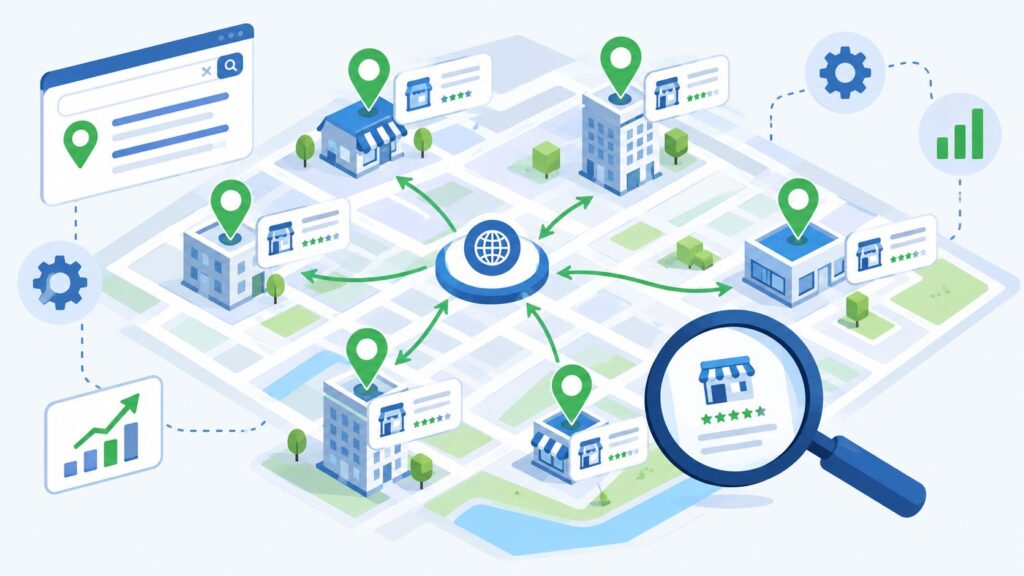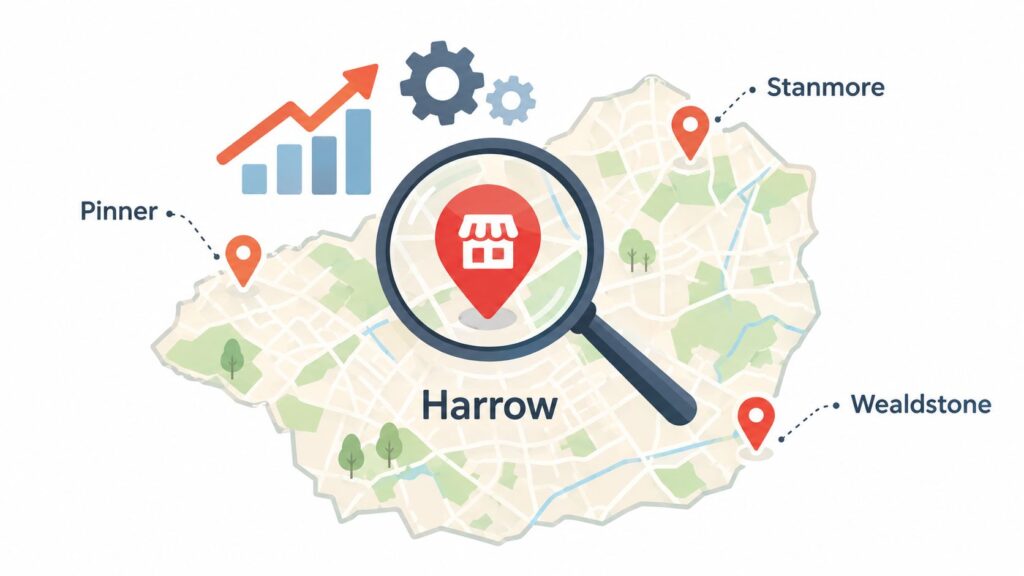

Using ChatGPT to write more blog posts won't automatically make a business visible in ChatGPT answers. AI-generated content is only one part of the system, and often not the most important part. If crawlers can't access the site, if the business identity changes from page to page, or if key facts aren't presented in a machine-readable format, polished copy may never become a reliable source for an answer engine.
That distinction matters for ChatGPT visibility for businesses. Traditional search optimisation still provides a useful foundation, but AI answer engines also need clear entities, accessible pages, consistent facts, relevant third-party signals, and content that answers natural-language questions directly. A business that treats the task as a content-volume exercise can spend heavily while remaining structurally difficult for AI systems to understand.
The UK market is already moving in this direction. Government data indicates that around 15% of UK businesses, approximately 432,000 companies, had adopted at least one AI technology, while adoption reached 68% among large companies, 34% among medium-sized companies, and 15% among small companies. The same dataset found that natural language processing and generation was used by 8% of firms, placing a measurable base of businesses in the same broad language-model category that supports AI-assisted discovery (London government report on generative artificial intelligence).
Rethinking Search for AI Answer Engines
The popular advice is to ask ChatGPT for search-optimised articles, publish them regularly, and wait for recommendations. That approach mistakes using an AI tool for being understood by an AI system. ChatGPT can draft copy, but it cannot grant crawler access, reconcile conflicting company details, or establish authority where the wider web provides no supporting evidence.
Traditional SEO remains useful for queries, relevance, internal links, and ranking signals. Answer engines add a separate interpretation layer. Depending on the product and query, they may retrieve pages, inspect snippets, read structured information, compare sources, and assemble a response. Businesses therefore need facts that are easy to locate, interpret, verify, and quote. This is the practical focus of answer-engine optimisation.
Content quality starts with access
A well-written article has limited value for web-based discovery if an AI crawler cannot reach it. An accessible site can still be difficult to cite when its titles, headings, metadata, address, services, and organisation details conflict. Visibility depends on both access and interpretation, not writing quality alone.
A UK audit of 31,152 websites found that 71.0% scored below 50 out of 100 for AI search visibility, only 1.1% reached the Strong tier, and none achieved the original AI-Ready threshold of 86 or above (UK SAVI report). The figures suggest a neglected opportunity, but they also identify the practical priority. Many organisations need a site that answer engines can crawl and classify before they need another generic article.
Practical rule: Treat every important business fact as data that machines must reconcile, not merely prose that people might read.
The difference between conventional SEO and generative search is examined in this guide to optimize for generative search. For an SME, the working model is clear: traditional SEO helps a page enter the information environment, while answer-engine optimisation helps systems extract accurate business, service, location, and suitability signals.
Recommendations require more than mentions
A brand mention is not automatically a commercial result. An answer may identify a business but give the wrong location, opening hours, services, pricing approach, or customer fit. It may also satisfy the user inside the interface, creating exposure without a website visit.
That creates a measurable trade-off. Businesses should pursue accurate citations and useful recommendations, then judge performance by outcomes such as enquiries, calls, bookings, or purchases. A workable programme combines technical accessibility, clear source content, consistent information across external platforms, and reporting that connects AI visibility with those outcomes.
Technical Prerequisites for AI Crawlers
Publishing AI-assisted content before fixing technical access creates a discoverability problem. Answer engines cannot rely on pages they cannot crawl, interpret, or reconcile with the rest of the business's information. Public service pages, location pages, product details, FAQs, and company information need a clear route through the site.
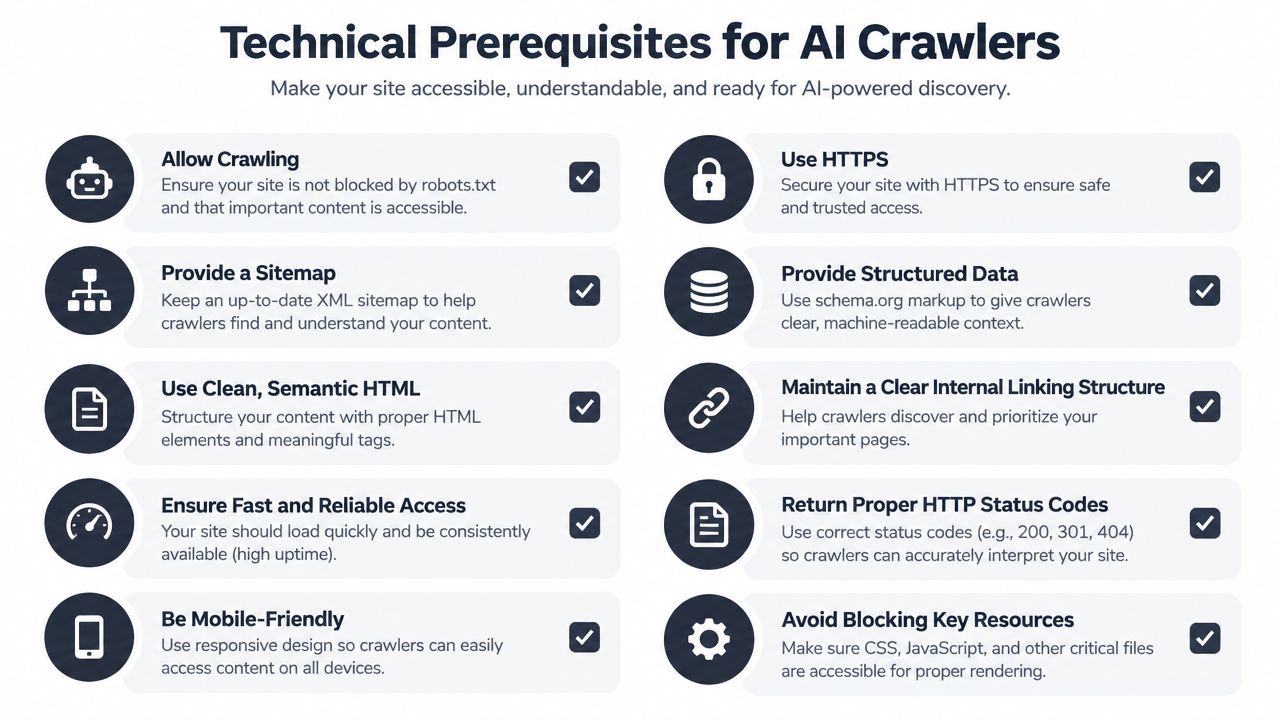
A useful audit follows an automated system from access, through retrieval, to interpretation.
Start with crawler access
Review robots.txt for accidental blocks affecting GPTBot and other relevant AI crawlers. A restriction may have a valid security or commercial purpose, so configure it deliberately rather than copying a standard template. The aim is to keep private and low-value areas restricted while leaving important public information available for legitimate discovery.
Then check indexability. Canonical tags, noindex directives, JavaScript rendering, authentication walls, broken links, and weak page architecture can stop an answer engine retrieving key information cleanly. XML sitemaps and relevant internal links provide useful routes through the public site, although they cannot correct every crawling issue.
The UK SAVI recommendations advise allowing AI crawlers in robots.txt, adding an llms.txt file, using LocalBusiness schema with a full address and geo coordinates, and placing answer-first copy on important pages (step-by-step UK AI visibility recommendations). An llms.txt file can describe the site's purpose and direct systems towards authoritative content. It is not a ranking switch. Its practical value is reinforcing a clear information architecture.
Make identity machine-readable
Schema markup should support facts already visible on the page. A local operator may need LocalBusiness, a more specific business type where appropriate, Organization, PostalAddress, GeoCoordinates, OpeningHoursSpecification, sameAs, service relationships, and accepted payment information. Review the markup whenever business details change.
The site also needs one consistent account of what the company does. If structured data describes one service while the title, H1, meta description, footer, and Google Business Profile describe another, the contradiction makes classification harder.
A separate UK study of more than 1,400 business websites found that 77% sent confusing signals to AI platforms, 62% described the business differently across the title, H1, and meta description, 44% had no Organisation schema, and 23% blocked at least one major AI crawler. Its dataset also found that only 13% had an llms.txt file and just 4% used Person schema (UK AI visibility statistics). These findings support a focused approach: remove contradictions first, then add markup that gives important entities a stable, verifiable identity.
Businesses needing a wider technical checklist can use this guide to what technical SEO involves as a reference point. AI crawler access belongs within technical SEO, alongside indexability, site architecture, and structured data.
Generating Answer-First Content with Prompts
Once crawler access and business identity are configured, prompts can help produce pages that answer engines can extract and evaluate. The prompt should specify the customer, question, approved evidence, page structure, business context, and review process. Asking for “a long SEO article” usually produces repetition rather than a useful answer.
Prompt for a direct answer
Start with the question a customer would ask:
Write a concise answer to the question “What should a customer check before choosing climate-controlled self-storage in [location]?” Use UK English. Give the direct answer in the opening paragraph, then explain temperature control, access, security, contract terms, insurance, and suitability. Do not invent prices, certifications, opening hours, or performance claims. Mark every statement that requires business verification.
The opening paragraph gives an answer engine a clear passage to extract. The verification instruction reduces a serious publishing risk: plausible details can appear authoritative even when the business has never confirmed them.
A second prompt can turn the approved answer into a service-page brief:
Create a page structure for [business name], offering [service] in [location]. Include one clear H1, a two-sentence summary, H2 sections based on customer questions, a comparison table where useful, five FAQs, internal-link suggestions, and a factual evidence checklist. Keep claims limited to the supplied business information.
Separate supplied facts from missing facts before publication. A reviewer should check opening hours, access arrangements, unit sizes, service availability, location references, guarantees, and compliance statements. The model can identify gaps, but it cannot verify operational reality.
Want a free audit like this for your own site?
We'll show you exactly what's holding your rankings and conversions back. No sales pitch.
Get My Free AuditUse prompts to preserve the brand
Answer-first content needs the company's own language and boundaries. Include approved terminology, tone, prohibited claims, common objections, service limits, and examples of how staff explain the offer. A storage operator may need plain explanations of vehicle access, unit suitability, document storage, business stock, and household moves. An e-commerce brand may need accurate product comparisons, delivery details, returns guidance, and compatibility information.
Prompt instructions work best in a fixed order: context, audience, task, source facts, format, exclusions, and review checklist. Teams refining this process can consult these prompt engineering tips for developers, while keeping the final brief usable by non-technical content staff.
One practical rule matters more than prompt length: do not let the model fill an evidence gap with confident wording.
Build pages around questions, not keyword variants
Keyword repetition does little if a page leaves the buying decision unresolved. Structure the page around questions such as:
- Suitability: Who is the service for, and who should choose another option?
- Practical details: How does access work, and what must customers bring?
- Risk and reassurance: How are security, insurance, and privacy handled?
- Comparison: What distinguishes this service from ordinary alternatives?
- Local relevance: Which nearby areas does the business serve?
The business blogging guidance from Amax Marketing reinforces a practical point: publishing should support a commercial objective, not create pages for their own sake. Give each page one defined customer question, one clear next action, and a named owner for factual review. That workflow keeps AI-assisted drafting connected to the business's actual service.
Local SEO and Sector-Specific Applications
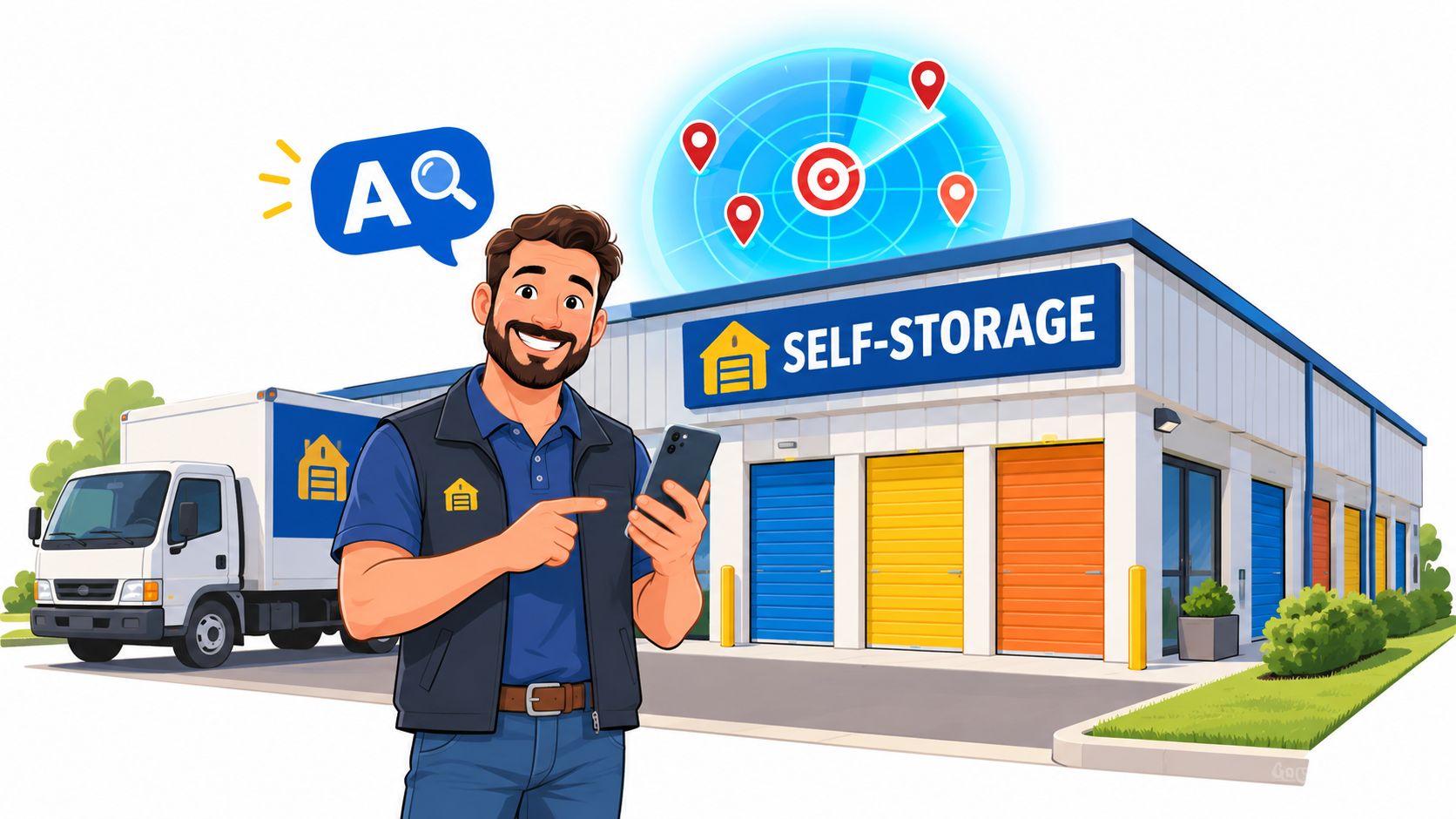
A self-storage business illustrates why local AI visibility must be grounded in operational truth. A facility may want to appear for a conversational request such as “Where can a small business store stock near me?” or “Which self-storage facility offers secure access for archived documents?” The answer engine needs more than a page containing the words “self-storage” and a town name.
Turn the facility into a clear local entity
The operator should first consolidate the facts that make the facility identifiable. That includes its official name, complete address, map position, service area, access arrangements, contact details, storage categories, accepted use cases, and any genuine features such as drive-up access, loading facilities, document storage, or climate control.
Those facts should appear consistently on the website, Google Business Profile, relevant directories, and sector listings. The website can then support them with a dedicated location page and service pages that answer practical questions. A page for business storage should explain stock, equipment, records, and access considerations. A household storage page should address moves, renovations, furniture, and flexible requirements. The copy should never claim a facility offers climate control, 24-hour access, or a particular security feature unless the operator confirms it.
Use one scenario to test the system
Consider a self-storage facility serving several London neighbourhoods. Its team could create a page titled around business storage in the actual service area, open with a direct explanation of who the facility helps, and then answer questions about access, unit selection, deliveries, insurance, and contract terms. A separate page could explain how customers should evaluate climate-controlled storage, without implying that every unit has that feature.
The Google Business Profile description should use natural customer language while staying accurate. Reviews can reinforce real-world attributes such as helpful staff, convenient access, or clean units, but the business must not manufacture sentiment or coach customers to repeat unsupported claims.
A local content plan might include guidance for retailers storing seasonal stock, tradespeople storing equipment, and households managing a move. Each page should link to the relevant service, location, contact, and booking paths. This creates a connected evidence base rather than a collection of thin location pages.
For local businesses, relevance is specific. A facility earns recommendation potential by making its location, services, suitability, and limitations easy to verify.
The commercial test is whether high-intent discovery leads to calls, form completions, booking enquiries, or visits. AI visibility can support trust before that action, but it can't replace accurate availability, responsive staff, clear access instructions, or a straightforward booking experience.
Measuring AI Visibility and Brand Citations
Keyword rankings remain useful, but they don't capture every way an answer engine can influence a buyer. A business may be named in an answer, cited as a source, omitted from the visible links, or described incorrectly. Measurement therefore needs to distinguish presence, accuracy, prominence, and commercial action.
The assigned visual shows a useful reporting model for brand mentions and performance indicators.
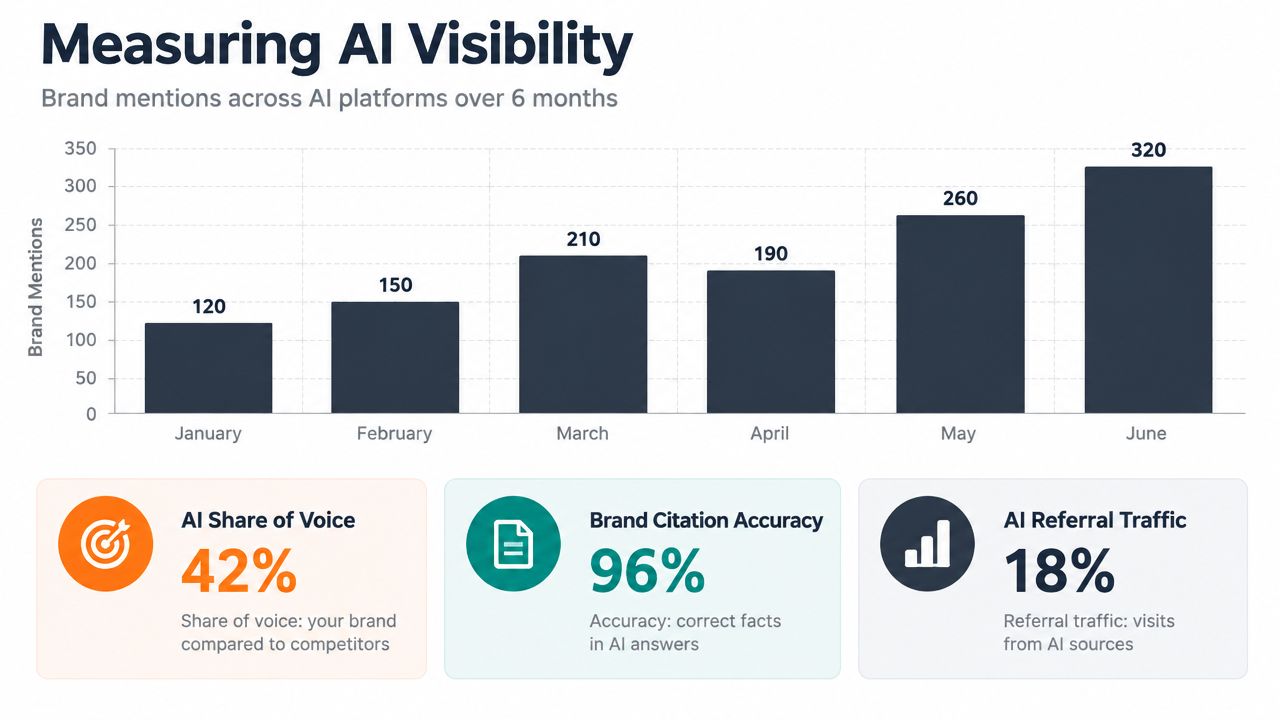
Track controlled questions
Create a stable set of natural-language prompts based on actual buying decisions. For a self-storage operator, prompts might cover the best storage options in a location, business stock storage, document storage, climate-controlled units, access requirements, and comparisons between nearby providers. Run them consistently across the AI platforms relevant to the audience, recording whether the brand appears, which competitors appear, which sources are cited, and whether the answer contains factual errors.
A simple review sheet can include:
| Measure | What it shows | Required action |
|---|---|---|
| Brand mention | Whether the business appears | Compare prompts and competitors |
| Citation source | Which page or listing supports the answer | Improve the source's relevance and access |
| Fact accuracy | Whether name, location, service, and claims are correct | Correct the authoritative source |
| Commercial response | Whether discovery produces enquiries or bookings | Compare with CRM and analytics data |
The measurement problem is real. One UK-focused report says roughly 47% of UK adults use AI-powered search tools, and about one in three Google UK searches triggers an AI Overview (UK AI search statistics). The same report cites an independent study finding that organic click-through rate falls from 1.76% to 0.61% when an AI Overview appears, with 83% of those searches ending without a click. Those figures make exposure and traffic separate outcomes, not interchangeable success measures.
Connect mentions to revenue
Analytics teams should annotate AI visibility checks alongside branded search, direct traffic, phone calls, form submissions, booking starts, completed bookings, and assisted conversions. Enquiry forms can ask how the customer found the business, but self-reported attribution should be treated as one signal rather than a complete answer. Call tracking, CRM notes, referral data, and branded-demand trends provide additional context.
Businesses should also check citation accuracy, because a mention that sends a customer to the wrong location can damage trust. The ChatGPT attribution insights from Cometly offer further context for teams building attribution workflows.
The right question isn't “How many times was the brand mentioned?” It's “Did accurate AI visibility improve qualified demand, brand confidence, or conversion quality without creating an unacceptable loss of direct visits?”
Building a Sustainable AI Visibility Workflow
AI visibility works best as a recurring operating process, not a one-off content campaign. The business needs a named owner for technical access, a reviewer for commercial facts, a content lead for answer-first pages, and a reporting owner who connects AI observations with enquiries and revenue.
A workable monthly cycle
Check access. Review
robots.txt, crawlability, indexability, sitemaps, key templates, and the presence and quality ofllms.txt.Reconcile identity. Compare the title, H1, meta description, organisation details, LocalBusiness schema, Google Business Profile, major directories, and sector listings. Correct contradictions at the source rather than adding more copy around them.
Test priority questions. Run a controlled prompt set across relevant answer engines. Record mentions, citations, competitors, missing services, incorrect facts, and changes in wording.
Publish one useful improvement. Choose a page based on a customer decision, not a vague topic. Add a direct answer, supporting detail, internal links, structured data, and a clear commercial action.
Verify the outcome. Check indexing, rendering, analytics, enquiries, calls, bookings, and customer feedback. Keep a change log so the team knows which technical or content revisions preceded later visibility changes.
Tools can support different parts of the workflow. Google Search Console and Bing Webmaster Tools help with search visibility and crawling signals. Schema validators can identify markup errors. Server and analytics logs can reveal bot activity, while AI visibility platforms can store prompt results and citation changes. The tool matters less than consistent testing and clear ownership.
Amax Marketing offers AI Search Optimisation alongside technical SEO, content, digital PR, PPC, local SEO, and web development, with processes that monitor how AI systems find, cite, and describe a business. That type of joined-up support suits SMEs that need the technical foundation and commercial measurement handled together.
The priorities should remain limited. Fix access first, standardise identity second, improve the pages that answer valuable customer questions third, then measure accurate mentions against real demand. Businesses that follow that order will avoid the most common mistake in this market, generating more content for a website that answer engines still struggle to crawl or trust.
For a practical assessment of crawler access, structured data, local signals, and answer-first content, visit Amax Marketing to discuss an AI visibility strategy for the business. The team can connect the technical audit with content, local SEO, and lead-generation priorities, so improved visibility supports measurable commercial action.