

A support lead at a growing online retailer signs up for a low-cost AI chatbot. It answers delivery questions, reduces the live-chat queue and looks inexpensive on the first invoice. Then a promotion brings more enquiries, automated resolutions increase, and the monthly bill climbs alongside the subscription the team already pays for its helpdesk.
The problem isn't necessarily the chatbot. The team bought against a headline price rather than the cost of running its support operation. Charges for seats, AI outcomes, conversation allowances and integrations can turn an apparently simple purchase into a variable operating expense.
The best AI customer service software depends on team size, channel mix, existing systems and tolerance for unpredictable bills. A retailer handling Instagram comments needs something different from a self-storage operator managing access enquiries, or a service team working inside Salesforce.
A cheap chatbot isn't a cheap support operation if staff still have to repair its answers, rebuild context and manage another inbox.
The platforms below are assessed by operational fit rather than feature count. Pricing descriptions explain what needs checking, not guaranteed quotations. Product packaging changes, so the final decision should rest on a written proposal and a trial using actual customer enquiries, not a polished demonstration.
Table of Contents
- 1. Exerta
- 2. Zendesk
- 3. Intercom
- 4. Freshdesk
- 5. Tidio
- 6. HubSpot Service Hub
- 7. Salesforce Service Cloud with Agentforce
- 8. Zoho Desk
- 9. Help Scout
- 10. Gorgias
- 11. Ada
- How the leading AI customer service platforms compare on pricing model, free access, and best fit
- Choosing the Right Platform Before You Commit to a Trial
1. Exerta
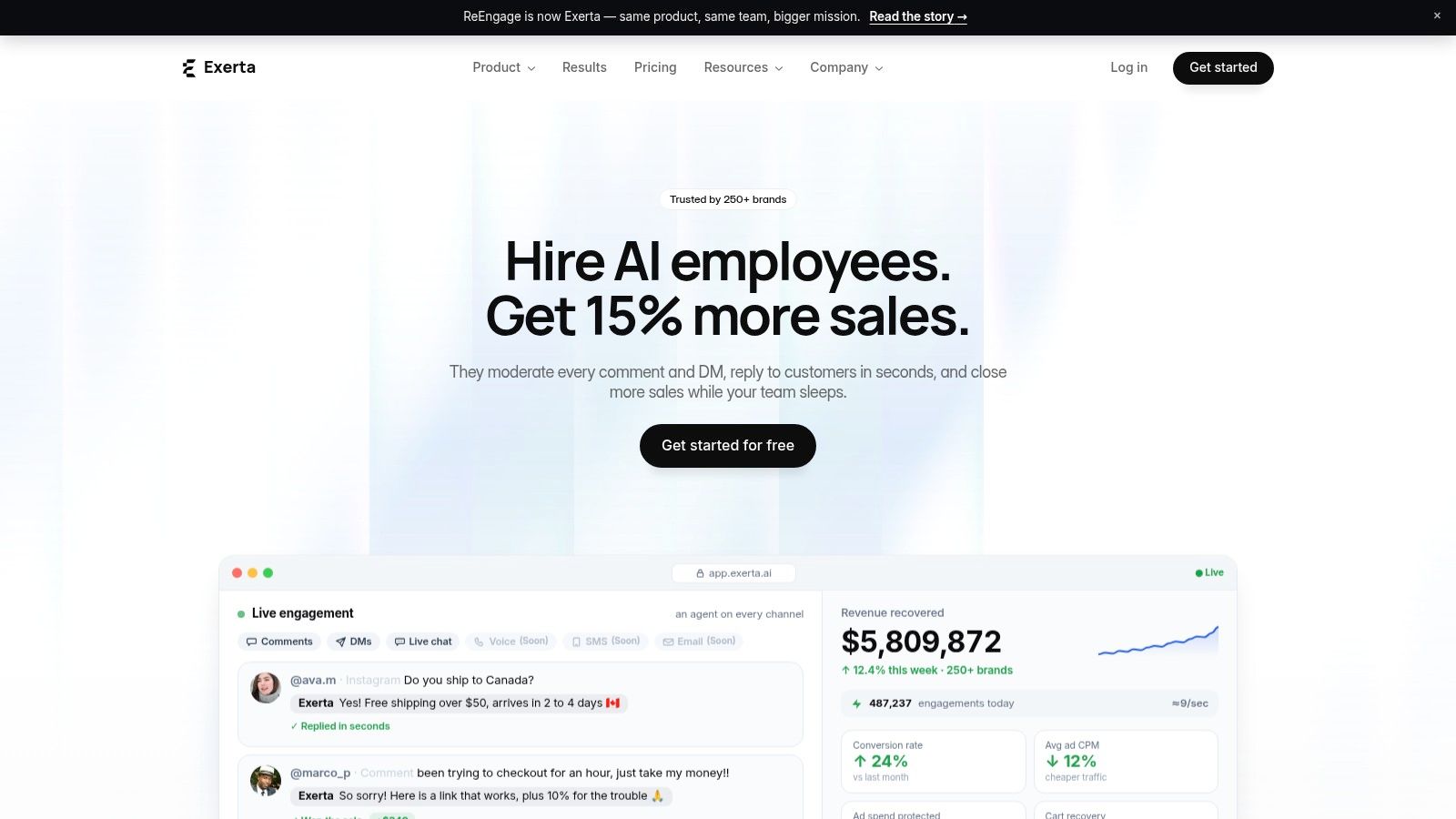
Best for brands whose support workload starts beneath paid social ads. Exerta focuses on customer engagement and revenue recovery across Facebook, Instagram, YouTube and website chat. That makes it particularly relevant to ecommerce brands, lead-generation businesses and agencies managing conversations around campaigns.
Its agents handle comments, direct messages and web enquiries in a configured brand voice. Moderation rules help teams manage spam and harmful content, while sales-recovery flows can recognise buying intent, share checkout links and follow up on interest.
The operational distinction is important: this goes well beyond an FAQ widget. A shopper asking about an offer beneath an Instagram ad needs an accurate response in that channel, not instructions to open a support ticket elsewhere.
Where Exerta fits the operation
Exerta combines configurable workflows, approval controls and activity logs. Its approach to human-in-the-loop AI is particularly relevant when routine product questions can be automated but complaints, sensitive enquiries and unusual discount requests need staff judgement.
- Team fit: Lean marketing and support teams sharing responsibility for social conversations.
- Integration test: Confirm commerce connections, attribution rules and how escalations reach the existing support system.
- Budget test: Request a written explanation of included activity, volume allowances and additional charges.
Revenue attribution deserves scrutiny. A dashboard associating a conversation with a purchase isn't, by itself, proof that the conversation caused the sale.
Skip it if the main requirement is a mature email-and-phone helpdesk. SMS, email and voice are roadmap channels, not capabilities to assume are available.
2. Zendesk
Zendesk suits a support department, not just a chatbot requirement. Its combination of ticketing, messaging, knowledge management, routing and reporting makes it a strong candidate for teams managing several queues and increasingly specialised responsibilities.
Zendesk provides AI agents alongside tools for classification, summaries and translations. For an established operation, the advantage is keeping automation close to the ticket history, routing rules and reporting staff already use.
That breadth also creates work. Someone needs to own queue design, permissions, knowledge quality and escalation logic. A smaller team can adopt Zendesk, but buying advanced configuration options doesn't remove the need to maintain them.
The cost of operational depth
Seat charges and AI-resolution charges need separate forecasts. A stable headcount doesn't guarantee a stable invoice when automated activity grows. Buyers should also establish which AI functions and channels are included in the proposed package.
A useful demonstration follows a difficult case from initial contact through reassignment and final resolution. It should show what happens to the transcript, customer details and service target throughout.
Skip it if the team needs a lightweight website assistant and has nobody available to administer a broader support platform.
3. Intercom
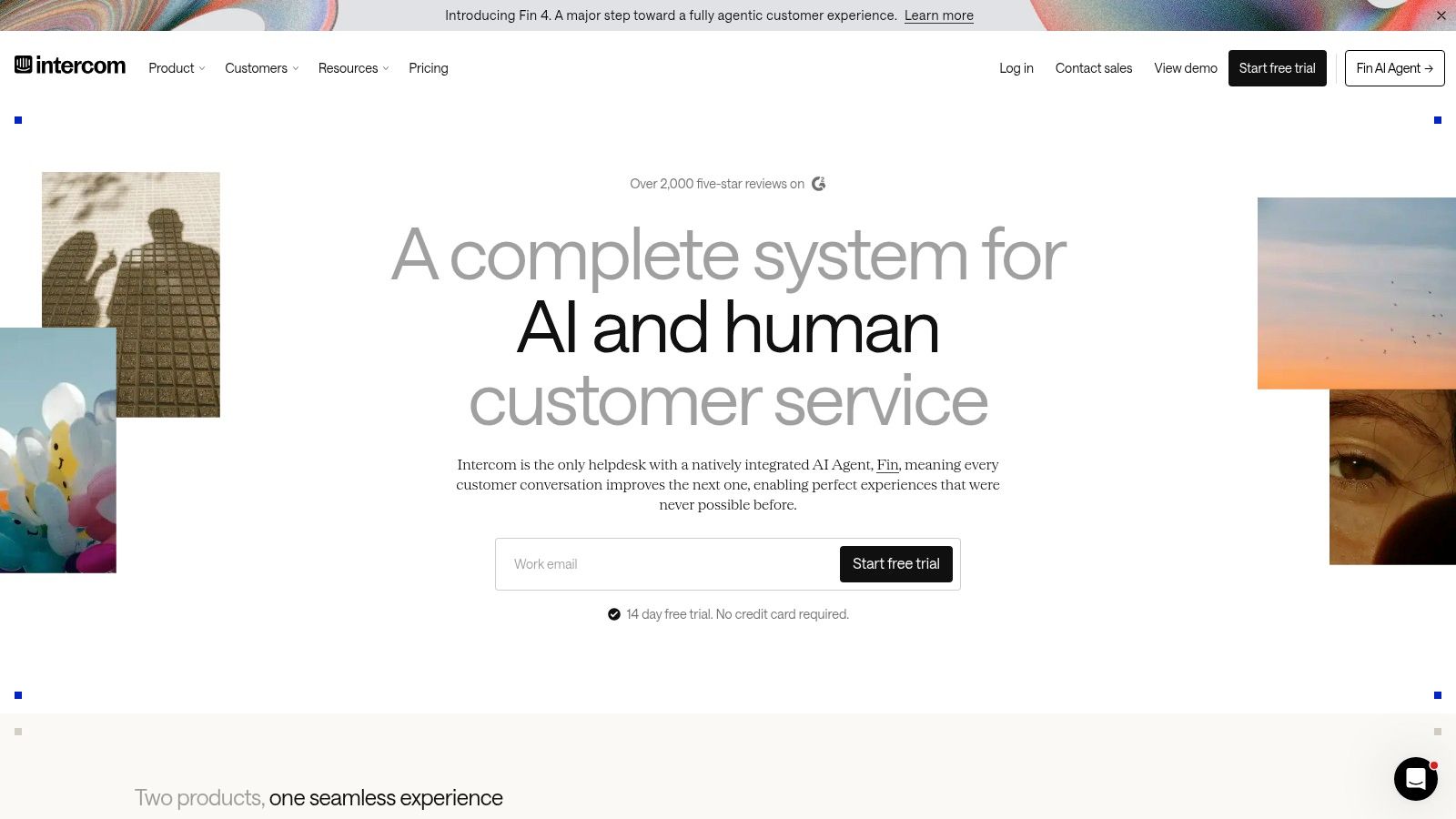
For a business supporting customers inside a website or application, Intercom makes messaging the centre of the workflow. Its shared inbox, help centre and Fin AI Agent are a natural combination when conversations regularly move between automated answers and staff.
Intercom is particularly relevant to chat-led teams that want agents and people working in a connected environment. Fin can also work with some existing helpdesks, which deserves investigation before committing to a migration.
The main commercial attraction is outcome-based AI billing. The limitation is that successful automation can increase expenditure, so outcome pricing shouldn't be mistaken for a fixed budget.
- Check the definition: Establish what counts as a billable outcome and how reopened conversations are treated.
- Check the handoff: Confirm that staff receive the conversation, relevant customer details and any attempted actions.
- Check the platform cost: Model subscriptions and AI usage together.
Businesses exploring AI tools for SEO should keep support knowledge separate from acquisition content. A persuasive landing page isn't necessarily an authoritative cancellation policy.
Skip it if most enquiries arrive by email and the team doesn't need an extensive messaging environment.
4. Freshdesk
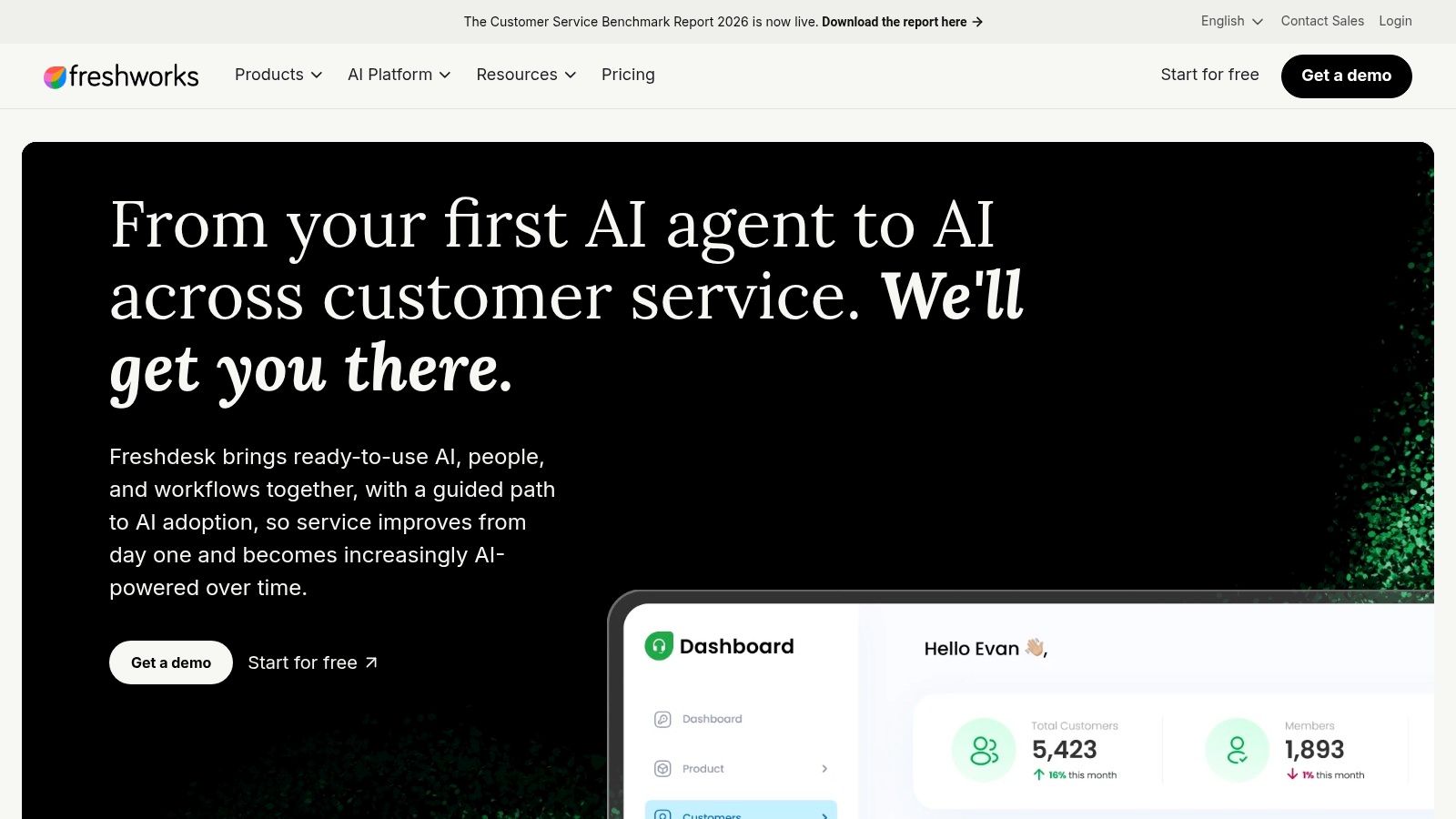
Freshdesk is a sensible starting point for an SME that needs orderly ticket handling before ambitious automation. Staff can work with a conventional helpdesk structure, then assess where Freddy AI improves customer self-service or agent productivity.
Freshdesk combines ticketing, collaboration, self-service and reporting. Freshdesk Omni and related Freshworks products offer additional routes for businesses managing a broader channel mix.
The buying risk is assuming that every Freshworks capability belongs to the same subscription. A demonstration may span several products or editions, so the proposal needs to identify exactly what the team will receive.
Buy the workflow, not the product family
A local service business might need email tickets, website enquiries and a shared knowledge base. That doesn't automatically justify a more extensive contact-centre setup.
The trial should follow a common enquiry through assignment, response, escalation and reporting. Staff should also test whether Freddy's suggestions save editing time rather than merely producing plausible drafts.
Budget predictability depends on the selected product, AI allowance and add-ons. The commercial comparison should include any upgrades required for the intended channels.
Skip it if the proposed setup requires several loosely understood subscriptions just to reproduce the team's existing workflow.
5. Tidio
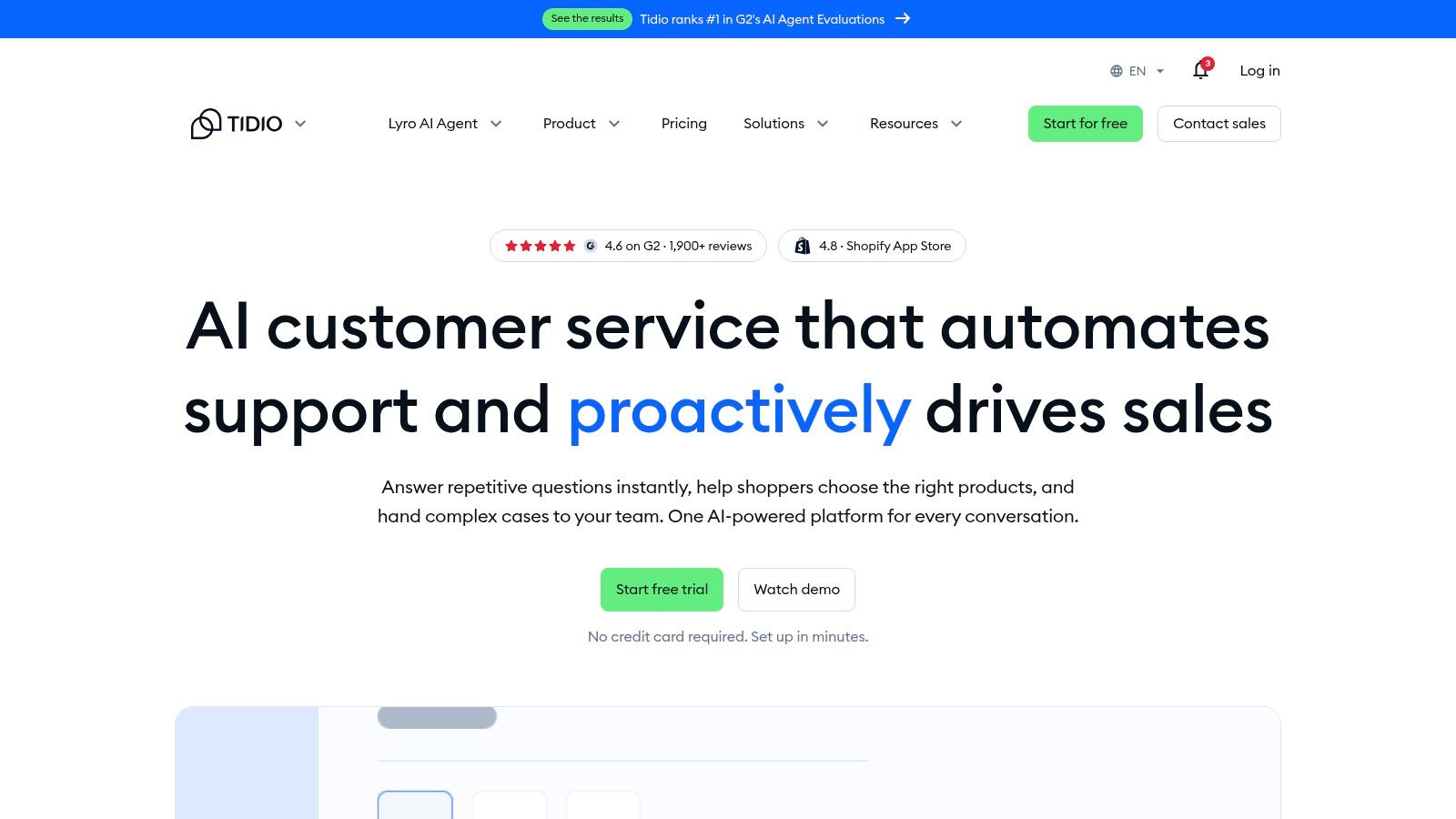
A small online shop with repetitive website questions doesn't always need a full service suite. Tidio is worth considering when website chat is the main requirement, with Lyro handling questions from support content and staff taking over when necessary.
Tidio combines live chat, ticketing and AI, while its no-code Flows support structured interactions. That gives a lean team a way to separate predictable journeys, such as collecting an enquiry, from questions requiring a generated answer.
The practical test is whether the system knows when not to answer. For a self-storage website, published opening hours are suitable knowledge. A promise about unit availability needs a reliable connection to current inventory or a clear handoff.
Practical rule: An AI agent should never turn missing information into a confident booking promise.
Conversation allowances are central to the purchase. Buyers should distinguish live-chat limits from Lyro usage and establish what happens when either allowance runs out.
A low-volume trial can demonstrate usability, but it won't reveal the bill during a campaign-driven traffic spike.
Skip it if complex case management, extensive phone support or tightly connected back-office actions matter more than accessible website chat.
6. HubSpot Service Hub
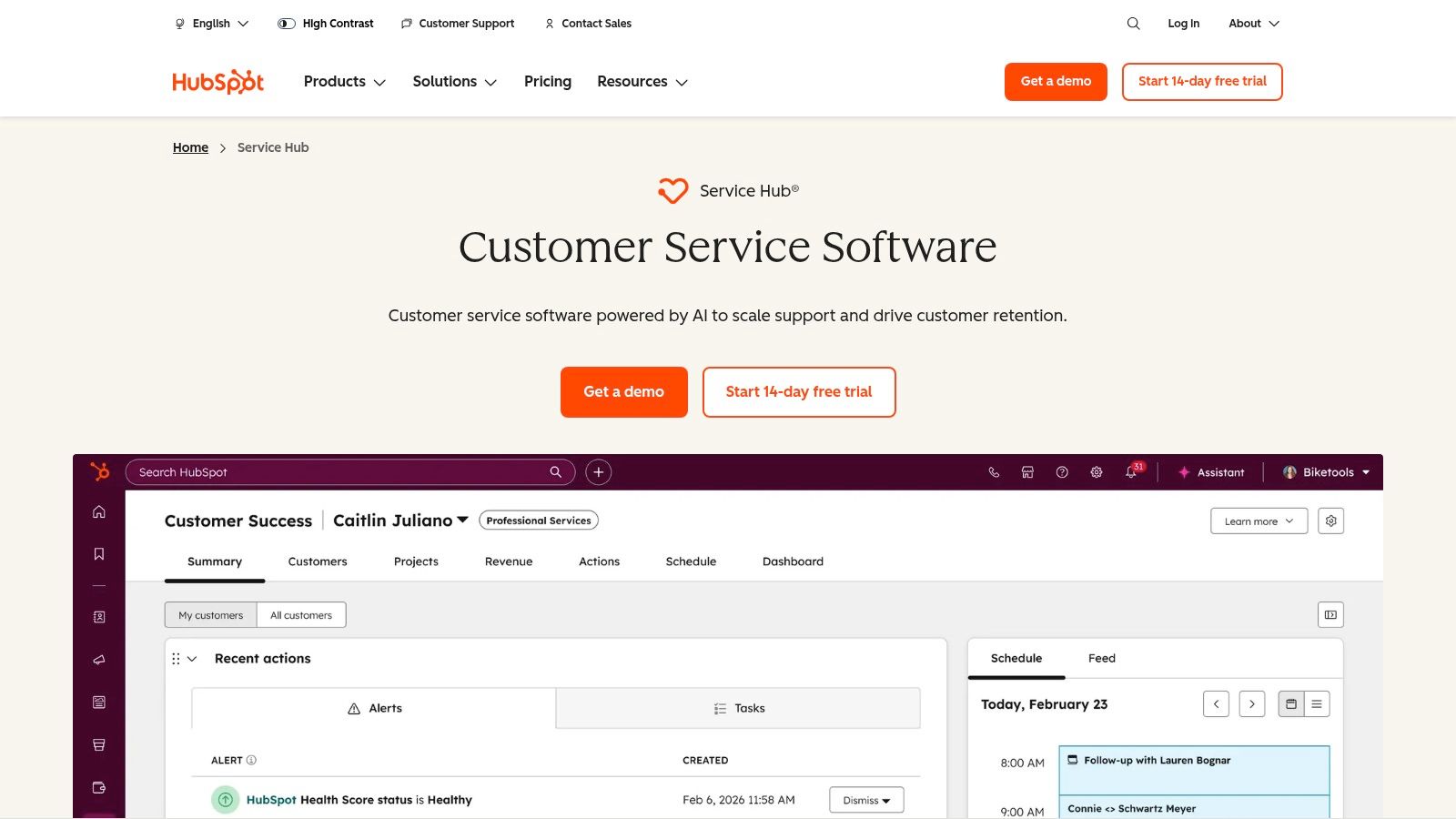
Existing HubSpot users should assess Service Hub before adding another customer database. The strongest reason to choose it is the connection between service conversations and the CRM records used by sales and marketing.
HubSpot Service Hub brings support tools, automation and reporting into that environment. Its AI customer agent can use company content and CRM context, making it relevant when an enquiry crosses departmental boundaries.
Want a free audit like this for your own site?
We'll show you exactly what's holding your rankings and conversions back. No sales pitch.
Get My Free AuditSay a prospect asks about a storage reservation after speaking to sales. The important capability isn't merely answering a policy question. It's preserving the difference between a new lead, a pending reservation and an existing customer's service issue.
CRM context needs boundaries
Shared records are useful only when permissions and ownership are clear. Teams should specify which properties the agent can access, what it can change and when a person must approve an action.
Professional or Enterprise access and HubSpot credits affect the commercial calculation. Resolution-based charging needs modelling alongside the underlying subscription and any wider platform commitments.
For businesses outside HubSpot, the cost and disruption of adopting the ecosystem may outweigh the benefit of connected records.
Skip it if the team wants a standalone chatbot and has no operational reason to move service into HubSpot.
7. Salesforce Service Cloud with Agentforce
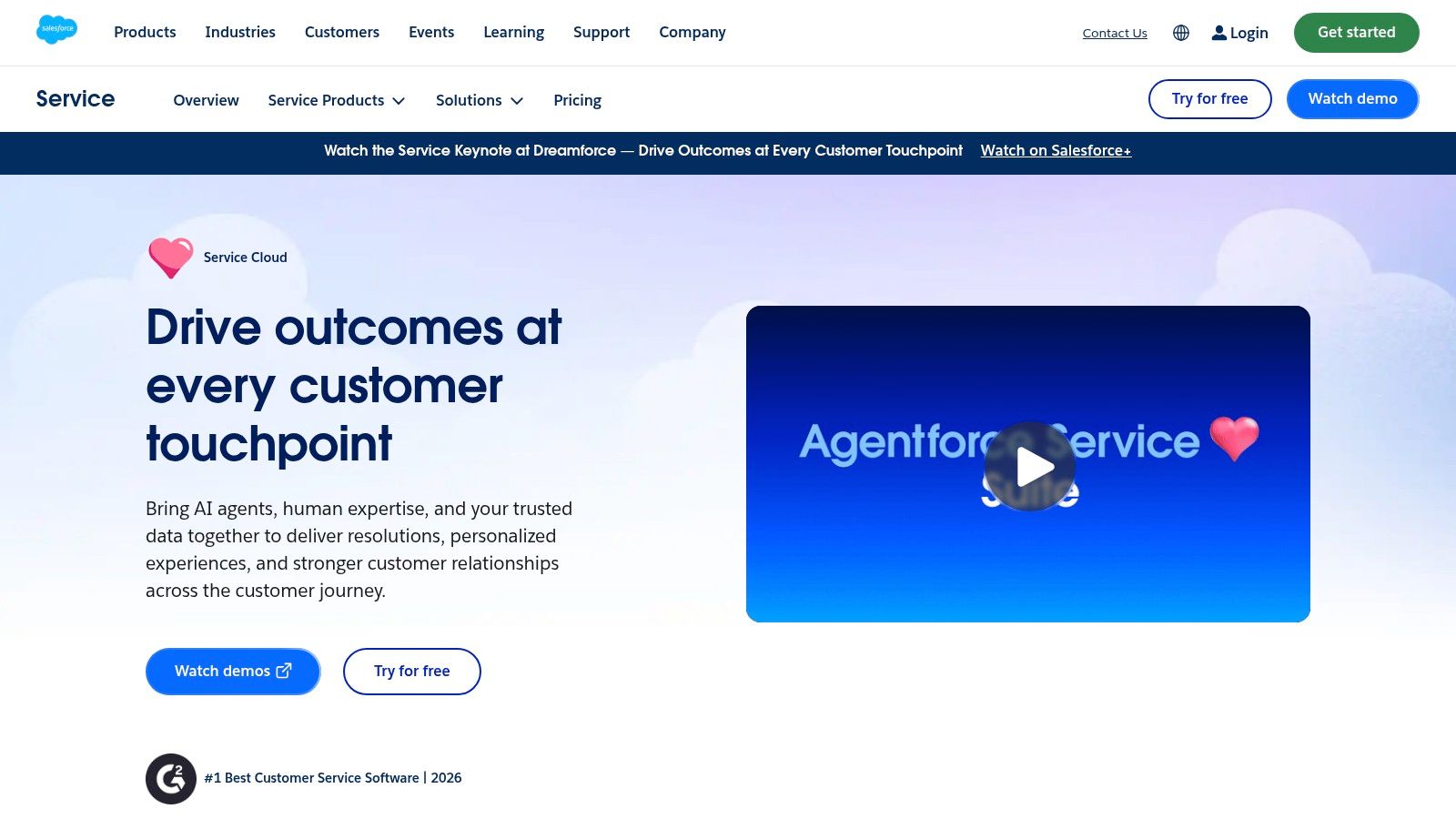
Complex service processes are where Salesforce Service Cloud with Agentforce deserves attention. A business already using Salesforce can connect AI activity to customer records, case history and configured business processes rather than maintaining a disconnected assistant.
Salesforce Service Cloud is a more natural fit for an established service operation with Salesforce expertise than for a small business seeking a quick chat widget. Agentforce can answer questions and execute configured actions, but those actions need carefully defined permissions and failure handling.
The implementation question isn't merely whether an integration exists. It's whether the agent can complete the intended task safely using the organisation's actual records and rules.
- Operational owner: Assign responsibility for agent configuration and ongoing changes.
- Action controls: Test permissions, unsuccessful updates and escalation after an error.
- Commercial model: Request worked examples using the proposed consumption model.
Pricing predictability requires more preparation here. Buyers need to understand the billable unit, expected consumption and any implementation support before comparing the proposal with a simpler helpdesk.
Skip it if Salesforce isn't already important to the business and the support process doesn't justify specialist configuration.
8. Zoho Desk
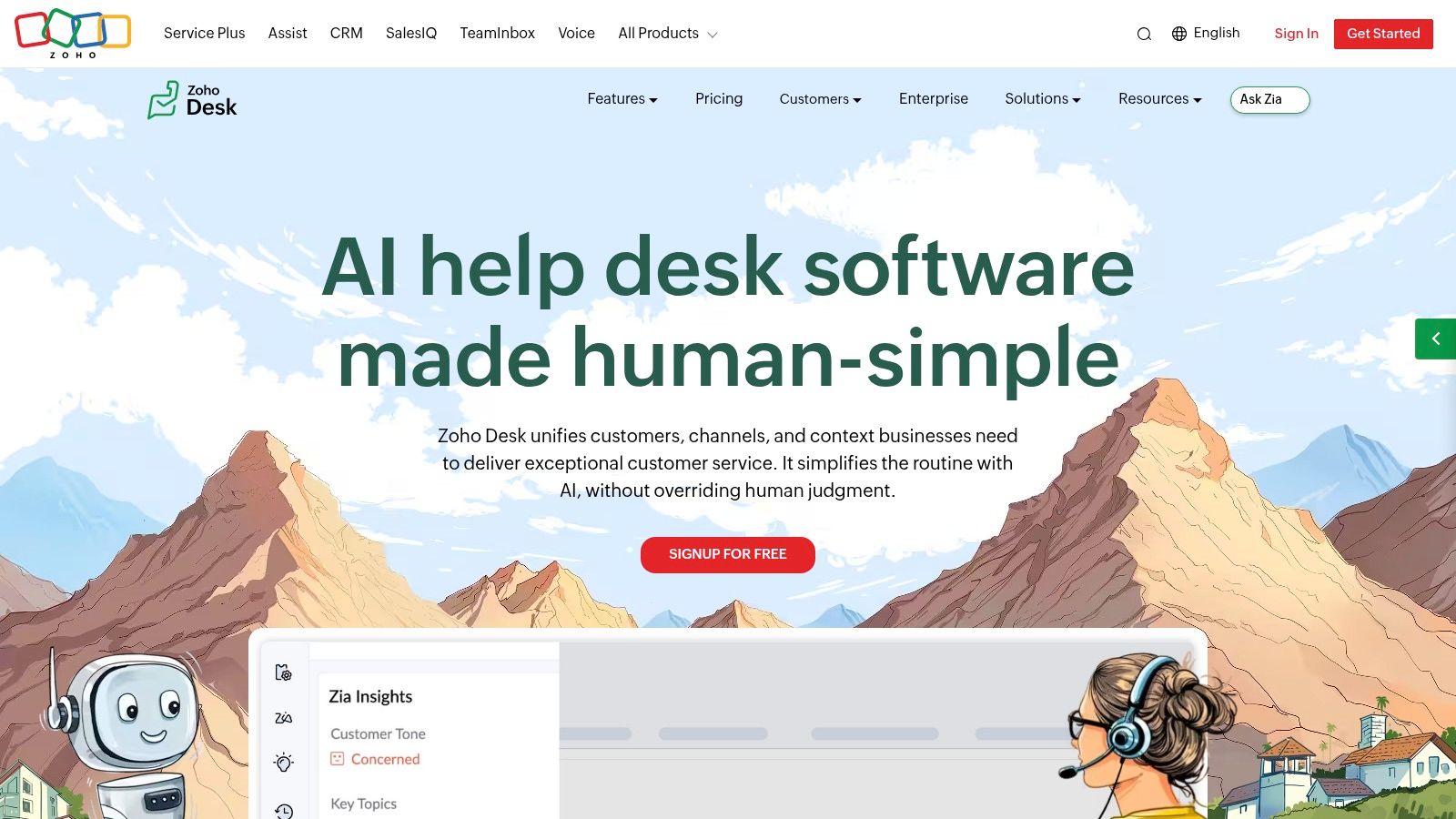
Zoho Desk belongs on the shortlist for smaller organisations already using Zoho software. Familiar customer records and connected business applications can matter more than an impressive standalone AI demonstration.
Zoho Desk offers ticket management and service workflows, with Zia providing AI capabilities whose availability depends on edition and data centre. Its entry-level options make it possible to explore the helpdesk before committing to a broader setup.
The important distinction is between testing Zoho Desk and testing the precise AI configuration the business intends to buy. An accessible entry edition doesn't establish that the required Zia tools are included.
Check the edition before the demo
The sales conversation should begin with the team's location, intended channels and required AI tasks. Buyers should request an explicit list of included capabilities rather than relying on a general feature page.
For an SME, the useful trial combines ordinary tickets with difficult examples: an unclear complaint, conflicting customer records and a request that should reach a manager.
Cost confidence depends on edition clarity. Any required upgrade, integration or additional service belongs in the same forecast.
Skip it if a specific AI capability is essential but its availability in the intended edition and data centre remains unclear.
9. Help Scout
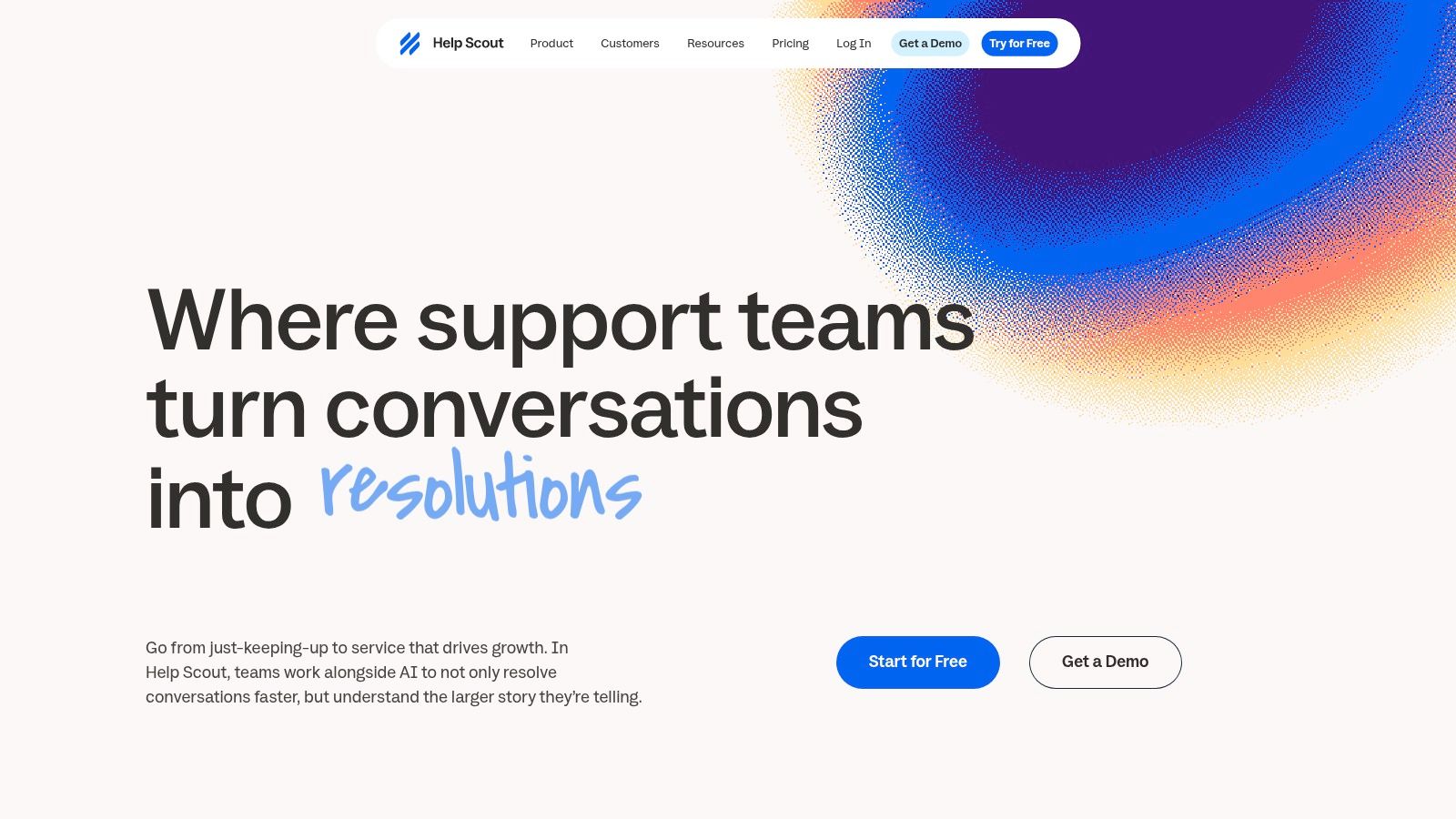
Some support teams need a shared inbox that feels close to email, not a contact-centre console. Help Scout suits that preference, particularly when personal replies and a maintained knowledge base remain central to the service.
Help Scout combines a shared inbox, knowledge content and customer-facing support tools. AI Answers can respond from the business's knowledge sources and escalate conversations to staff.
That makes it a practical candidate for a small service team answering recurring policy and product questions. The operational priority should be a clean transition from self-service to a person, without making the customer submit the same information again.
Spending limits protect the invoice only if the team also knows what customers experience after the limit is reached.
AI Answers uses successful-resolution billing, with spending controls available. Buyers should test those controls and confirm how the system behaves when the budget is exhausted.
More advanced routing and security requirements also need checking against the proposed plan. A straightforward inbox can be an advantage, but it shouldn't conceal a mismatch with mandatory controls.
Skip it if the business needs extensive contact-centre orchestration or advanced routing that would undermine the simplicity behind the purchase.
10. Gorgias
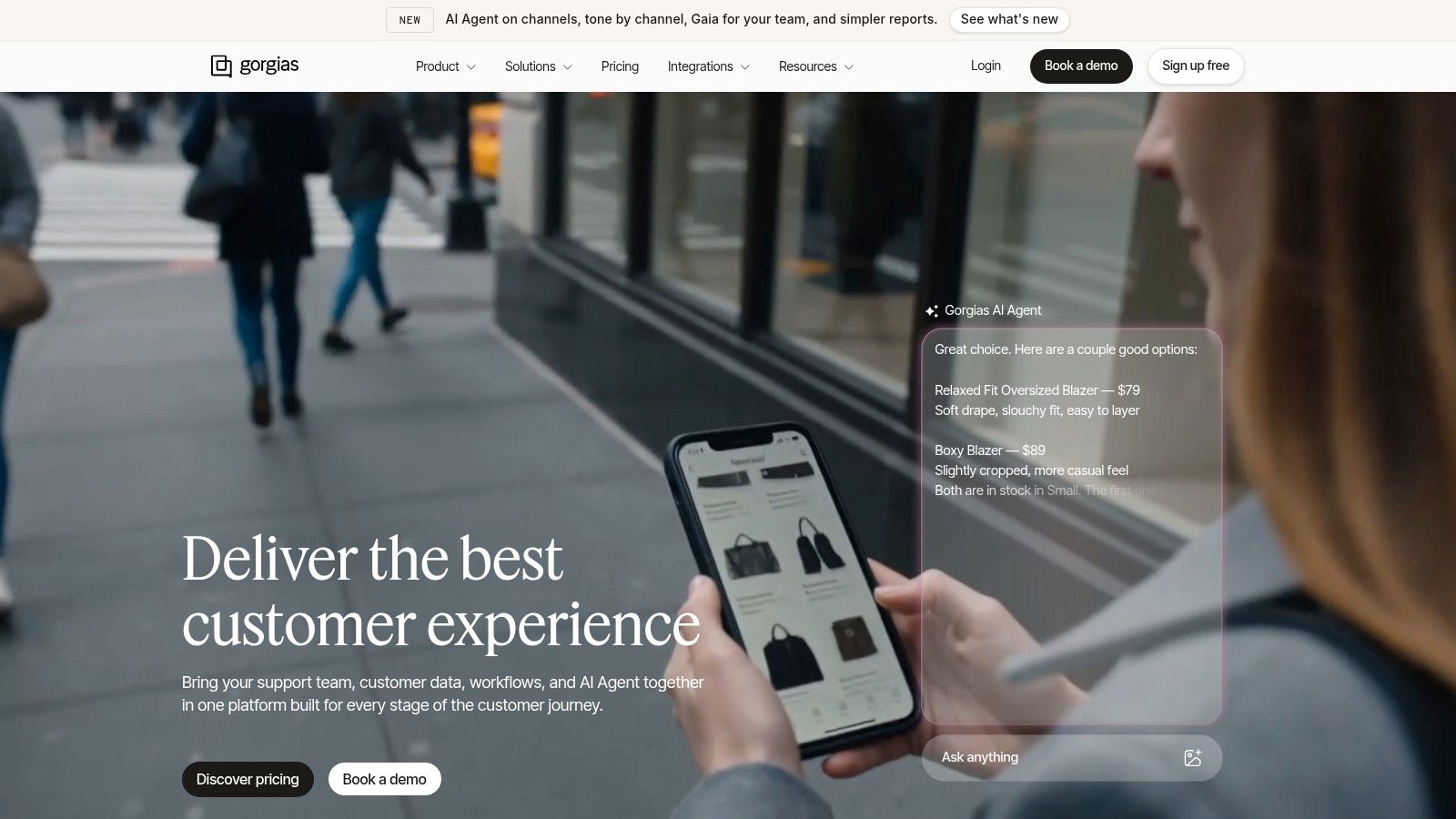
Order tracking, shipping questions, returns and product enquiries make ecommerce support unusually repetitive. Gorgias is built around that operating context, making it a stronger candidate for retailers than for businesses managing unrelated service cases.
Gorgias connects helpdesk conversations with commerce workflows. Its AI Agent handles common enquiries and supported actions, but buyers should validate those actions against their store platform and policies.
For a retailer, the trial should distinguish between explaining a return policy and completing an authorised return workflow. Those are different levels of service, risk and staff effort.
Forecast both billing layers
Ticket charges and AI-resolution charges are separate considerations. A promotion can increase overall contact volume while also increasing the number of conversations resolved automatically.
Commercial modelling should therefore include seasonal peaks, not merely an average month. It should also establish how conversations are counted and what happens when customers return with the same unresolved issue.
Businesses investing in ecommerce marketing services should connect campaign planning with support capacity. Promotions change the questions customers ask as well as the number of enquiries.
Skip it if the business isn't commerce-led, or if ticket-based and AI-based charges exceed its tolerance for variable expenditure.
11. Ada
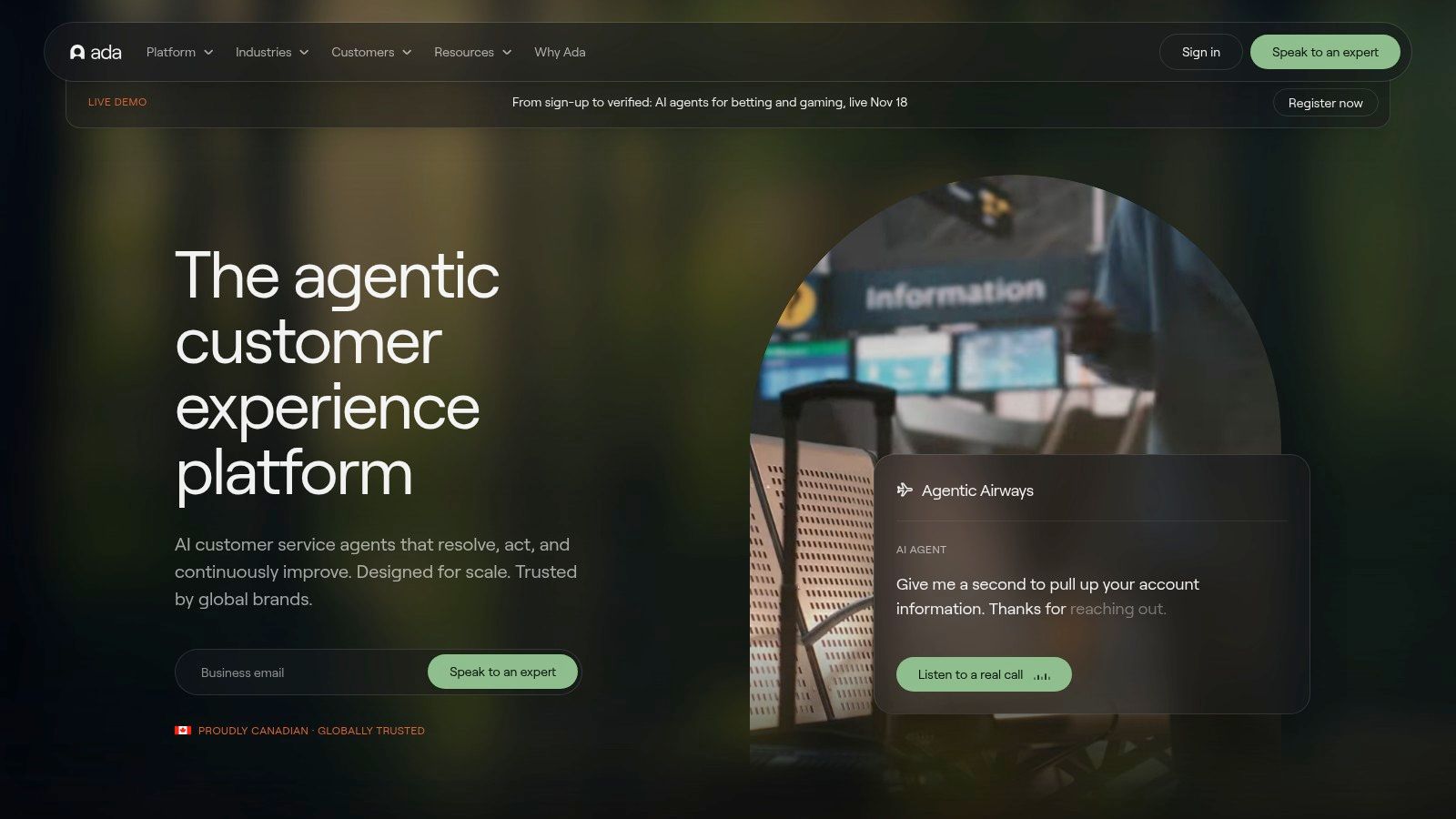
Ada is an enterprise automation candidate rather than a basic live-chat purchase. It merits investigation when an established support organisation has substantial conversation volume, defined processes and resources to manage implementation.
Ada focuses on AI-led customer experience across service channels. Its sales-led evaluation means buyers need to establish commercial and implementation requirements directly rather than comparing a simple public subscription.
The strongest business case starts with a clearly bounded workload. Automating a documented service journey is easier to evaluate than a broad ambition to replace customer support.
- Stack fit: Demonstrate the connection to the existing helpdesk and customer records.
- Escalation fit: Show how unresolved cases reach the right people with usable context.
- Budget fit: Obtain the charging basis, implementation scope and expansion terms in writing.
Enterprises investigating AI SEO services should distinguish discoverable public content from permission-controlled support knowledge. Service agents need authoritative operational answers, not unrestricted access to every published page.
Public pricing opacity makes early qualification important. A customized proposal may be appropriate, but the team shouldn't invest heavily in evaluation before establishing commercial fit.
Skip it if the requirement is a lightweight assistant and nobody can own implementation, knowledge maintenance and performance review.
How the leading AI customer service platforms compare on pricing model, free access, and best fit
| Item | AI Pricing Model | Free Plan or Trial | Best For |
|---|---|---|---|
| Exerta | Free and Starter plans, with custom volume plans | Free plan available | Brands recovering sales and managing engagement across social channels |
| Zendesk | Per-agent fees and AI-resolution charges | Not specified | Teams managing multichannel support and complex workflows |
| Intercom | Usage-based, tied to AI outcomes; team costs also apply | Not specified | Businesses focused on website or in-app messaging |
| Freshdesk | Depends on product and plan; AI may involve add-ons | Not specified | SMEs seeking a conventional helpdesk and ticketing system |
| Tidio | Conversation quotas; AI may require a separate plan | Free plan and trial options | Ecommerce and lead-generation sites handling repeat questions |
| HubSpot Service Hub | Resolution-based AI pricing, plus subscription and credits | Not specified | Teams sharing customer context through HubSpot CRM |
| Salesforce Service Cloud with Agentforce | Consumption-based AI pricing options | Not specified | Salesforce-based organisations with complex service workflows |
| Zoho Desk | Varies by edition and AI feature availability | Free edition for up to three users; 15-day paid-plan trial | Smaller teams using Zoho or seeking an entry-level helpdesk |
| Help Scout | Per successful AI resolution | Three-month AI Answers trial for new accounts | Smaller teams preferring a shared inbox and human support |
| Gorgias | Usage-based AI resolutions, separate from ticket fees | Not specified | Ecommerce brands handling order, returns, and product queries |
| Ada | Sales-led pricing; public pricing not readily available | Not specified | Established organisations automating high-volume support |
Choosing the Right Platform Before You Commit to a Trial
The best AI customer service software is the platform that fits the existing operation and improves customer outcomes at an acceptable total cost. The strongest demonstration isn't necessarily the strongest purchase.
A useful decision starts with a monthly contact map. The support lead should record volumes by channel, common enquiry types, staffing requirements and the CRM or commerce systems involved. The finance owner should then define how much variable AI expenditure the business can tolerate.
Build a shortlist around the actual workload
A compact shortlist should reflect operational differences, not minor feature variations. Social-commerce teams might compare Exerta with a commerce helpdesk, while an established Salesforce operation should assess the value of staying inside its existing environment.
Human handoff deserves particular attention: 42% of UK respondents said they often or always had to repeat themselves when transferred from an AI agent to a person, according to the consumer survey reported by IT Brief UK. A trial that tests only automated answers misses that failure point.
- Use real enquiries: Include common questions, ambiguous requests, complaints and cases requiring live account information.
- Measure genuine resolution: Track completed requests alongside repeat contacts, escalations and customer feedback.
- Inspect the handoff: Check transcript completeness, routing accuracy and the time before a person responds.
- Model a volume surge: Recalculate the entire bill with current contact volume doubled, including seats, usage, add-ons and integration support.
Keep governance inside the buying decision
Privacy, cybersecurity, sensitive-data exposure and accountability are identified as adoption barriers in the government's AI adoption research. Buyers should therefore confirm retention settings, access controls, processing arrangements and audit trails before connecting customer records.
A named owner should maintain knowledge, review failed conversations and approve changes to agent permissions. Complaints, payment disputes and sensitive circumstances need explicit escalation rules, not a vague instruction to exercise judgement.
The contract should make the billing unit understandable and the exit route workable. Conversation exports, knowledge portability and access to historical reporting matter if the platform later becomes unsuitable.
For an outside view, support and marketing managers can request Amax Marketing's complimentary marketing audit, bringing their current software list, channel volumes and sample enquiries. That provides a concrete starting point for discussing where acquisition journeys and customer support need better alignment before another platform is added.