


The popular advice on AI UGC ads is to generate more videos, test more hooks and replace expensive creator shoots with synthetic presenters. That advice skips the commercial question: does the business acquire customers profitably once production, approval, media spend and customer trust are accounted for?
Table of Contents
- Why Faster AI UGC Ads Are Not Automatically Better Ads
- Understand What AI UGC Ads Actually Represent
- Build an AI UGC Ad Production Workflow
- How Knowlify Can Help
- Match AI UGC Formats to Real Marketing Needs
- Measure AI UGC Performance Beyond Cheap Production
- Protect Authenticity with Disclosure and Permission
- Decide Whether AI UGC Ads Deserve More Budget
Why Faster AI UGC Ads Are Not Automatically Better Ads
A self-storage operator could generate a library of convincing-looking videos and still struggle to secure qualified enquiries. Prospective customers need accurate information about the facility, access arrangements and available space. A presenter's natural delivery doesn't establish any of those facts.
The pressure to adopt is understandable. UK advertisers reporting a live generative AI use case increased from 9% in April 2024 to 41% in July 2025, according to ISBA's advertiser survey. Those figures describe generative AI adoption generally, not AI UGC advertising specifically.
Commercial principle: Cheaper production only matters when the finished creative remains accurate, gets approved and contributes to worthwhile customer acquisition.
The sensible starting point is therefore a production decision, not a race to replace people. Businesses need to understand what an asset represents, commission an evidence-backed workflow and compare its full cost with downstream results. Otherwise, faster generation can produce more material that the team can't confidently publish.
Understand What AI UGC Ads Actually Represent
AI UGC ads are advertisements produced or adapted with AI to resemble creator-style, customer-style or informal social content. The terminology describes an appearance and production method. It doesn't establish that a customer volunteered the content or experienced the service.
Consider a video explaining how a storage service works. Similar-looking clips can have very different origins.
Similar presentation, different evidence
| Content type | Storage-service example | What it can establish |
|---|---|---|
| Genuine customer footage | A customer describes their own move into storage | That person's experience, subject to verification and permission |
| Commissioned creator content | A paid creator tours the facility | What the creator genuinely observed, not an invented history as a customer |
| AI-assisted production | Real footage receives AI-assisted scripting, captions or editing | The underlying recorded evidence, provided edits preserve its meaning |
| Synthetic spokesperson | A generated presenter explains approved service information | The business's explanation, not independent customer experience |
UGC is often used loosely in advertising to describe a social-native style. A handheld composition, conversational script and informal setting can all be commissioned. None makes the speaker a genuine customer.
Treat AI as a production studio
An AI production workflow might combine generated scripts, voiceovers, avatars, captions and localisation. These components need separate descriptions because their risks differ. Automatically captioning a real facility tour is not equivalent to generating someone who appears to recommend that facility from personal experience.
AI can act as a production studio. It cannot act as a customer witness.
Audience attitudes support a nuanced approach. In a 2026 Canva survey of 509 UK consumers, 91% believed the best advertising still requires a human touch, while 71% didn't mind AI in adverts when it made the result more helpful or relevant, as reported in Canva's UK consumer findings. These are stated attitudes, not measured campaign results.
A useful asset description therefore names what was generated, what was recorded and whose experience, if any, the advert represents. That description gives reviewers a firmer basis for approval than the broad label “UGC”.
Build an AI UGC Ad Production Workflow
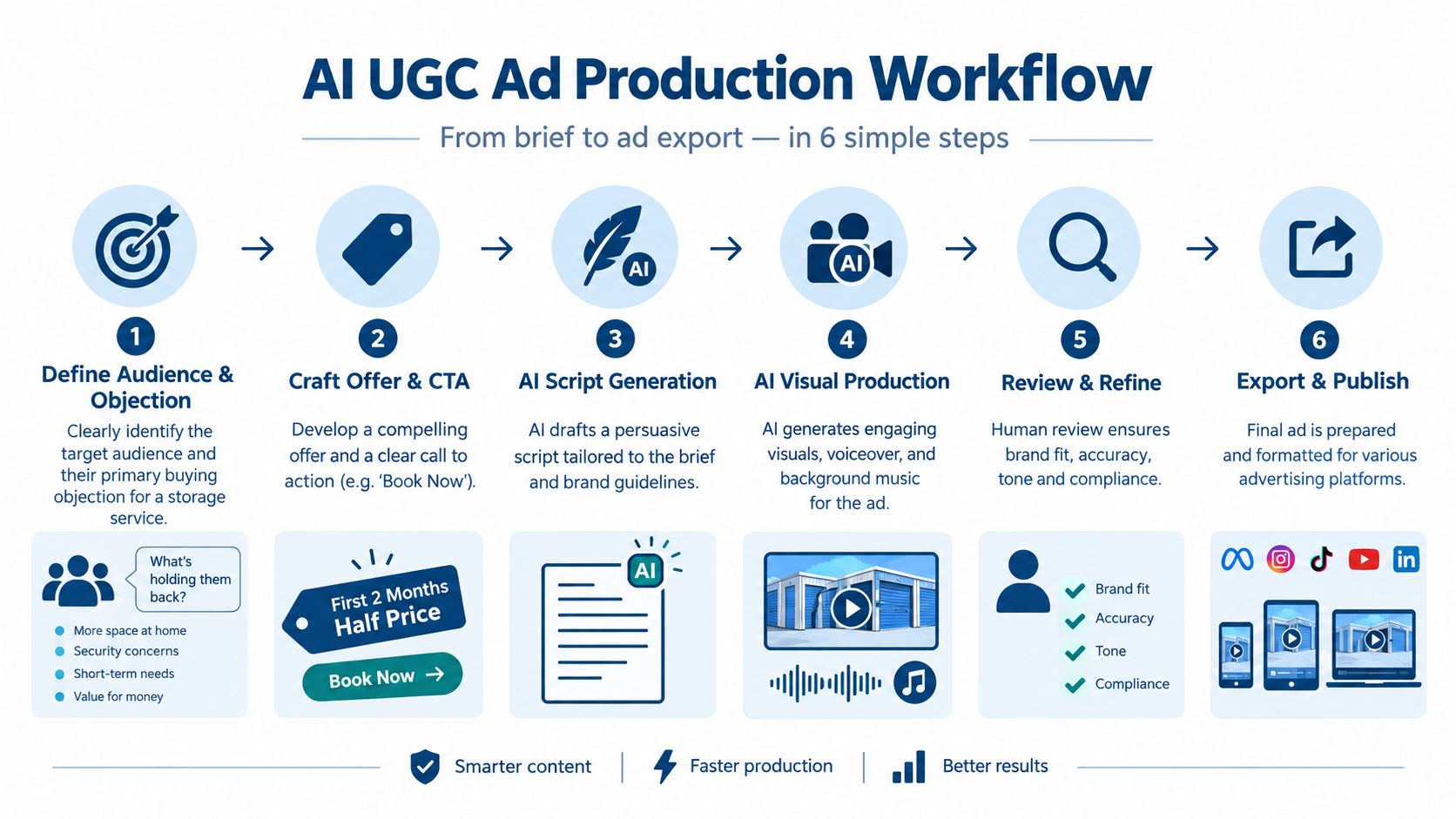
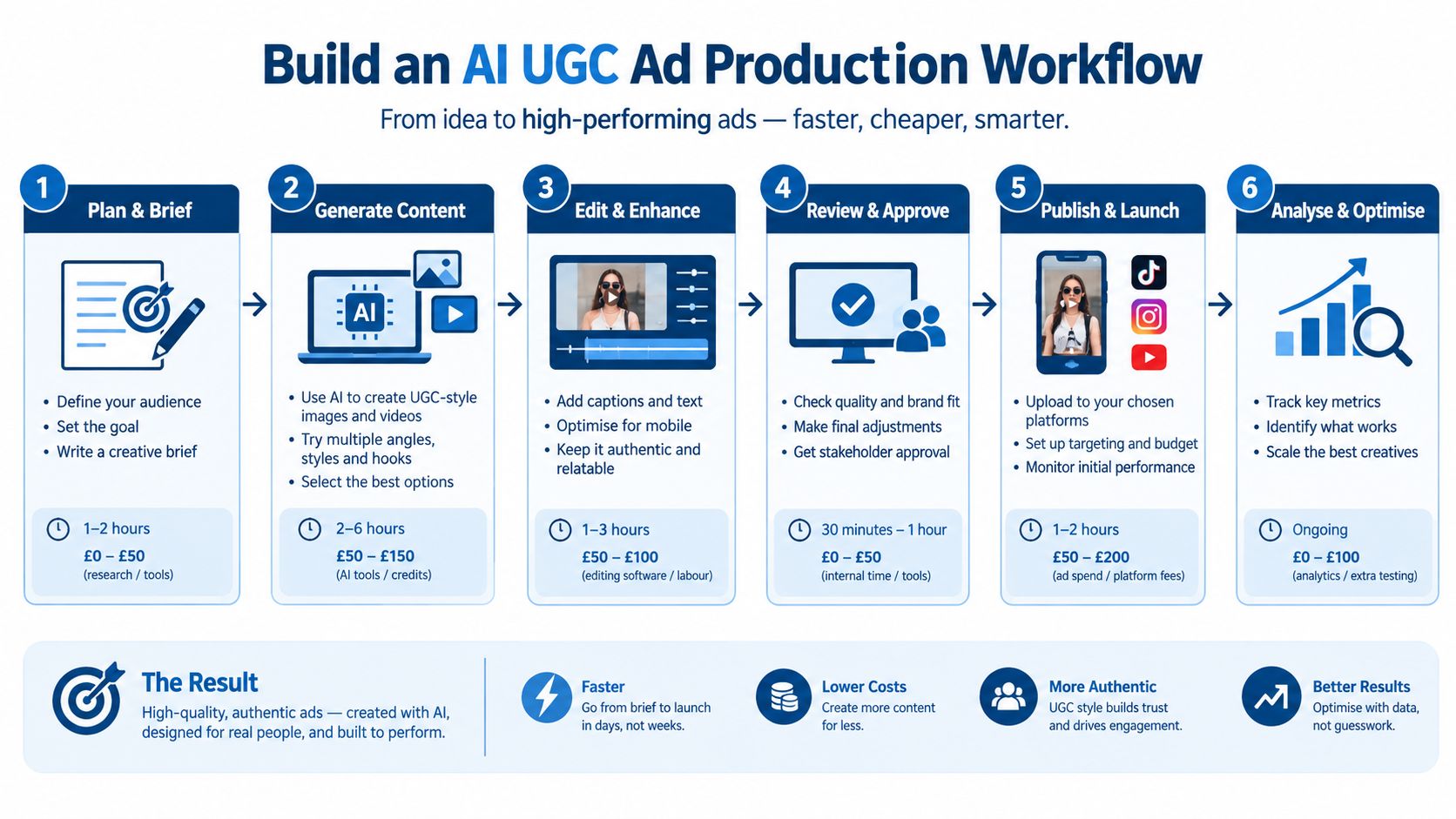
A workable brief starts with a buying obstacle, not an avatar selection. For a hypothetical storage advert, the obstacle might be uncertainty about unit size. The intended action could be requesting a size recommendation through a dedicated enquiry page.
The brief should specify the audience, approved offer, destination page and intended action. It should also identify the person responsible for factual approval, the person responsible for creative quality and the campaign owner authorised to publish.
Assemble the evidence before generating
The source pack should contain the material needed to make the advert accurate:
- Approved claims: Service descriptions, access arrangements and any limitations that affect the message.
- Current commercial details: Prices, offer conditions and availability information, with an owner responsible for checking changes.
- Original assets: Facility footage, product photographs, logos and brand guidance.
- Permissions and disclosures: Recorded usage rights, customer permissions and fields describing advertising identification and synthetic elements.
For the storage example, footage should show the actual facility and relevant unit options. The script shouldn't imply that a generated room is a faithful representation of available space.
Draft the narrative around a hook, problem, demonstrable benefit, evidence and call to action. These are editorial functions, not mandatory timing slots. An advert answering a straightforward question may need less setup than one explaining an unfamiliar service.
The size-recommendation script could acknowledge uncertainty, show real unit footage, explain what information the team needs and direct viewers to the enquiry form. A member of staff should confirm that the proposed assistance is available before production proceeds.
Select tools around control
The useful question isn't which tool produces the most impressive preview. It's which tool lets the team correct errors without rebuilding the entire asset.
Editing control matters when a price changes or a voiceover mispronounces a location. Commercial licensing, privacy terms and export options need assessment before anyone uploads customer material.
| Selection criterion | Practical check |
|---|---|
| Voice and accent | Can reviewers correct local place names and avoid an unsuitable regional delivery? |
| Editing flexibility | Can individual scenes, captions and audio tracks be replaced? |
| Accessibility | Can captions be reviewed and contrast adjusted? |
| Rights and privacy | Are intended commercial uses permitted, and how are uploaded assets handled? |
| Export control | Can the team prepare placement-specific framing without obscuring essential text? |
Approve the exported advert
Reviewers should inspect the finished export, not just the script or an editing preview. Check lip-sync, pronunciation, product accuracy, captions, background details and text placement on a mobile screen.
The factual approver should compare the advert with the source pack and destination page. The creative reviewer should check whether the speaker's delivery, images or editing imply something the script never explicitly says.
Finally, save the approved version alongside its script, source assets and sign-off. Automatic generation doesn't remove accountability for the published result.
How Knowlify Can Help
A managed production service suits businesses that have a clear offer and usable evidence but lack the capacity to coordinate concepts, editing and delivery internally. Knowlify describes its current offer as done-for-you AI video advertising for B2B and B2C companies running paid social, rather than a self-service animation or training-video platform.
Its service covers concepts, scripts, production, editing and sound across AI UGC ads, Pixar-style character animation ads and AI commercials. Finished adverts receive a human quality check. The practical distinction is that the client commissions an ongoing creative service rather than learning a generation interface.

Where managed production could fit
These scenarios are hypothetical, not client results:
- Self-storage operator: The agency could turn approved access information and facility footage into explanatory adverts. A real staff member should still verify operational details.
- E-commerce retailer: AI-assisted concepts and editing could create alternative introductions around genuine product demonstrations. The product's appearance and behaviour should remain anchored in recorded evidence.
- Local service company: An animated explanation could introduce the booking process. Staff expertise should support technical statements, rather than a synthetic customer supplying a fictional recommendation.
What a buyer should clarify
Knowlify's described process includes a kickoff discussion, approval of creative direction and recurring batches informed by campaign results. Clients can choose production alone or combine it with Facebook and Instagram campaign management; media spend is separate, and clients retain their accounts and finished adverts.
The decision should turn on approval capacity and scope, not promised output volume. A proposal should identify revision arrangements, source-footage responsibilities, disclosure handling, pricing and what happens when an advert fails review.
Managed production is a stronger fit when a business needs coordinated creative delivery. It won't resolve an unclear offer, missing permissions or an unreliable landing page.
Want a free audit like this for your own site?
We'll show you exactly what's holding your rankings and conversions back. No sales pitch.
Get My Free AuditMatch AI UGC Formats to Real Marketing Needs
Choose the format by the question the buyer needs answered. A spokesperson, demonstration and testimonial serve different purposes, even when all appear in the same social feed.
The following campaign examples are hypothetical. Each uses evidence the business could reasonably assemble rather than a fabricated customer story.
Self-storage and uncertainty about space
Buying question: Which storage option fits the customer's belongings?
A paid social explainer could combine genuine facility footage with an AI-assisted script describing the information needed for a size recommendation. The next action would be a relevant enquiry form, with enough detail for staff to provide useful guidance.
The advert shouldn't invent a customer's security experience or depict generated unit interiors as actual availability. Its job is to help someone take an informed next step.
E-commerce and product suitability
Buying question: Does the product work in the way the shopper needs?
A prospecting advert could use genuine product demonstrations with alternative hooks, tighter edits and reviewed captions. The destination should be the matching product page, with accurate specifications and a clear purchase route.
AI assistance belongs around the demonstration, not inside an invented performance result. Changing a product's apparent finish, dimensions or behaviour would undermine the evidence the shopper needs.

Local services and booking confidence
Buying question: What happens after an enquiry?
A retargeting advert could explain the assessment and quotation process using approved staff expertise, simple graphics and a clearly presented narrator. Its next action could be booking an assessment, without implying that a fictional speaker has hired the company.
Format selection should sit within a broader social media marketing strategy for small businesses, including audience relevance and a suitable destination.
- Use explanation deliberately: YouGov found 30% of Britons considered AI-generated performers acceptable for explaining services, compared with 23% for product demonstrations; acceptance was 45% for humour and 44% for background roles, according to its research on synthetic actors in adverts.
- Keep the evidence in perspective: Those responses describe acceptability, not advertising returns. They support choosing testable applications, not declaring synthetic explanation a proven winner.
Measure AI UGC Performance Beyond Cheap Production
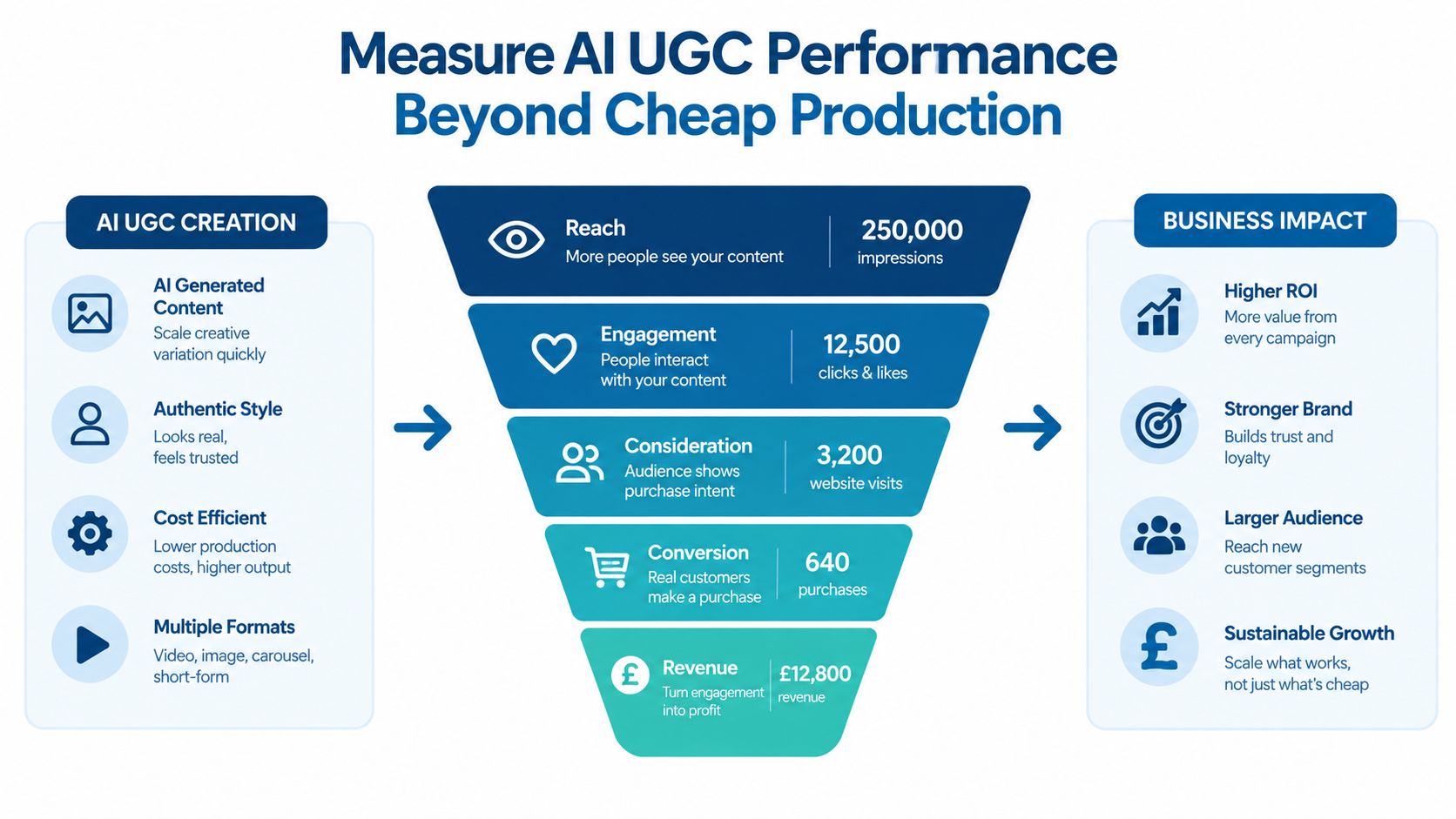
Cost per exported video is a production metric. It doesn't reveal how much the business paid for a usable advert, a qualified enquiry or a profitable order.
The more informative production measure is cost per approved asset. That calculation should include unsuccessful generations and rejected revisions, not only the final export.
Count the full production cost
A campaign cost record should include:
- Technology costs: Subscriptions, generation credits and any separate editing or audio services.
- Source material: Real footage, creator fees, product samples and asset preparation.
- Rights and review: Permissions, licensing checks, factual approval and quality-control time.
- Rework: Corrections, abandoned concepts and placement-specific amendments.
This exposes a common trade-off. A low-priced generated asset may require substantial correction, while a more expensive human-shot advert may arrive closer to publication. Neither production method deserves preference without the full calculation.
Budget test: An advert that costs little to generate but cannot earn approval has no usable production value.
Compare like with like
Test an AI-assisted advert against a human-shot control using the same offer, audience, landing page and measurement window wherever practical. If the purpose is to assess presentation style, changing the offer simultaneously makes interpretation harder.
Use platform experiments or holdout audiences where appropriate. Auction variation, uneven delivery and attribution limits still matter, while small samples can produce unstable conclusions. A weak early result may justify more observation rather than an immediate verdict.
The test record should state what changed, what stayed constant and what outcome would justify continued spending. A fuller marketing ROI assessment should connect creative decisions with business economics.
Prioritise the outcome after the click
Click-through rate describes how often impressions produce clicks. Cost per acquisition divides relevant spend by acquired customers or another clearly defined conversion. Return on ad spend compares attributed revenue with advertising spend, but doesn't establish profit by itself.
For storage, track qualified enquiries, bookings and the suitability of the requested space. For e-commerce, assess sales alongside margin, returns and fulfilment costs. Cheap traffic isn't a useful substitute for either.
Quality and trust deserve monitoring too. A study reported in August 2026 found 49% of UK consumers reacted negatively to low-quality, uncanny or strange AI advertising, compared with 29% for polished, professional-looking AI advertising, according to reporting on AI creative quality and brand trust. That finding supports reviewing perceived quality, not predicting a conversion uplift.
Record negative comments, misleading expectations and sales-team feedback alongside conversion data. Those observations can explain why an apparently engaging advert attracts enquiries the business cannot convert.
Protect Authenticity with Disclosure and Permission
Approval needs to answer separate questions about advertising identification, synthetic presentation and the truth of the message. Passing one check doesn't satisfy the others.
An advertising label identifies commercial content. A synthetic-media disclosure explains relevant generated or manipulated elements. Substantiation supports the claims and experiences presented.
Keep the disclosure questions separate
An advert can be clearly identified as advertising and still contain a misleading testimonial. Similarly, an AI label doesn't excuse a false statement about product performance, pricing or service availability.
The ASA's monitoring of more than 50,000 Instagram and YouTube posts, drawn from 509 UK-based accounts representing 390 influencers, found approximately 57% of likely advertising content adequately identifiable as advertising and around 43% undisclosed or inadequately disclosed, according to its influencer advertising disclosure report. This was an influencer-post study, not an AI-specific compliance audit.
For production teams, the practical response is to make disclosure an approval field rather than a last-minute caption decision. Clear advertising identification should survive resizing, cropping and reuse.
Current ASA guidance and the relevant platform's policies should be checked before publication, particularly when synthetic people or manipulated voices are involved. There shouldn't be an assumed universal UK rule that every AI-assisted edit requires the same label. Requirements and appropriate explanations depend on the content, placement and risk of misleading viewers.
Permission needs a defined scope
Permission to film a person shouldn't be treated as permission to clone their voice or generate new performances. Written agreements should address the intended use of likeness, voice, editing, synthetic adaptation, paid distribution and reuse.
Customer footage needs equally careful handling. Approval should cover the published message, especially when editing changes context or localisation changes what the person appears to say.
- Usage rights: Confirm commercial permissions for footage, music, generated assets and commissioned work.
- Sensitive information: Keep unnecessary customer details out of generation tools and check how providers handle uploaded material.
- Version records: Retain scripts, consent records, disclosure decisions, source evidence and the final approved export.
- Distribution changes: Recheck approvals when an asset moves into a new placement, language or campaign.
A practical set of online video guidelines can help teams turn those checks into consistent publishing controls.
Pre-publication approval checklist
The approver should be able to confirm:
- Recognisable advertising: Commercial intent is clear in the finished placement.
- Honest presentation: Synthetic elements don't create a false impression of genuine experience.
- Supported claims: Product, service and endorsement statements match retained evidence.
- Valid permissions: Relevant people and rights holders have authorised the intended use.
- Traceable approval: The exact published version has a named approver and accessible records.
The investment decision follows from these controls. If the team can't establish who authorised the content or what supports its message, the apparent production saving isn't a sound reason to publish.
Decide Whether AI UGC Ads Deserve More Budget
AI assistance deserves further investment when the business can preserve accurate evidence, approve assets reliably and demonstrate acceptable downstream results after full production and media costs. Natural-looking content alone isn't sufficient.
If those conditions are missing, the better decision may be to narrow the application. Captioning, editing or explanatory graphics can remain useful without committing the entire campaign to synthetic presenters.
Questions before increasing spend
- What remains verifiable? Identify genuine footage, expertise or customer experience supporting the advert.
- Who owns publication approval? Confirm responsibility for accuracy, permissions and the final asset.
- Which outcome supports expansion? Define the qualified enquiry, booking or contribution-aware sale that makes further investment worthwhile.
A business shouldn't generate more variants because the tool permits it. More budget should follow a credible commercial result and a production process the team can defend.
For businesses assessing that decision, Amax Marketing's complimentary marketing audit offers a practical starting point. An audit discussion can focus on campaign measurement, landing-page alignment and lead quality, helping the business judge whether its next investment belongs in creative production, the conversion journey or both.