


The UK garden services sector is projected to reach £7.7 billion in 2026 and includes 24,702 businesses, with business count up 1.7% from 2025 according to IBISWorld's UK landscaping services market data. That one fact changes how marketing for gardeners should be approached. This isn't a market where broad awareness wins by default. It's a market where local visibility, proof of work, and fast follow-up decide who gets the call.
Most providers don't need more “brand reach”. They need to show up when a homeowner is actively comparing garden design, paving, turfing, or maintenance options in a specific town. They need a Google Business Profile that looks active, service pages that match what buyers search for, and a portfolio that removes doubt quickly.
That matters even more because household spend isn't one-dimensional. Research cited by Tom Riley, drawing on Oxford Economics and the Horticultural Trades Association, estimates UK households spent around £5.8 billion on professional gardeners and landscaping firms in 2023, with 36% on routine maintenance and 64% on outdoor projects, as outlined in these UK landscaping marketing statistics. Maintenance and project work don't convert the same way. They need different pages, different offers, and often different follow-up.
Table of Contents
- Why Marketing for Landscapers Is a Local Game Now
- Build Your Local SEO and Google Business Profile Foundation
- Turn Your Website and Portfolio Into a Lead Engine
- How benjiads Can Help
- Win Faster Enquiries With PPC Social Proof and Referrals
- Track Optimise and Plan Your Next 90 Days
- Your Next Steps to More Consistent Landscaping Work
Why Marketing for Landscapers Is a Local Game Now
With 24,702 businesses competing for work in a £7.7bn sector, local visibility is not a nice extra. It decides who gets the enquiry and who never makes the shortlist.
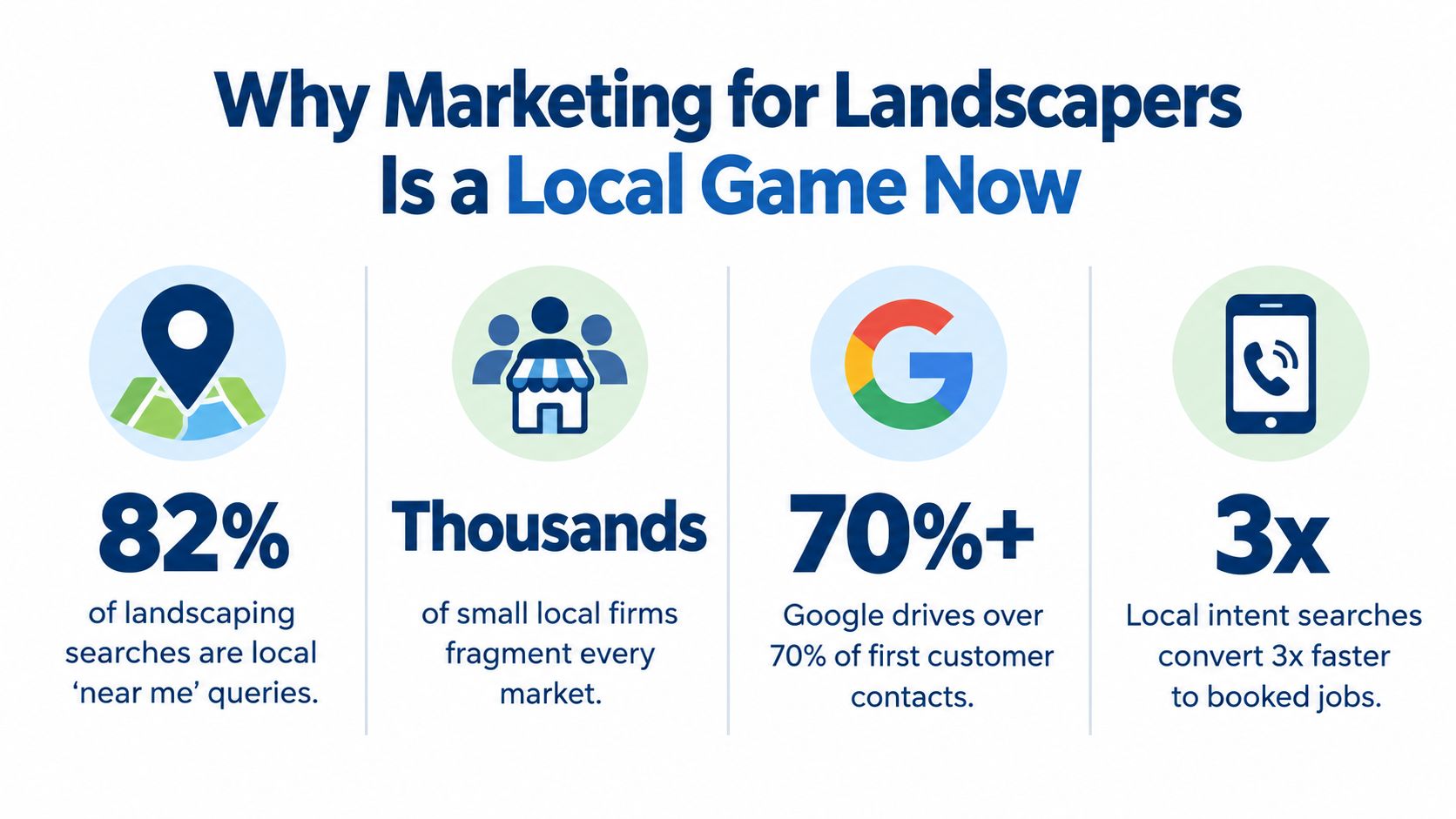
For most firms, this is a demand-capture job first. Homeowners rarely search for a provider across a whole region. They search in a town, a postcode, or the next village over, then compare the few businesses that look active, credible, and easy to contact. In a fragmented market like this, broad reach matters far less than showing up well in the places you want to win work.
Fragmentation makes local trust the real filter
The crowded part is obvious. The more important point is what buyers do next.
They do not compare every contractor in the county. They check a tight local set. Usually that means the firms that appear in maps, have proof from nearby jobs, and look straightforward to deal with. A business can do excellent work and still lose if its online presence looks neglected or too generic for the area it serves.
That is why hyperlocal coverage beats vague visibility. A paving page for Solihull, a maintenance page for Harborne, and a profile full of recent work from those areas will usually do more than a polished homepage trying to cover an entire county at once.
Project leads and maintenance leads need different journeys
These enquiries do not behave the same way, and treating them as one bucket wastes demand.
Maintenance buyers want speed and certainty. They care about coverage, reliability, visit frequency, and whether you can start soon. Project buyers take longer to decide. They look for design quality, build standards, organisation, and signs that you can manage a larger spend without chaos.
As noted earlier, the 2023 spending split leaned more heavily toward projects than maintenance. That matters because one generic services page usually fails both audiences. It is too thin for someone pricing a full garden build, and too broad for someone who just wants regular upkeep in a specific area.
Practical rule: If every service runs through one page, you may still get impressions but lose enquiries because the page does not match the reason the buyer searched.
Rankings help. Proof and usability close the lead.
Analysts cited by Rank My Local report that 46% of Google searches have local intent, and complete profiles can earn 5x more views than incomplete ones, according to its UK local SEO statistics page. For firms selling garden builds, paving, turfing, fencing, or maintenance, that changes what good marketing looks like.
A ranking position means little if the profile shows no photos from the last 12 months and the quote form asks ten fields before anyone can submit. Buyers use the listing and the landing page to check risk. If both look current, specific, and easy to use, enquiry rates improve. If either one looks neglected, clicks do not turn into calls.
I see this a lot with local trades. The business is visible enough to get considered, but not convincing enough to get contacted.
Seasonality exposes weak systems fast
This trade does not get steady demand every month. Spring fills diaries quickly. Early summer stays strong. Autumn can produce solid work for tidy-ups, planting, drainage, and prep. Winter often gets thin unless the business has recurring work, hardscape jobs, or a deliberate plan to keep demand coming in.
Firms that rely on referrals alone tend to feel this hardest. They look fully booked in peak periods, then scramble when the natural rush drops off.
A better setup smooths the year instead of chasing it. Local search coverage, recent reviews, fresh job photos, and service pages built around real buyer intent help keep enquiries coming in outside the obvious peaks. That matters more in this market than chasing vanity reach on channels that rarely produce local buying intent.
What actually wins in a local market
Generic posting and broad awareness campaigns often look busy without producing many qualified leads. Homeowners want enough proof to trust the next step.
The assets that usually pull their weight are simpler:
- Hyperlocal coverage: real towns, districts, and postcode clusters you serve
- Visual proof: before-and-after photos, short videos, and concise project summaries
- Clear conversion paths: obvious phone number, short forms, and realistic response expectations
- Review momentum: a steady flow of recent feedback, not a burst from two years ago
Buyers do not reward the firm with the broadest online footprint. They usually choose the one that looks nearest, clearest, and safest to contact.
Build Your Local SEO and Google Business Profile Foundation
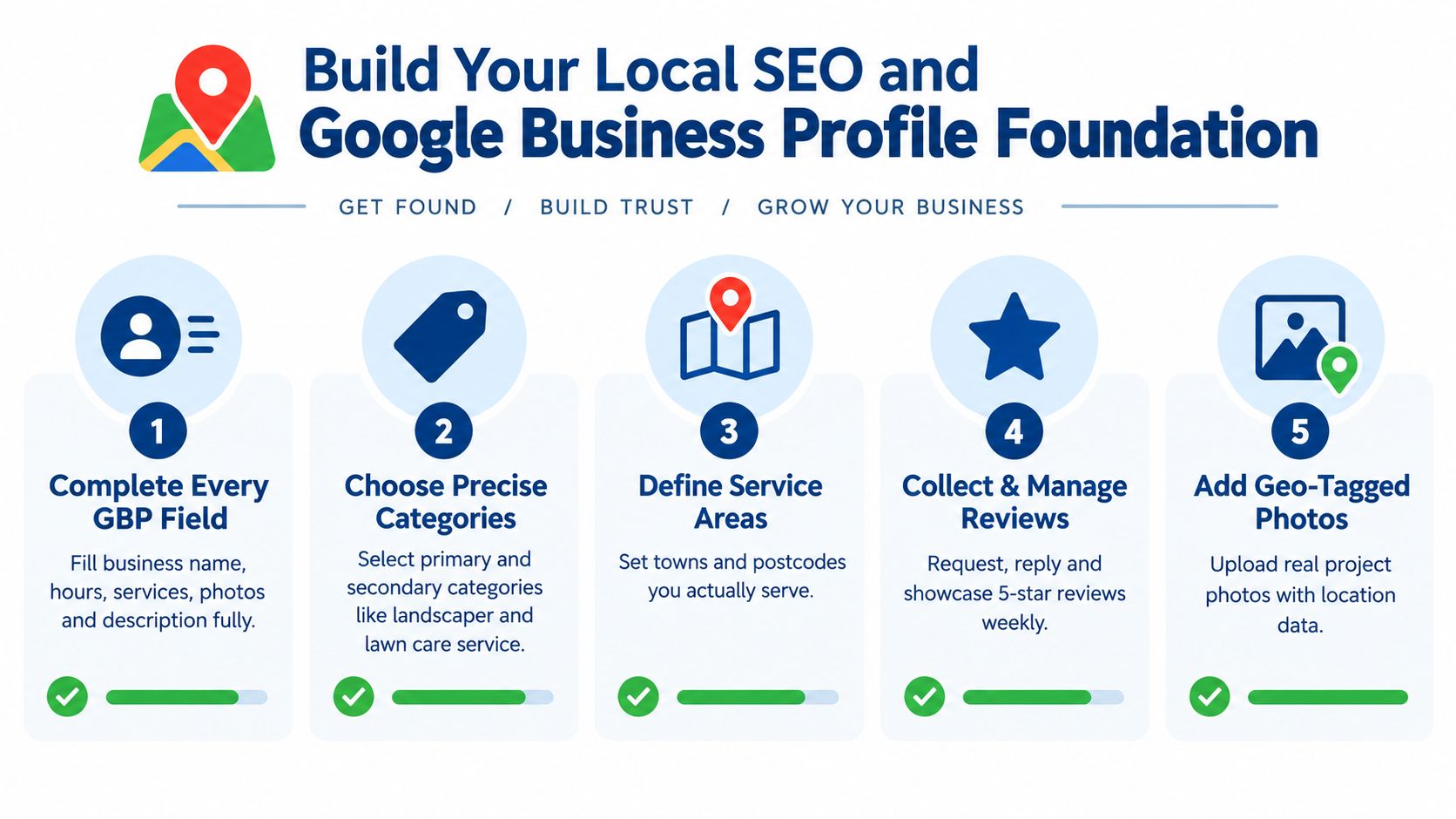
In a fragmented local market, Google Business Profile and local SEO do the demand-capture work that broad awareness rarely does. Homeowners usually compare three things fast: proximity, proof, and whether the firm looks active now. If the profile is thin, the site is vague, or reviews look old, enquiries drop before a call happens.
As noted earlier, complete profiles earn far more views than incomplete ones. That is why setup deserves the same care as a sales page, not a quick admin task.
Complete the profile like it's a landing page
A lot of profiles are live but not persuasive. They show a phone number, a rough service label, and a few photos. That might get an impression, but it does not do much to win the click or the call.
A stronger setup includes:
- Business details filled in fully: trading name, phone, website, opening hours, and seasonal updates where relevant
- Service list completed: paving, fencing, turfing, garden design, planting, maintenance, drainage, and other work the team sells
- Business description written clearly: short copy on what the company does, who it serves, and where it works
- Photo coverage across service types: recent job photos, not stock images or generic garden shots
- Questions and answers monitored: useful for recurring concerns on access, lead times, site visits, and quote process
Businesses that want a more structured process can review what goes into Google Business Profile optimisation, especially for category setup, review management, and local visibility.
Choose categories and service areas carefully
Category selection shapes what searches the profile can show up for. The trade-off is straightforward. Go too broad and relevance gets diluted. Go too narrow and profitable adjacent work gets missed.
Firms should choose a primary category that reflects the main revenue driver, then add secondary categories only for services they genuinely deliver and want more of. A business focused on design and build should not be structured the same way as one built around ongoing maintenance.
Service areas need the same discipline. Listing every town within an hour can look ambitious, but it often creates poor-fit leads, longer travel, and lower margins. Better results usually come from a tighter map based on realistic drive time, crew efficiency, and minimum job value.
A practical service-area structure is:
- Core towns where the business wants repeat work and review volume
- Nearby postcode clusters that still make sense commercially
- Outer areas reserved for larger or higher-margin projects
Build location pages that reflect real intent
The profile cannot carry the whole load. It needs support from matching pages on the site, especially in a market where buyers search by town, service, and urgency.
Thin pages with one paragraph and a swapped place name rarely help. Good local pages give someone a reason to believe the firm works in that area regularly and understands the kind of jobs common there.
Useful location pages usually include:
- The services offered in that area
- Photos from nearby or comparable jobs
- Notes on common property styles, access issues, drainage problems, or garden sizes in that location
- Clear next steps for a quote or site visit
- Trust markers such as reviews, guarantees, or accreditations where relevant
This is one of the best ways to turn a fragmented £7.7bn market into a workable local system. Instead of trying to rank everywhere, the business builds coverage where crews can convert and fulfil profitably.
Keep NAP and site signals aligned
Local businesses still lose trust through simple inconsistencies. The business name appears one way on the profile, another in the site footer, and a third in directories. The phone number changes. Opening hours are old. None of that kills performance on its own, but each mismatch adds friction.
The basics matter:
| Asset | What to check | Why it matters |
|---|---|---|
| Website footer | Business name, phone, area served | Reinforces consistency |
| Contact page | Matching contact details and form routing | Prevents lead leakage |
| Directory listings | Same core business details | Supports local trust signals |
| Map embed or address info | Clear and accurate location context | Helps users verify legitimacy |
Build a review system, not a review scramble
Reviews work best when they are built into operations. Teams often ask only after the biggest projects, which leaves a lot of credible proof unused. Smaller paving jobs, tidy-ups, turfing work, and regular maintenance can all produce useful reviews if the handoff is handled properly.
A reliable review workflow is simple:
- Ask at the right moment: after completion, once the client has seen the result
- Use one direct route: text or email with a clear review link
- Assign responsibility: one person checks that the request was sent
- Reply regularly: short, human responses are enough
- Use recurring themes in site copy: if customers keep praising tidiness, communication, or reliability, put that language on the relevant pages
Fresh reviews and recent project photos usually do more for local conversion than polished branding alone.
What actually costs you enquiries
The biggest local SEO losses are usually operational. Old photos. Half-finished services. No location support on the site. Review requests sent inconsistently. Pages written for search engines instead of homeowners.
I have seen firms spend money on ads before fixing any of that. The result is predictable. They pay to push people into a weak local presence, then wonder why lead quality feels inconsistent.
Get the foundation right first. In this category, tight local relevance beats generic reach almost every time.
Turn Your Website and Portfolio Into a Lead Engine
Getting found is only half the job. The website has to convert cautious visitors into enquiries, and it has to do it quickly. Homeowners comparing pros aren't reading every line. They scan for proof, relevance, and signs that the business can handle the kind of work they need.
That's why one broad landscaping page usually underperforms. Commercial intent varies. A buyer searching for design help behaves differently from someone looking for ongoing maintenance or a quick paving quote.
Structure pages around job intent
One verified UK keyword set for garden professionals shows a wide spread of search intent, from “garden design” and “landscaper” to “gardeners near me” and “garden maintenance near me”, with volumes in that set ranging from 12,600 down to 390, as outlined in this landscaper SEO resource. That's the clearest reason not to dump every service into one catch-all page.
A better page structure separates intent, for example:
- Garden design pages for inspiration, process, and project quality
- Patio or paving pages for material options, installation proof, and quote prompts
- Garden maintenance pages for frequency, scope, and reliability
- Turfing or planting pages for outcome imagery and practical considerations
- Location-plus-service pages where search behaviour justifies them
For businesses building these pages at scale, local landing page SEO becomes the useful discipline. It combines service intent, place relevance, and conversion design rather than treating location pages as filler.
Want a free audit like this for your own site?
We'll show you exactly what's holding your rankings and conversions back. No sales pitch.
Get My Free AuditShow the work before explaining the work
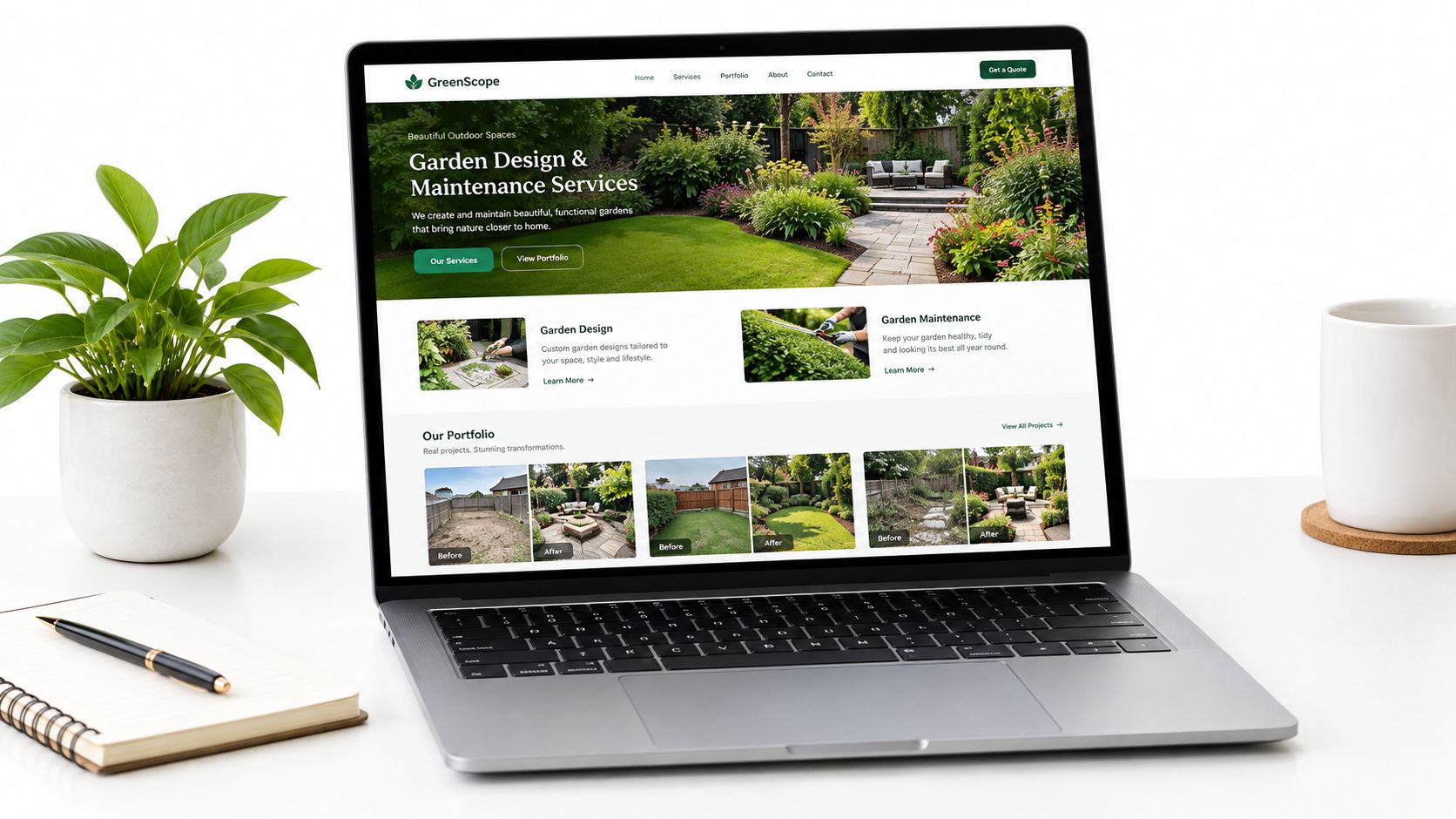
Landscaping is visual. A strong gallery often answers trust questions faster than paragraphs do. That doesn't mean stuffing dozens of images onto one portfolio page and hoping for the best.
Useful visual proof tends to follow a few rules:
- Group projects by service type: patios with patios, planting with planting, redesigns with redesigns.
- Use before-and-after framing: buyers want to see the improvement, not just the finished shot.
- Add short captions: state what was done, where roughly it was done, and what problem it solved.
- Include real environments: front gardens, back gardens, sloped plots, drainage problems, narrow spaces.
Short video walkthroughs also help. Even a simple phone video of a completed garden, narrated clearly, can do more than long blocks of copy because it proves workmanship, scale, and finish in a way text can't.
Make key trust signals impossible to miss
Many company websites bury the details buyers care about most. Contact methods are hidden in menus. Service areas are vague. There's no clue what types of jobs the company prefers. Reviews sit on a separate page no one visits.
High-converting pages usually place trust signals close to action points:
| Page element | What it should do |
|---|---|
| Hero section | State service, area, and next action clearly |
| Gallery block | Prove quality fast |
| Review snippets | Reduce risk at the point of decision |
| Service area note | Confirm that the buyer is in range |
| Quote form | Ask only for essential details |
Field reality: If a homeowner can't tell within seconds whether the business covers their area and does their type of job, they usually go back to search.
Reduce friction in the enquiry path
A lot of lead loss happens because the form asks too much too early. For first contact, most buyers don't want to upload plans, measure the garden, or write a project brief. They want to know whether the business is relevant, available, and worth speaking to.
A better quote form asks for just enough:
- Name and contact details
- Postcode or town
- Service needed
- Short message or job summary
- Optional photo upload
Phone numbers should be visible, but the site shouldn't force everyone to call. Some buyers prefer forms. Some prefer text. The more rigid the contact path, the more leads leak to competitors who make it easier.
Add pricing guidance without boxing the business in
Many professionals in the field avoid any mention of price. The concern is understandable. Every site visit, material choice, and scope change affects the final quote. But saying nothing at all can create hesitation.
Pricing guidance doesn't need to be a fixed rate card. It can be framed around project factors:
- typical variables that affect cost
- whether site access changes labour requirements
- what's usually included in a maintenance visit or installation quote
- whether there's a minimum job size or preferred project type
That sort of guidance filters poor-fit leads without discouraging serious ones.
Write for comparison, not for decoration
The strongest landscaping contractor websites don't sound like brochures. They answer the practical questions buyers ask while comparing options. What exactly is included. What happens next. What types of gardens are a good fit. How long the quote process takes. Whether the team handles only installation or also design.
That tone tends to convert better than polished but vague brand language.
How benjiads Can Help
Some providers already have the organic side in motion and need faster lead flow. Others know paid ads should work for their area but don't have the time to build campaigns, write ad copy, set up tracking, manage retargeting, and chase slow leads. That's the gap software can fill if it handles more than just ad launch.
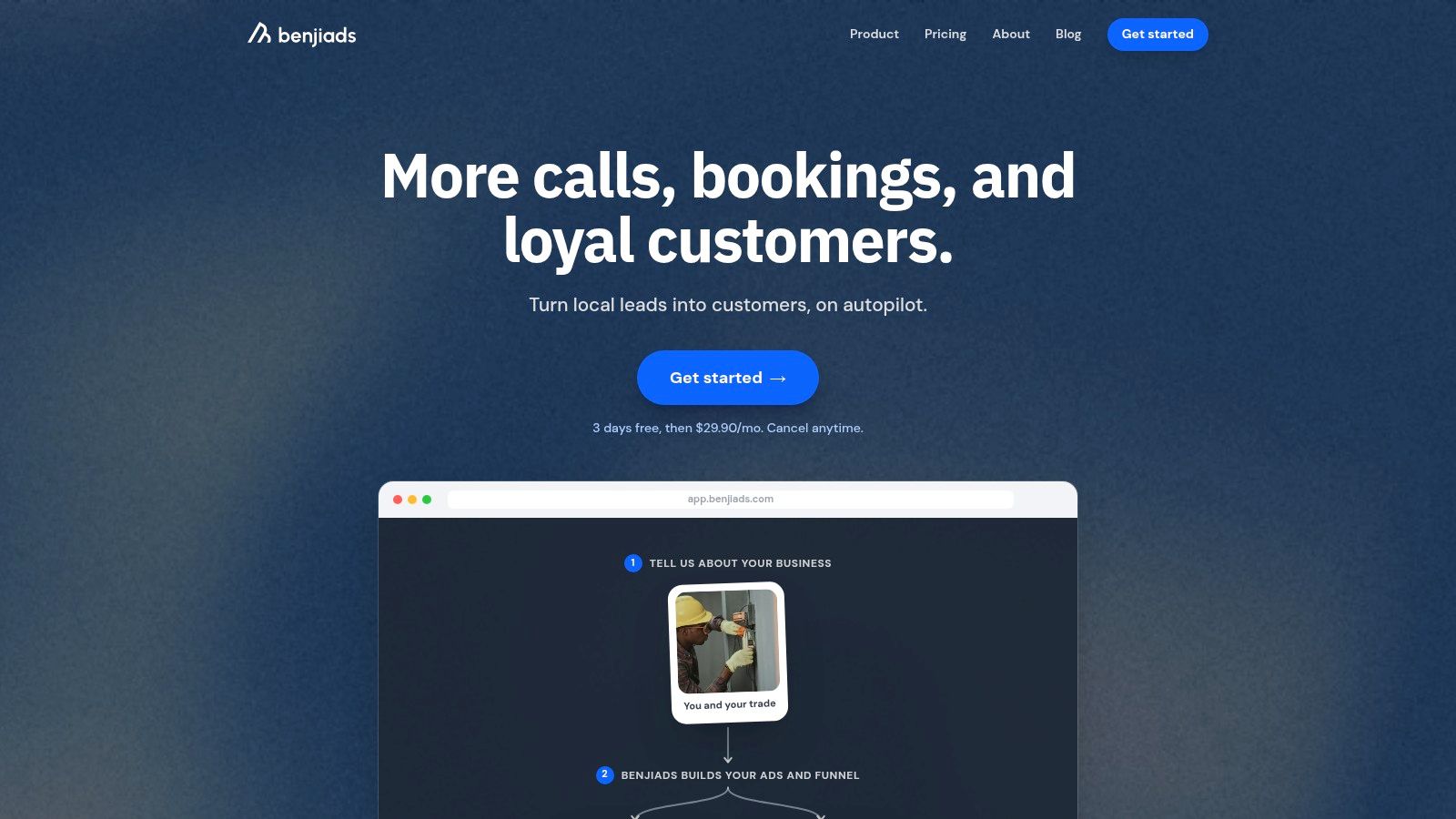
benjiads is software built to automate online advertising and lead follow-up for local service businesses. The useful distinction is that it's not positioned as a traditional agency retainer and it's not a DIY ads dashboard either. It combines creative generation, campaign setup on Meta and Google, landing flows, retargeting, tracking, and automated SMS follow-up in one system, with campaigns approved before they go live.
That makes it a good fit in a few situations:
- Time is the bottleneck: the business owner or office manager can't spend hours each week inside ad platforms.
- Follow-up is inconsistent: leads arrive, but response speed drops when the team is on site.
- Tracking is unclear: it's hard to tell which campaign produced booked work.
- Creative production is patchy: there isn't a repeatable process for writing ads and producing visual variants.
A practical review point is whether the business needs a unified paid system rather than another fragmented tool stack. For pros in outdoor property care comparing options, BenjiAds for landscapers is worth evaluating when the goal is quicker paid acquisition with follow-up baked in. It's especially relevant where the owner wants approval control but doesn't want to operate Meta and Google ads manually.
The trade-off is straightforward. Businesses with strong in-house paid media skills may prefer direct platform control and custom builds. Businesses without that capability often need something more operationally complete than basic ad software.
Win Faster Enquiries With PPC Social Proof and Referrals
Organic visibility builds steadily. Paid and relationship channels help fill the gaps, accelerate demand capture, and keep the diary moving when seasonality shifts. The mistake is treating every channel as if it does the same job.
Search ads, social proof, and referrals sit at different points in the decision path. Pros get better results when each channel is assigned a clear role.
Use PPC where intent is already high
PPC works best when the service is urgent, specific, or easy for a buyer to define. Someone searching for patio installation, garden clearance, turf laying, or maintenance in a named area is already well down the path.
Campaigns usually perform more cleanly when they are split by:
- Service line: design, build, maintenance, fencing, paving, planting
- Geography: core towns and profitable travel zones
- Commercial priority: higher-margin jobs separated from smaller reactive work
The ad should send traffic to a matching page, not the homepage. A patio ad goes to a patio page. A maintenance ad goes to a maintenance page. Anything else adds friction.
Professionals in outdoor design and groundskeeping that need support managing paid search can compare provider options such as a PPC management service, particularly where campaign structure, search term control, and landing page alignment are weak.
Social proof should support search, not replace it
Social platforms matter for outdoor property specialists because the work is visual. But the role of social is often misunderstood. It usually performs better as proof and reassurance than as a pure demand-generation engine.
Useful social content tends to include:
- before-and-after carousels
- short project walkthroughs
- planting or paving close-ups
- customer feedback screenshots
- seasonal updates tied to real jobs
That content helps a buyer who already found the business through Google and wants one more reason to trust it. It can also support remarketing. It rarely replaces local search intent on its own.
A strong Instagram or Facebook feed won't rescue a weak local search presence. It will, however, help close people who are already checking whether the business looks legitimate.
Referrals still matter, but they need a process
Word of mouth remains valuable. It just becomes more reliable when it's engineered instead of left to chance.
Good referral sources for garden professionals often include estate agents, garden centres, builders, driveway firms, electricians, and maintenance trades already serving the same homes. The best partnerships usually come from shared geography and clear fit, not from trying to build a huge network.
A simple system works:
- Identify adjacent local businesses serving similar homeowners.
- Make the referral ask specific. Mention the types of jobs wanted.
- Share photos and a short service summary they can forward confidently.
- Keep them updated when a referred job lands.
- Return the favour where it makes sense.
Choosing the Right Channel for Each Landscaping Job Type
| Channel | Best For | Intent Level | Budget Tip |
|---|---|---|---|
| Google Search PPC | Quote-ready project and maintenance searches | High | Focus spend on core services and tight geography first |
| Google Business Profile | Local discovery and direct contact | High | Invest time in upkeep before adding more ad spend |
| Instagram and Facebook organic | Visual proof and remarketing support | Medium | Reuse jobsite content instead of creating polished campaigns from scratch |
| Referral partners | Trust-led local jobs | High | Spend effort on relationships, not broad sponsorship scatter |
| Email or SMS follow-up | Re-engaging past leads and customers | Medium to high | Use it to revive old quotes and seasonal opportunities |
Build offers around the calendar, not around guesswork
Seasonal smoothing usually comes from better timing rather than louder promotion. Maintenance reminders, autumn tidy-up pushes, winter hardscaping availability, and spring project booking windows all work better when they are planned in advance.
The key is to avoid going fully reactive. Businesses that decide offers only when work slows down usually market too late. A simple quarterly promotion calendar fixes that.
Track Optimise and Plan Your Next 90 Days
Busy marketing activity can still underperform if nobody tracks what turned into booked work. Pros often know which channels “feel” productive, but feeling isn't enough when budgets are tight and seasonality changes demand.
A workable system doesn't need to be complicated. It needs to connect visibility, enquiries, and booked jobs clearly enough to guide the next decision.
Track booked work, not just clicks
Clicks are easy to see and easy to overvalue. Professionals in the outdoor design industry need a tighter set of practical signals:
- Phone enquiries by source
- Form submissions by page or campaign
- Google Business Profile interactions
- Quoted jobs
- Booked jobs
- Jobs declined due to area, budget, or fit
That last group matters because it improves judgement. If lots of leads are outside the service area or too small to be viable, the issue may be targeting rather than volume.
Review weekly with a short scoreboard
A brief weekly review usually works better than an occasional deep dive because local-service demand moves quickly. The team doesn't need a full analytics report. It needs a short scoreboard and a few actions.
A useful review asks:
- Which source produced the most relevant enquiries this week?
- Which page or ad brought poor-fit leads?
- Were all new reviews requested and answered?
- Which service page needs fresh photos or examples?
- Is response speed slipping on any lead source?
Decision filter: Keep the channels that produce work the team wants more of. Cut or tighten the ones that create noise, travel waste, or price shoppers.
A practical 90-day rhythm
The strongest local marketing systems improve through steady maintenance. They don't rely on one large launch.
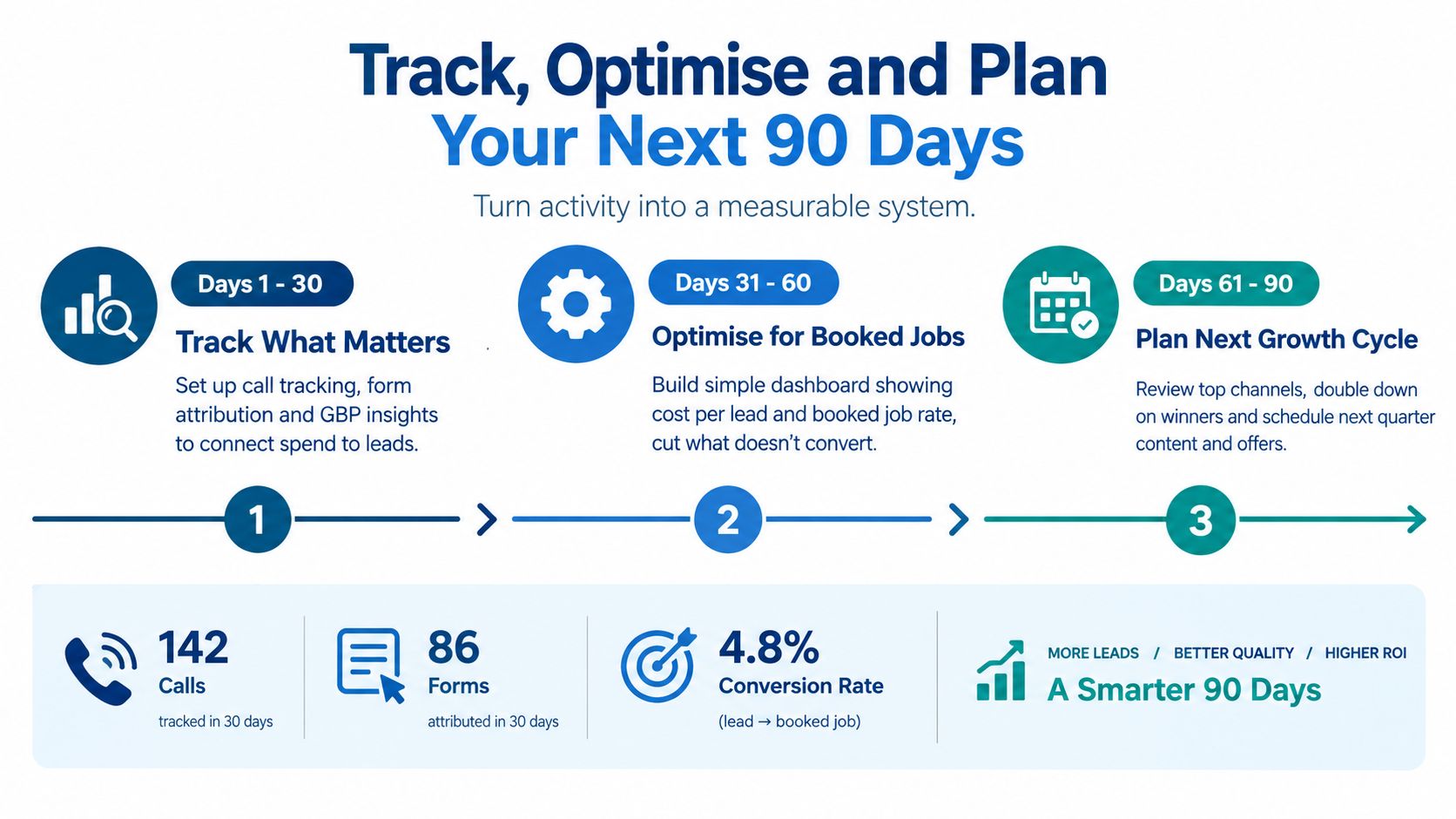
Days 1 to 30
Focus on accuracy and capture. Tighten profile details, clean up contact paths, add missing service pages, and make sure every lead source can be identified. Review old enquiries for patterns. If the same question keeps appearing, the site is missing an answer.
Days 31 to 60
Improve conversion. Add stronger project proof, update forms, test sharper calls to action, and review paid traffic quality if ads are running. This is usually the right stage to prune weak service areas or redirect spend toward the better-fit work.
Days 61 to 90
Plan the next cycle. Decide which services need more visibility for the coming season. Schedule content updates, line up new project photography, and prepare offers before the diary softens.
Solo operator and small team priorities differ
A solo operator and a multi-crew business shouldn't run the same marketing system. The solo operator usually needs selectivity more than scale. Better to attract fewer, better-fit jobs nearby than chase every enquiry.
A small team with office support can do more. It can segment service lines, test paid acquisition more consistently, and maintain a stronger review and content cadence. The system should match operational capacity, or lead quality starts to break down.
Keep the machine light enough to maintain
The best 90-day plan is the one the business can keep running during busy weeks. If the process needs too many tools, too much manual admin, or too much design work, it usually fades.
A lean system tends to hold up better:
| Area | Keep it simple |
|---|---|
| Reviews | One send process, one owner |
| Photos | Upload from completed jobs weekly |
| Tracking | Use source notes and basic dashboarding |
| Content | Improve core service pages before adding more blog content |
| Paid testing | Small, focused tests tied to clear job types |
Your Next Steps to More Consistent Landscaping Work
Marketing for garden service providers gets easier when it stops being treated as a collection of random tactics. The businesses that generate steadier enquiries usually follow a sequence. First, they make themselves easy to find locally. Then they make themselves easy to trust. After that, they add paid and referral channels to accelerate what already converts.
That order matters. Running ads into a weak profile and a vague website doesn't solve the underlying issue. Posting nice project photos on social won't fix missing service pages, stale reviews, or unclear service-area coverage either.
A practical next-step checklist looks like this:
- Audit the local foundation: check the Google Business Profile, contact details, service list, hours, and photo freshness.
- Review service pages: make sure each priority service has its own page with relevant proof.
- Tighten the portfolio: group images by job type and add short explanations.
- Fix the enquiry path: reduce friction in forms and make contact options obvious.
- Create a review routine: ask consistently after completed work, not only after major projects.
- Decide on one growth channel: either paid search, referral partnerships, or remarketing. Don't launch all three at once.
Short-term action should be narrow. One week is enough to improve a profile, clean up contact details, and update neglected photos. One month is enough to rebuild weak service pages and put review requests on a schedule. A quarter is enough to test paid traffic properly, strengthen referral links, and build a repeatable content rhythm.
Some firms can handle that internally. Others need outside help because the bottleneck isn't ideas. It's time, implementation, or channel expertise. In those cases, specialist support is useful when it solves a defined problem such as local SEO setup, landing page build-out, or paid search management. Amax Marketing is one example of a provider that offers local SEO, PPC, and related digital support for local businesses.
The strongest result doesn't come from doing everything. It comes from doing the most impactful work in the right order, then maintaining it through the year.
Professionals who design and maintain outdoor spaces that want more consistent work should start with one question this week. Can a homeowner in the target area find the business, trust the business, and enquire without friction? If the answer is anything less than yes, that's where the next gain sits.