
91% of marketers globally are actively using AI in their work in 2026, up from 63% the previous year, while AI-generated answers now threaten up to 50% of traditional search traffic and 60% of all Google searches end without a click according to Seoprofy's compiled statistics.
That changes the job of SEO.
For UK businesses, the old model was simple enough. Rank a page, win the click, convert the visit. That still matters, but it's no longer the whole game. Buyers now get answers inside Google AI Overviews, ChatGPT, Perplexity, and other AI interfaces before they ever reach a website. A business can be visible, influential, and still lose the lead if its brand isn't understood properly by those systems.
That's why AI SEO services matter. Not because “AI content” is fashionable, and not because every agency has added new labels to old retainers. They matter because search has shifted from link lists to answer engines. In the UK especially, where local intent, trust signals, and entity consistency shape lead quality, the gap between appearing in an answer and converting from that answer is now one of the most important strategic problems in digital marketing. For how we approach this in practice, see our AI search optimisation service.
The New Digital Landscape in 2026
Search behaviour has moved faster than many businesses expected. Teams that still measure SEO only by rankings and sessions are often looking at the wrong scoreboard.
Google's interface is changing how discovery works. AI summaries answer informational questions directly. Large language models are becoming starting points for research. Buyers compare providers without opening ten tabs. A business can lose visibility without dropping positions in the old sense, because the user never reaches the list of blue links.
Search is shifting from ranking to recommendation
When search engines and AI tools generate a summary, they're choosing which brands to mention, which pages to trust, and which facts to surface. That puts pressure on content quality, site structure, and brand clarity.
For owners and managers, the practical implication is straightforward:
- Ranking alone isn't enough: A page can rank and still lose attention if the AI layer answers the question first.
- Informational content has new strategic value: Top-of-funnel pages now help a brand become the cited answer, not just the clicked result.
- Authority must be machine-readable: If a platform can't confidently understand what a business does, where it operates, and why it's credible, it's less likely to feature it.
Practical rule: SEO now has two jobs. Earn visibility in traditional results and make the brand easy for AI systems to interpret and cite.
Why UK businesses feel this change sharply
The UK market often combines dense local competition with buyers who search in highly specific ways. Service-area pages, local trust markers, product detail, and sector relevance all need to line up cleanly.
That's why generic optimisation is fading. Businesses need pages that answer the exact question being asked, but they also need supporting signals that confirm the business behind the answer. Without that second layer, AI visibility can become superficial. It may generate mentions, but not meaningful enquiries.
What Exactly Are AI SEO Services
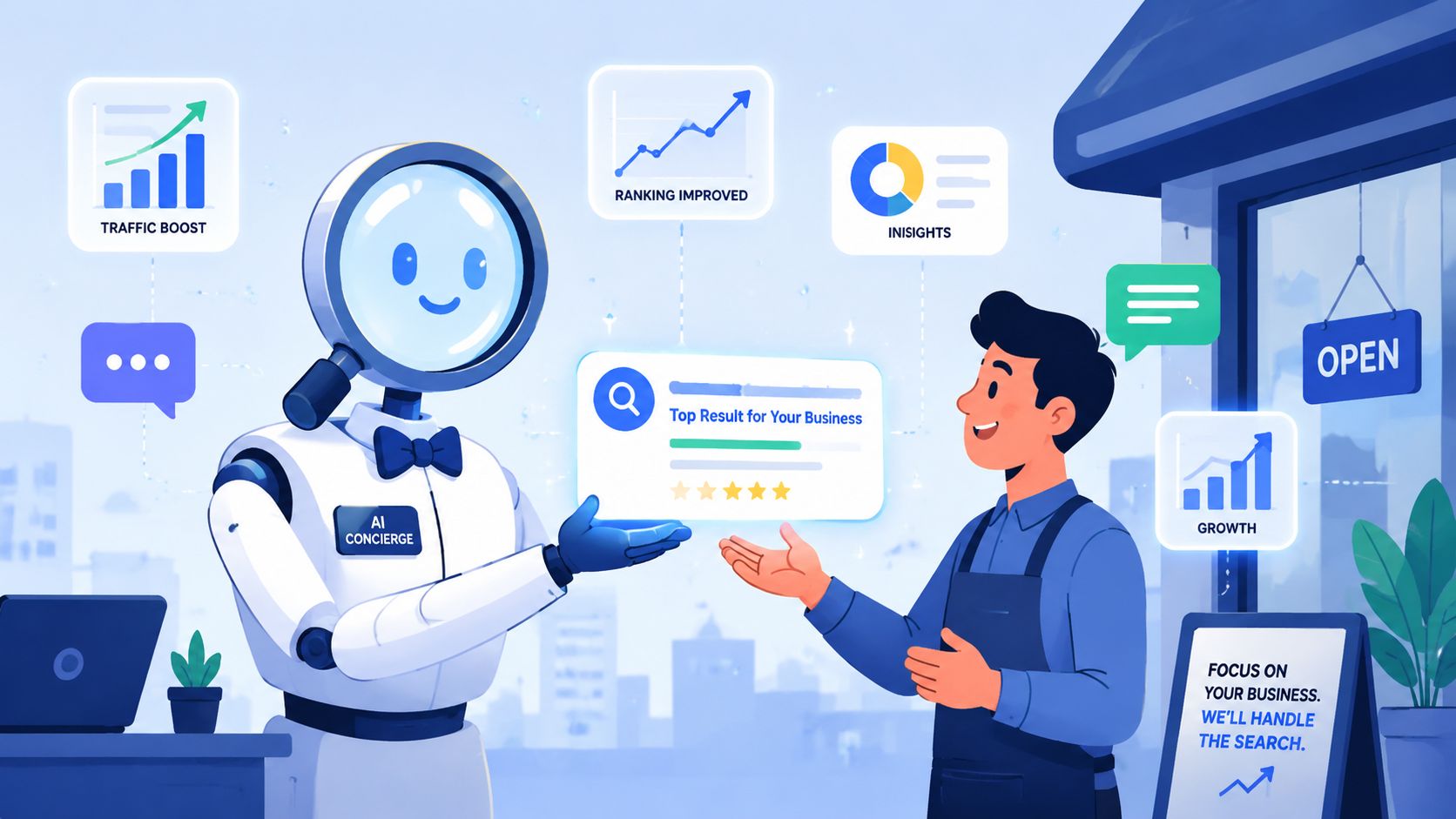
AI SEO services are best understood as a digital concierge for search visibility. Traditional SEO helped search engines index and rank pages. AI SEO helps answer engines understand a business well enough to feature it when users ask direct questions.
That sounds abstract until it's broken into working parts. The goal isn't just to publish faster or automate copy. The primary goal is to make the business easier to discover, easier to interpret, and easier to trust across search systems that summarise information instead of merely listing pages.

The core shift behind AI SEO
Google AI Overviews reach 2 billion monthly users, 99.9% of triggered keywords are informational, and 37% of consumers now start their search journey with an LLM instead of a traditional search engine based on Semrush's reported statistics.
That means AI SEO services focus heavily on question-led discovery. Businesses need content that answers clearly, but they also need context around that content so the platform knows who is speaking, what the business offers, and when it's relevant.
A useful framework for leadership teams is to look at modern visibility through the lens of AI search strategies for leaders. The strategic issue isn't whether AI tools exist. It's whether the company is building assets those tools can reliably cite.
What these services usually include
Large Language Model Optimisation
LLMO is the practice of shaping content and site signals so platforms like ChatGPT and Perplexity can extract useful, accurate answers. It isn't about stuffing pages with robotic phrasing. It's about clarity.
That often means:
- Concise answer blocks: Short sections that resolve common questions directly
- Structured page logic: Strong headings, sensible topic flow, and self-contained sections
- Clear topical depth: Supporting pages that reinforce the main subject from different angles
Entity-based SEO
Entity SEO helps systems connect a business name with its services, locations, sector, and expertise. If a storage company operates across several towns, its identity has to be consistent enough that AI tools don't treat each mention as fragmented information.
Typical work includes:
- Business identity alignment: Matching service descriptions, locations, and brand references across key assets
- Authoritative associations: Building supporting mentions and references that reinforce expertise
- Structured data deployment: Adding machine-readable context on core pages
Automated analysis and prioritisation
AI doesn't replace strategy, but it does improve analysis speed. Agencies use it to cluster topics, review competitor coverage, identify content gaps, and flag pages that are poorly aligned with intent.
Strong AI SEO services don't sell automation. They use automation to find where human judgement matters most.
How AI SEO Differs From Traditional SEO
Traditional SEO still matters. Technical health, useful content, internal linking, and authority remain the base. The difference is that AI SEO services are designed for a search environment where being referenced can matter as much as being clicked.
The biggest operational shift is this. Traditional SEO often asks, “How do we rank this page?” AI SEO also asks, “How do we become the answer engine's trusted source for this topic?”
The practical differences
70% of businesses report higher ROI from integrating AI into their SEO strategy compared with traditional methods alone, with entity-based optimisation and structured data used to help brands get cited in AI Overviews as reported by Slate.
That doesn't mean old SEO should be discarded. It means the workflow changes.
| Aspect | Traditional SEO | AI SEO Services |
|---|---|---|
| Primary goal | Rank pages for target keywords | Earn visibility in rankings and AI-generated answers |
| Keyword approach | Focus on head terms and search volume | Model intent, clusters, and question patterns |
| Content briefs | Manual and often keyword-first | Data-assisted and answer-first |
| Technical work | Periodic audits and standard fixes | Continuous monitoring plus entity and schema refinement |
| Authority signals | Backlinks and on-site trust elements | Backlinks, trust elements, and machine-readable brand clarity |
| Reporting focus | Rankings, traffic, conversions | Citations, qualified AI traffic, conversions, lead quality |
| Strategy style | Reactive to ranking changes | Predictive and guided by emerging search behaviour |
What works and what doesn't
What works is a joined-up system. That includes technical SEO, strong local pages, schema, clear service explanations, and authority building. For authority building at scale, many teams now pair outreach with specialist tools such as a link building platform to manage digital PR workflows more consistently.
What doesn't work is treating AI SEO as bulk content production. Flooding a site with thin FAQ pages, generic city pages, or lightly rewritten articles may create volume, but it rarely creates trust. AI systems are far more likely to reward pages that are specific, attributable, and clearly useful.
The hidden trade-off
AI SEO is usually faster at surfacing opportunities, but it also exposes weak positioning. If a business has unclear service boundaries, inconsistent location signals, or vague proof of expertise, better tooling won't hide that. It will reveal the problem sooner.
Real World Examples Of AI SEO In Action
For self-storage operators, AI SEO is rarely about broad visibility alone. It's about capturing specific commercial intent and turning that intent into usable leads across multiple locations.
The strongest opportunities usually appear where a standard local SEO programme leaves gaps. One site might rank for “self-storage London”, but miss the narrower searches that carry stronger buying intent, such as seasonal storage, business storage, archive storage, or climate-sensitive items. AI-led analysis is useful here because it groups those patterns quickly and shows where location pages, service pages, and FAQs need more precise coverage.
Want a free audit like this for your own site?
We'll show you exactly what's holding your rankings and conversions back. No sales pitch.
Get My Free Audit
A representative self-storage scenario
A multi-location storage company in the South East often faces a familiar issue. Core pages are serviceable, but they're broad. Every branch page says roughly the same thing. FAQs are thin. Google Business Profiles aren't aligned tightly with on-site content. The business appears in search, but not always for the queries that lead to booked units or qualified calls.
An AI SEO programme would usually tighten four areas first:
- Location intent mapping: Distinguish between domestic, student, and commercial demand by branch
- Page specialisation: Build or refine pages around specific use cases rather than generic storage copy
- Entity reinforcement: Make sure each branch, service type, and brand signal is consistent across web assets
- Answer-led content: Add useful, concise responses to the exact questions people ask before booking
Where the lead quality comes from
For UK businesses, the value of AI traffic can be unusually high. ChatGPT-referred visitors convert at nearly 9x the rate of Google organic visitors, and Perplexity achieves a 10.5% conversion rate according to Agile Digital Agency's reported figures.
That matters because self-storage buyers often have immediate practical needs. They aren't browsing casually. They're moving house, clearing office space, storing stock, or handling a life event. When an AI platform sends that user through after giving them context, the visit is often more qualified.
A citation isn't the finish line. The commercial win comes when the answer engine sends someone who already understands the offer and is ready to act.
What usually fails in this sector
Two things tend to underperform.
The first is scaled copy with minimal local distinction. If ten branch pages use nearly identical wording, answer engines have little reason to surface one over another. The second is chasing AI mentions without checking whether the cited page supports the conversion. An AI platform might reference a general guide, but the lead is lost if the next step to pricing, booking, or contacting the branch is clumsy.
That's why the practical version of AI SEO looks less glamorous than the hype. It's usually disciplined work on page architecture, commercial intent, and trust signals.
Key AI Platforms And Technologies Used
The technology behind AI SEO services only becomes useful when it's organised into a workflow. Most strong campaigns don't rely on one platform. They combine several tools to handle research, content refinement, technical monitoring, and reporting.

Strategic intelligence tools
Platforms such as SurferSEO, MarketMuse, Ahrefs, and Semrush help teams identify topic gaps, compare SERP patterns, and model content depth. They don't decide strategy on their own, but they remove a lot of guesswork.
A strategist might use these tools to spot where a storage company has strong brand demand but weak supporting content, or where a service page is too generic to compete for AI-driven discovery. For businesses reviewing the tooling options, this roundup of AI tools to help businesses with SEO gives a practical view of what different platforms are built to do.
Content optimisation and generation tools
This category includes Jasper, Claude, ChatGPT, Grammarly, and specialist briefing systems. Their best use isn't one-click publishing. It's speeding up repetitive analysis and sharpening drafts that already have a clear purpose.
Useful applications include:
- Brief creation: Turning search patterns into structured content outlines
- Content refinement: Tightening headings, answer sections, and FAQ copy
- Entity consistency checks: Reviewing whether the business is described the same way across key pages
Technical and schema tools
Screaming Frog, Sitebulb, Google Search Console, GA4, and schema testing tools help agencies monitor crawlability, internal linking, metadata patterns, and structured data health.
At this point, many AI SEO campaigns either become durable or fall apart. If the business has unclear canonicals, weak internal pathways, or missing structured data on critical commercial pages, answer engines have a poorer foundation to work from.
What the stack should achieve
A sensible AI SEO stack should solve four business problems:
- Reduce planning waste
- Improve content precision
- Strengthen machine-readable trust
- Spot performance changes early
The tools matter. The orchestration matters more. Businesses don't need an agency because it owns software. They need one because it knows which signals deserve attention, and which are noise.
How To Evaluate And Choose An AI SEO Provider
Most agencies now claim to offer AI SEO services. That phrase on its own doesn't mean much.
A provider is worth serious consideration when it can explain how AI visibility connects to leads, revenue, and sales quality. That's especially important in the UK, where local trust, sector nuance, and brand verification often determine whether AI traffic converts or drifts away.

The question many businesses forget to ask
Only 12% of AI-driven leads convert for UK businesses due to missing entity verification in overview summaries according to Carrie Ann Sudlow's reported data.
That single point exposes the weakness in a lot of agency pitches. They talk about getting mentioned by AI platforms, but they don't talk about whether those mentions are accurate, persuasive, and connected to a page that can close the enquiry.
A good provider should be comfortable discussing AI Answer Engine Optimisation, not just AI content or AI visibility. If they can't explain how they improve verification, entity clarity, and post-click conversion paths, the service is incomplete.
Questions worth asking in the sales process
How do you define success
A weak answer focuses on impressions, citations, or content output. A stronger answer includes lead quality, conversion pathways, commercial landing pages, and the difference between branded and non-branded AI traffic.
What is your AEO approach
Look for an explanation that includes entity consistency, structured data, answer formatting, internal linking, and authority reinforcement. If the proposal sounds like generic content production with “AI” added to the label, that's a warning sign.
How will you measure traffic quality
The provider should talk about source analysis, assisted conversions, engagement by landing page, and what happens after the visit. AI traffic can be valuable, but only if someone is checking whether it leads to calls, forms, bookings, or sales.
Key test: Ask the agency what it does when AI citations increase but lead quality falls. The answer reveals whether it's managing a channel or chasing a vanity metric.
Signs of a capable provider
- They can explain trade-offs: For example, why an informational page may help visibility but still need a tighter bridge to enquiry.
- They understand entity verification: They don't treat citations as enough.
- They connect technical SEO with commercial pages: Not just blog output.
- They show process clarity: Audit, prioritisation, implementation, and reporting should be easy to follow.
- They educate without hiding behind jargon: Terms like LLMO and AEO should come with plain-English explanations.
A practical reference point for the wider decision process is this guide on how to choose a digital marketing agency. The same logic applies here. Method, communication, and accountability matter more than a fashionable service label.
What to avoid
Avoid agencies that promise guaranteed inclusion in AI Overviews or chatbot answers. Those systems don't work on guarantees. Also avoid providers that present AI SEO as detached from technical SEO, local SEO, and conversion optimisation. In practice, those disciplines now overlap more than ever.
Your AI SEO Implementation Roadmap
The work is manageable when it follows a clear sequence. Most effective AI SEO services break into three phases.
Audit
The first phase establishes what the business already looks like to search engines and answer engines. That includes technical health, content gaps, entity consistency, schema coverage, local signals, and conversion friction on key landing pages.
A practical starting point is a structured technical review using a resource such as this technical SEO audit checklist. Without that baseline, it's difficult to tell whether an AI visibility issue is really a content problem, a trust problem, or a site architecture problem.
Strategy
The second phase decides where effort will pay off. That means choosing the pages, topics, and commercial journeys most likely to improve qualified demand.
For a local or niche business, this often includes refining service pages, building intent-led support content, improving entity clarity, and fixing the path between informational discovery and enquiry. The strategy should also distinguish between content built for awareness and pages built to convert.
Implementation and optimisation
The final phase turns the strategy into a working system. Content gets refined. Structured data is added or corrected. internal linking is improved. Local and authority signals are aligned. Reporting tracks not just traffic, but whether AI-driven visits support leads and revenue.
The strongest campaigns then repeat the cycle. Audit again. Improve again. Tighten what converts and remove what doesn't.
Businesses that want a practical starting point can speak with Amax Marketing and request a complimentary, no-obligation marketing audit. It's a straightforward way to identify where AI search visibility is being lost, where AEO gaps are hurting conversion, and what a realistic roadmap for growth should look like.