
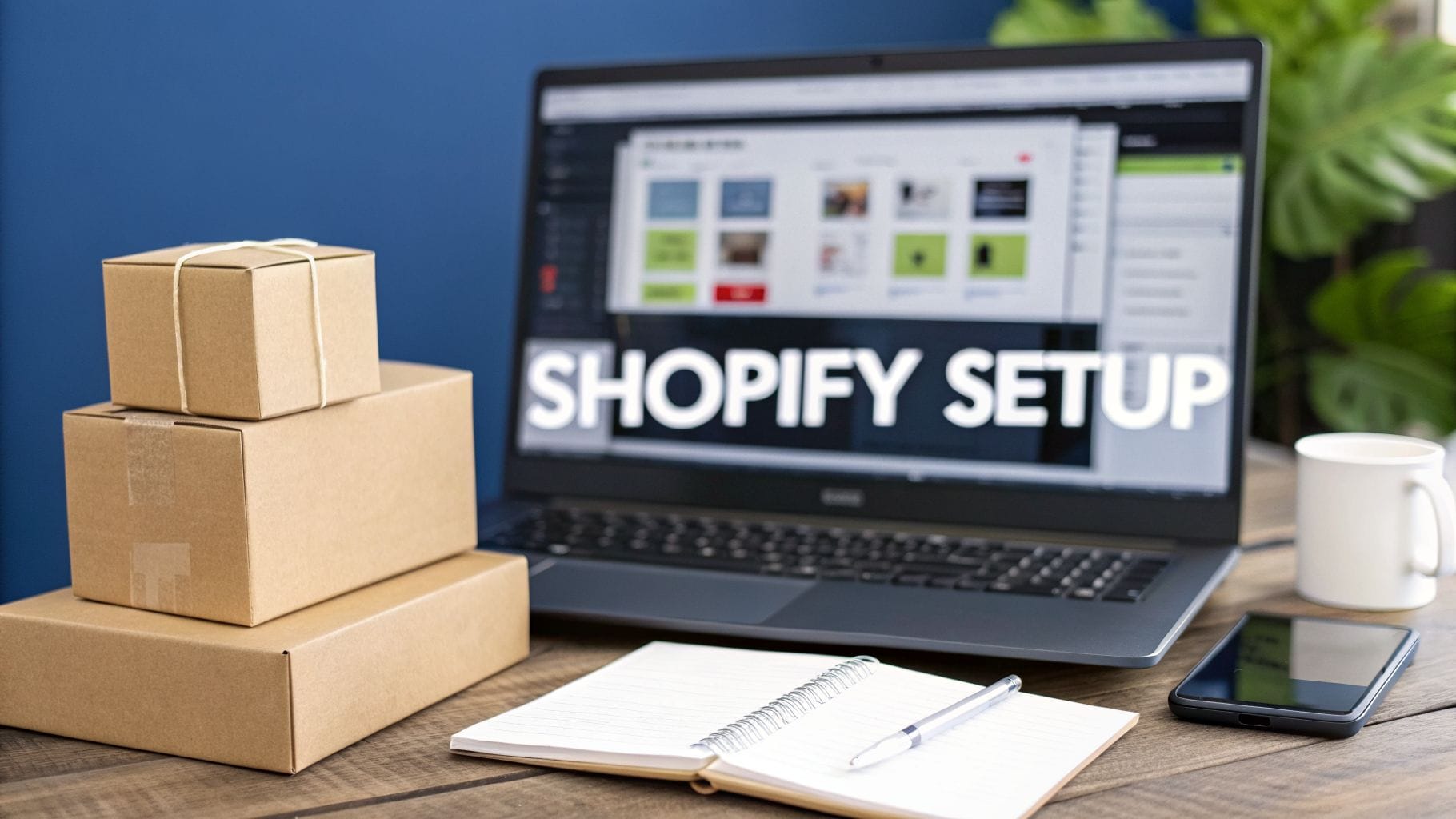
Before you even think about picking a Shopify theme or adding a single product, there’s some critical groundwork to do. Diving straight into the technical setup is a common mistake, but your success really hangs on the strategic decisions you make right at the start. This initial planning shapes your brand, your product sourcing, and your entire marketing approach.
Building Your E-commerce Foundation Before Day One

It’s easy to get swept up in the excitement of starting an online business and jump right into the tech side of a Shopify store setup. I’ve seen it countless times. But the businesses that truly last are the ones built on a solid strategic foundation, long before the first product is even listed. This pre-launch phase is what often separates a thriving UK business from a project that fizzles out.
Let's be honest about the reality of e-commerce. It's a tough market. While over 11 million stores have been launched globally, the churn rate is incredibly high. In fact, 70% of e-commerce stores fail in their first year, and only about 10% make it past the first 90 days. To succeed here in the UK, you have to make smart, informed decisions from day one.
Define Your Niche and Business Model
First things first: you absolutely must decide what you're selling and how you're going to sell it. Are you a self-storage operator in Manchester wanting to sell packing supplies to your local customers online? Or maybe you're an artisan in Bristol crafting bespoke jewellery? Your specific niche will steer every other decision you make.
Once you’ve got that clarity, it’s time to pick a business model that fits your resources and ambitions. Generally, you're looking at one of these main routes:
- Creating Your Own Products: This gives you total control over quality and branding. The trade-off? It requires a much bigger upfront investment in production and holding stock.
- Dropshipping: You act as the storefront, selling products from a third-party supplier who manages all the shipping. It’s a low-cost way to start, but your profit margins will be thinner and you have less control over the customer experience.
- Digital Products or Services: Think e-books, online courses, or consultancy. This model completely removes the headache of inventory and shipping.
The path you choose here will directly impact your whole setup, from the Shopify theme you select to the apps you'll eventually need. To make sure you get this foundation right, it's worth following a complete growth blueprint for starting a Shopify store to cover all your bases.
Analyse Your Competitors Effectively
Here’s a common pitfall: only looking at what your competitors sell. A much smarter move is to dig into how they sell. You're looking for the gaps in their strategy, the places where you can do better.
Don't just browse a competitor's site, become their customer. Go through their entire checkout process. Take note of their shipping costs, see what their follow-up emails look like, and test their customer service response times. This is where you'll find their weaknesses and your opportunities.
For example, maybe a competitor has brilliant products but their delivery is painfully slow. You can immediately gain an edge by offering faster, more reliable shipping with Royal Mail. Or if their product descriptions are dry and boring, you can write compelling stories that truly connect with your buyers.
This deep dive gives you a clear roadmap for standing out. Plus, a great brand story is the cornerstone of effective content marketing, which will help you attract and keep customers for the long haul.
2. Your Initial Shopify Account and Store Configuration
With your game plan in hand, it’s time to roll up your sleeves and dive into the Shopify platform. This is where the ideas from your notebook start turning into a real, functional online store. Getting the initial account setup right is one of those non-negotiable steps. Honestly, a few minutes spent here can save you from massive headaches with payments and taxes down the line.
First things first, you’ll sign up for your free trial. This gives you a risk-free playground to get a feel for how everything works before you commit. As part of this, you’ll be prompted to choose a Shopify plan, but there’s no need to rush that decision.
Choosing the Right Shopify Plan
The plan you pick should be a direct match for your business goals right now. For most new UK businesses, it usually boils down to two options:
- Basic Shopify: Perfect for start-ups or if you're just dipping your toes in the water with a new product idea. If you’re a self-storage operator wanting to sell some packing supplies online for the first time, this plan has all the essentials to get you launched and making sales without a big monthly outgoing.
- Shopify: This is the go-to for businesses that are ready to scale. Once your sales start picking up, the lower transaction fees on this plan often make it more cost-effective than the Basic plan, even with the higher monthly cost. It also unlocks better reporting features, which are gold for figuring out what’s working and what’s not.
Think of it this way: ‘Basic’ is for proving your concept works, while ‘Shopify’ is for hitting the accelerator. You can always upgrade later as you grow, so starting with Basic is a smart, safe bet for most. If you want a really detailed walkthrough of these first few steps, following a comprehensive Shopify store tutorial can be a huge help.
Configuring Core Business Details
Once you've picked a plan, you'll land on your main Shopify dashboard. I know the temptation is to jump straight into making things look pretty with themes, but your first port of call should be the 'Settings' cog in the bottom-left corner. This is your store’s command centre.
Head straight to 'Store details'. This is where you’ll plug in the foundational information that Shopify needs for legal and communication purposes.
Key Fields to Complete Immediately:
- Store Name & Legal Name: Your store name is what customers see. The legal name needs to match your official registered business details.
- Store Industry: This helps Shopify tailor its advice and show you relevant benchmarks.
- Store Address & Contact Information: This is often a legal requirement and builds a massive amount of trust. It will show up on your invoices and email notifications.
- Store Currency: For a UK business, set this to Pound Sterling (GBP). This is a huge one. Once you make your first sale, changing this becomes a real pain. Getting it right from the start means customers see prices they understand and you avoid any currency conversion dramas.
Getting your legal name, address, and currency correct from day one is non-negotiable. Shopify Payments and other gateways use this information for verification, and any mismatch can lead to frozen funds or a complete failure to process payments.
Setting Up Staff Accounts and Permissions
Even if you’re a one-person show right now, it’s worth getting your head around staff accounts. As you grow, you might bring on a virtual assistant to manage orders or a content writer for your blog. Handing over the keys to the kingdom with full admin access is a major security risk.
Shopify lets you create staff accounts with limited access. The key thing to realise, though, is that some permissions are quite broad. For example, giving someone access to 'Blog posts and pages' also lets them edit your static website pages, like your 'About Us' or 'Contact' page.
Unfortunately, Shopify doesn’t have a super-granular permission just for blog posts. A common workaround, if you need to give someone access only to write articles, is to have them draft the content in Google Docs. An admin can then copy it over and publish it. It’s an extra step, but it keeps your core site pages secure. For most other jobs, like order fulfilment or theme customisation, the built-in permissions work perfectly well.
Designing a Store That Converts Visitors

Your store’s design isn't just about picking pretty colours and fonts; it's your single most powerful sales tool. A brilliant design guides visitors seamlessly from the moment they arrive to that final, satisfying click at checkout. Getting this right is a fundamental part of a successful Shopify store setup.
Think of your theme as the digital blueprint for your shop floor. A cluttered, confusing layout in a physical store sends customers straight for the exit. The same logic applies online – if visitors can’t find what they’re looking for fast, they’ll simply leave.
Your first major decision is choosing a theme. Shopify offers an excellent range of free and paid options, and the right choice really boils down to your brand, your products, and your budget.
Shopify Free vs Paid Themes: A Practical Comparison
It’s easy to get drawn in by a flashy, feature-packed paid theme, but don’t underestimate the power of Shopify's own free options. I’ve seen countless businesses build stunning, high-revenue stores using them. They’re well-coded, mobile-friendly, and fully supported by Shopify itself, which is a huge plus.
To help you decide, here’s a quick breakdown of what you can realistically expect from each.
| Feature | Free Themes (e.g., Dawn) | Paid Themes (e.g., from Theme Store) |
|---|---|---|
| Cost | Completely free. | Typically a one-off fee of £150 – £350. |
| Best For | Start-ups, brands with a clean, minimal aesthetic, and businesses testing the waters. Also perfect for B2B suppliers or companies with a small product catalogue. | Stores needing advanced features out of the box, unique layouts, or a highly specific design. Great for high-volume fashion or lifestyle brands. |
| Features | Includes all core e-commerce essentials: product pages, collections, a blog, and a secure checkout. Everything you need to get started. | Often packed with built-in extras like mega menus, advanced product filtering, and countdown timers, which can reduce your reliance on paid apps. |
| Support | Supported directly by the Shopify team. You get reliable, consistent help when you need it. | Supported by the third-party theme developer. The quality and speed of support can vary significantly between developers. |
Honestly, for most new businesses, a free theme like ‘Dawn’ is more than enough to get going. It’s clean, incredibly fast, and provides a brilliant foundation. A paid theme only really makes sense when you've identified a specific feature you absolutely must have, one that would otherwise require multiple costly apps to replicate.
Customising Your Theme for Your Brand
Once you’ve settled on a theme, the real fun begins in the Shopify theme editor. This is a brilliant, user-friendly tool that lets you mould the theme to fit your brand identity without touching a single line of code.
Here, you can easily tweak colours, upload your logo, and change fonts. My advice? Don't go overboard. The goal is clarity and building trust, not creating a kaleidoscope of clashing colours. A simple, consistent brand identity always looks more professional.
Stick to two or three primary colours and a couple of clear, legible fonts. Consistency is key.
Pro Tip: I can’t stress this enough: your theme’s performance directly impacts sales. A slow site frustrates users and will absolutely hurt your search rankings. Always prioritise speed. Before you start installing lots of apps or uploading huge, unoptimised images, it's worth learning how to improve website loading speed to keep your store snappy from day one.
Creating Navigation That Sells
Your navigation menu is your store's roadmap. If customers get lost, they won't buy. Simple as that. The trick is to put yourself in your customer’s shoes and make your menus completely intuitive.
Let's say you're a fashion brand. Your main menu shouldn't be a random jumble of product types. Instead, organise it logically:
- Main Menu: New In, Womens, Mens, Accessories, Sale
- Womens Drop-Down: Dresses, Tops, Trousers, Skirts
- Accessories Drop-Down: Bags, Jewellery, Scarves
This simple structure helps shoppers find exactly what they’re looking for in just a couple of clicks.
The principle is the same no matter what you sell. If you’re a B2B supplier, you might organise the menu by product category or the industry it serves. Whatever your business, the goal is always to reduce the number of clicks it takes to get from the homepage to a product. Make it effortless.
Want a free audit like this for your own site?
We'll show you exactly what's holding your rankings and conversions back. No sales pitch.
Get My Free AuditAdding Products and Building Your Catalogue

Alright, your storefront is looking sharp. Now for the most important part: filling those digital shelves. This is where your business really takes shape, moving from a concept to a tangible place where people can shop. Your products are the heart of your operation, but how you present them is what will turn a casual browser into a paying customer.
Simply listing a product name and price won't cut it. We need to create product pages that tell a story, answer questions before they’re even asked, and build an undeniable sense of value. Let’s get into the nitty-gritty of building a product catalogue that doesn’t just look professional, but is built from the ground up to sell.
Crafting Product Titles and Descriptions That Sell
Think of your product title as a headline. It's the first thing a customer sees on your site and, crucially, in Google search results. It needs to be crystal clear, descriptive, and packed with the keywords real people use when they're looking to buy. Resist the urge to be overly clever with names that mean nothing to a first-time visitor.
For instance, "Red Jumper" is okay, but it’s not working hard enough. A much better title is "Women's Merino Wool Crewneck Jumper in Poppy Red". It’s specific, informative, and captures all the key details a shopper needs.
Your product description is your 24/7 salesperson. Its job is to close the gap between seeing a product on a screen and imagining it in real life.
- Focus on Benefits, Not Just Features: A feature is what a product is (e.g., "100% waterproof fabric"). A benefit is what it does for your customer (e.g., "Keeps you completely dry and comfortable on your rainy commute"). Always translate features into benefits.
- Use Short Paragraphs and Bullet Points: Break up your text. No one wants to read a wall of text on a product page. Make it easy for people to scan and find the information they need quickly.
- Anticipate Their Questions: Imagine a customer standing in front of you in a shop. What would they ask? Include details on sizing, materials, care instructions, and what’s in the box.
Managing Product Media and Variants
High-quality product photography isn't a luxury; it’s an absolute necessity in e-commerce. It’s the closest your customer can get to physically touching your product. You don't need a fancy studio, a modern smartphone, good natural light, and a clean background can give you fantastic results.
Now, let's talk about variants. This is how you handle a single product that comes in different sizes, colours, or materials. Shopify makes this incredibly simple. When you add a product, you’ll find the ‘Variants’ option. You can define the different attributes (like "Size" and "Colour"), and Shopify will automatically create all the possible combinations for you.
Here's a pro tip for a smooth Shopify store setup: Assign a unique image to each variant. When a customer clicks on a different colour, the main product image should instantly switch to show that specific version. This removes any guesswork and massively improves the shopping experience.
Organising Your Products with Collections
Once you've added a few products, you need to organise them. That's where collections come in. Think of collections as the different aisles or sections of your shop; they group related products together and are the backbone of your store's navigation.
Shopify gives you two ways to create them:
- Manual Collections: You hand-pick exactly which products belong in the group. This is perfect for small, curated sets like a "Founder's Favourites" or a seasonal promotion.
- Automated Collections: You set up rules, and Shopify automatically adds any product that meets your criteria. This is a huge time-saver for larger inventories. For example, a gift shop could create an automated collection for "Gifts Under £30" by setting a simple rule based on product price.
Using a smart mix of both types will help you build a logical and enjoyable browsing experience. A well-organised store guides customers to discover more products, which often leads to them buying more. Don't underestimate the power of a clear structure.
6. Sorting Out Payments, Shipping, and Taxes in the UK
Alright, you've got your products looking great. Now for the nuts and bolts: getting paid and getting your products to your customers. This is where we wire up the checkout – the part of your store that turns a 'maybe' into a sale.
A clunky or untrustworthy checkout is a deal-breaker. We need to make it seamless. This part is less about flair and more about getting the details right to avoid abandoned carts and build trust from the very first order.
Getting Paid: Activating Your Payment Options
The easiest way to start taking money is with Shopify Payments. It's already built-in, takes just a few clicks to activate, and handles all the major credit and debit cards. For most new shops, this will be your go-to.
But don't stop there. Relying on a single payment method is a rookie mistake. You want to give people choices they already know and trust.
- PayPal: It's a household name. So many shoppers have an account and feel safer using it than typing in card details on a new site. Adding PayPal can give your store an instant credibility boost.
- Buy Now, Pay Later (BNPL): Think Klarna or Clearpay. These have become incredibly popular, especially if you're selling items with a higher price tag. They let customers spread the cost, which can often nudge them to hit 'buy' and even increase how much they spend.
Think of it this way: Shopify Payments is your main till, while PayPal and Klarna are like express lanes for different shoppers. In the UK's massive e-commerce market, projected to hit a staggering $871 billion by 2026, offering these options is just smart business. You'll be in good company, too; there are already 244,694 live Shopify stores in the UK. You can dig into more Shopify growth stats at ecommercetrix.com.
Setting Up UK Shipping That Sells
Shipping can make or break a sale. Unexpectedly high shipping costs are the number one reason people abandon their carts. Your mission here is to be upfront, fair, and, if you can, use shipping as a marketing tool.
Pop over to Settings > Shipping and delivery. This is where you'll set up your 'shipping zones'. If you're only selling within the UK, you'll create one zone for the United Kingdom and then add your rates.
A Few Proven Shipping Strategies for UK Stores:
- Keep It Simple with Flat-Rate Shipping: Charge one fixed price for delivery, like £4.95 for Royal Mail 48. It's straightforward and customers know exactly what to expect.
- Use a Free Shipping Threshold: This is a classic for a reason. Offering "Free Royal Mail 24 on orders over £50" is a powerful incentive for customers to add just one more item to their basket.
- Offer Local Delivery: This is a brilliant option if you're a local business. For example, a self-storage firm selling packing materials could offer a cheap or even free delivery service within a specific postcode radius. It's a fantastic way to serve your local community.
Don't just pluck a number out of the air for your shipping costs. Grab a Royal Mail price guide or use your courier's online calculator to work out what it'll actually cost you. The goal is to cover your expenses, not to profit from postage.
Handling UK VAT the Right Way
Finally, let's get your taxes in order. In the UK, that means dealing with Value Added Tax (VAT). Sorting this out properly from day one will save you a world of accounting pain later.
Head to Settings > Taxes and duties. This is where you'll tell Shopify how to handle VAT. If you aren't VAT registered yet, you just need to make sure your settings reflect that you're not charging it.
The game changes once your turnover hits the government's VAT threshold (currently £90,000 over any 12-month period). At that point, you're legally required to register for VAT. Once you're registered, you simply enter your VAT number into Shopify. The platform then takes over, automatically adding the standard 20% VAT to your prices for UK customers.
Getting this configuration right ensures your invoices are legally sound and your financial reports are accurate. It's a quick administrative task that provides crucial protection for your business down the line.
Getting ready to hit that ‘publish’ button is a genuinely exciting moment. But before you do, there are a few final, but absolutely critical, steps to take. These are the details that separate a standard Shopify store setup from a professional business ready to grow from day one. Let’s make sure you launch with a bang.
The very first thing to sort out is your domain. Your default your-store-name.myshopify.com URL works, but it doesn't exactly build confidence. Investing in a custom domain like yourbrand.co.uk is one of the smartest, simplest things you can do. It immediately makes your store look more credible and trustworthy to potential customers.
Getting the On-Page SEO Basics Right
Before you can make a sale, people need to be able to find you. That’s where Search Engine Optimisation (SEO) comes in, and getting the basics in place from the start is non-negotiable. This tells search engines like Google what your shop is all about, so they can start sending the right kind of visitors your way.
For every single page and product on your site, focus on these three things:
- SEO Title: This is the big blue link people see in Google search results. Keep it clear, include the product name, and maybe a key selling point.
- Meta Description: This is the little snippet of text underneath the title. While it doesn't directly affect your ranking, a compelling description is your sales pitch to get someone to click on your link over a competitor's.
- Image Alt Text: This is just a short, descriptive line of text for your images. It’s crucial for visually impaired users and also helps your products show up in Google Image searches.
Nailing these fundamentals is the foundation for attracting free, organic traffic. If you're ready to go a bit deeper, our guide on e-commerce SEO best practices lays out a more comprehensive strategy.
Must-Have Apps and Final Checks
One of the best things about Shopify is its vast app store. It's easy to get carried away, but I always advise clients to start lean to keep the site fast. Focus on the essentials first.
A little insider tip: Shopify doesn't have great built-in blog analytics. You can see your overall traffic, but you won't know which posts are actually resonating with readers. The best free fix for this is integrating Google Analytics 4 (GA4) so you can track views and engagement for each article.
Before you even think about launching, make sure these apps are installed:
- Google & YouTube: The official app from Google. It's the easiest way to sync your products with Google Merchant Center and get your Google Analytics set up correctly.
- An Email Marketing App: Whether you choose a platform like Klaviyo or Mailchimp, you need a way to collect customer emails from the moment you go live.
- A Product Review App: Tools such as Judge.me or Loox are fantastic for building social proof. Positive reviews are one of the most powerful trust signals you can have.
Once your essential apps are in place, it’s time for a final, thorough once-over. Go through your store with a fine-tooth comb. Click every link. View it on your mobile phone. And most importantly, place a test order. Go through the entire checkout process yourself to catch any last-minute snags. This is your final opportunity to ensure that your very first customer has a perfect experience.
Got a Few Lingering Questions?
It's completely normal to have a few questions buzzing around as you get ready to hit the launch button. Having guided countless businesses through this exact process, I've found a few common queries pop up time and time again. Let's tackle them head-on so you can move forward with confidence.
What’s the Real Cost of Setting Up a Shopify Store in the UK?
This is the big one, isn't it? Your starting costs really boil down to a few key decisions. Your main, recurring expense will be your Shopify subscription itself, with the 'Basic' plan being a great starting point at around £25 per month.
Beyond that, here’s a realistic breakdown of what you should budget for:
- Your Custom Domain: A professional
.co.ukor.comdomain is non-negotiable for brand credibility. You’re looking at about £10-£20 a year. A small price for a professional look. - A Premium Theme: You can definitely start with a free theme, but a paid one often provides better design and more built-in features. These are a one-time purchase, typically ranging from £150 to £350.
- Essential Apps: It's easy to get carried away here. My advice? Start lean. Only add apps that solve a genuine problem for you or your customers, and be mindful that many have monthly fees.
Factoring these costs in from day one means you won't face any nasty surprises down the line.
Do I Honestly Need to Know How to Code or Design?
In a word: no. And that's the beauty of Shopify. It was built from the ground up for people who want to sell things, not for web developers.
The drag-and-drop editor is surprisingly powerful. You can change colours, fonts, and page layouts without seeing a single snippet of code. For the vast majority of new businesses, the tools Shopify provides are more than enough to build a store that looks slick, professional, and is ready to make sales.
How Long Does This Actually Take?
This really depends on how prepared you are. I've seen clients with all their branding, photos, and product descriptions ready to go get a beautiful, simple store live in a weekend. That's not an exaggeration.
However, if you're starting from scratch with a large inventory or need to create a lot of content, it’s far more realistic to give yourself a few weeks. The key to a speedy setup isn't rushing; it's being organised. Following a clear plan, like the one we've outlined in this guide, is the quickest path from A to B.
The single biggest mistake I see new store owners make? They build a beautiful shop and then wait for customers to magically appear. A great-looking store is pointless without visitors. Focusing on marketing and SEO from the moment you launch isn't just a good idea, it's the only way to survive and thrive.
If your Amax Marketing needs a guiding hand to master SEO and pull the right kind of traffic to your new Shopify store, our team is ready to help. Get your complimentary marketing audit and let's find your hidden growth opportunities.