


A PPC account isn't healthy because campaigns are live, impressions are flowing and clicks keep arriving. Plenty of weak accounts stay active for months while wasting budget on poor queries, misreporting conversions and sending buyers to pages that can't close the gap between interest and action. The most popular advice about a PPC audit checklist often starts too low down the stack. It jumps straight to bids, ad strength or asset groups before proving whether the measurement is trustworthy.
That order causes expensive mistakes. If conversion tracking is broken, a team can scale the wrong campaigns. If search terms are vague or mismatched, more spend buys more low-intent traffic. If the landing page offers the wrong message, even strong ads can create the illusion of demand while enquiries stay weak. A useful PPC audit checklist works more like an operating system than a platform settings review. It validates measurement first, then tests whether spend reaches commercially relevant searches, then checks whether the post-click journey can convert.
That matters even more in UK search because budgets are concentrated there. Search accounted for 44% of total UK digital ad spend, or £17.9bn, in 2025 according to this UK benchmark summary. An audit should therefore spend most of its energy where most of the budget risk sits.
For self-storage operators, the commercial picture is usually local demand, occupancy pressure, enquiry quality and route-to-site convenience. A click from the wrong town, on the wrong unit type, at the wrong stage of need can distort decisions fast. For resource-constrained SMEs, the problem is different but just as sharp. There's less room for testing, less tolerance for tracking errors and fewer chances to absorb wasted spend.
The end product shouldn't be a spreadsheet full of observations. It should be a decision scorecard with owners, evidence, impact, effort and deadlines.
Table of Contents
- 1. PPC Geeks
- 2. Account Structure and Campaign Organization
- 3. Keyword Research and Relevance Analysis
- 4. Quality Score Optimization
- 5. Ad Copy and Creative Performance Analysis
- 6. Landing Page Experience and Conversion Rate Optimization
- 7. Bid Strategy and Budget Allocation
- 8. Negative Keywords and Search Term Management
- 9. Audience Targeting and Remarketing Strategy
- 10. Conversion Tracking and Attribution Analysis
- 11. Competitive Analysis and Market Positioning
- 11-Point PPC Audit Comparison
- Turn Audit Findings Into a Fix-First Roadmap
1. PPC Geeks
Some businesses don't need another template. They need an outside team that can inspect an account without inheriting its assumptions. That's where PPC Geeks fits well. It's a UK specialist agency focused on paid media across Google Ads, Microsoft Ads, Meta and Amazon, and its free pay-per-click audit is most useful when a business suspects waste but can't yet prove where it sits.
That distinction matters. A strong audit partner shouldn't just point at weak click-through rate or broad campaign clutter. It should connect those findings to commercial consequence. Which campaigns create low-quality leads. Which locations consume budget without bookings. Which conversion actions are inflating platform signals. Which landing pages break trust after the click.
Where PPC Geeks is the right fit
PPC Geeks is strongest when the account is already active, spend is meaningful to the business, and internal teams don't have time to rebuild structure, tracking and reporting properly. That's common with SMEs where one marketing manager handles paid search alongside email, website updates and reporting, and with e-commerce brands where feed issues, remarketing gaps and attribution noise overlap.
For self-storage operators, the value is less about abstract optimisation and more about practical control. A location-led account can look tidy while still mixing town intent, unit size intent and short-term versus long-term demand into the same campaigns. An external audit can isolate whether spend is supporting occupancy and enquiry quality by site.
Practical rule: If a business can't clearly explain how Google Ads conversions connect to calls, forms, booked visits or sales in the CRM, the audit should start outside the campaigns and work inward.
Strengths and trade-offs
The main advantage of using a specialist agency for audit work is pattern recognition. A team that audits accounts every week usually spots hidden duplication, confused match-type strategy, weak tracking hierarchy and reporting theatre faster than an in-house generalist. PPC Geeks also covers adjacent areas such as landing pages, feeds and ongoing strategic reviews, which matters because many PPC problems aren't bid problems.
The trade-off is straightforward. An external audit only creates value if the business is willing to act on uncomfortable findings. That might mean changing naming conventions, replacing legacy campaign structures, redefining conversions or challenging an agency setup that still reports well on paper.
Useful signals to look for in the audit output include:
- Measurement proof: Evidence that forms, calls, purchases and offline outcomes are tracked in a way the business can verify independently.
- Waste ranking: A clear list of where spend is being lost first, not a generic sweep of every account setting.
- Remediation path: Actions grouped by urgency, commercial impact and implementation effort.
- Ownership clarity: Whether fixes belong to PPC, web, CRM or management, rather than being left as abstract recommendations.
For busy SMEs and self-storage brands that need diagnosis before expansion, that's often the right level of support.
2. Account Structure and Campaign Organization
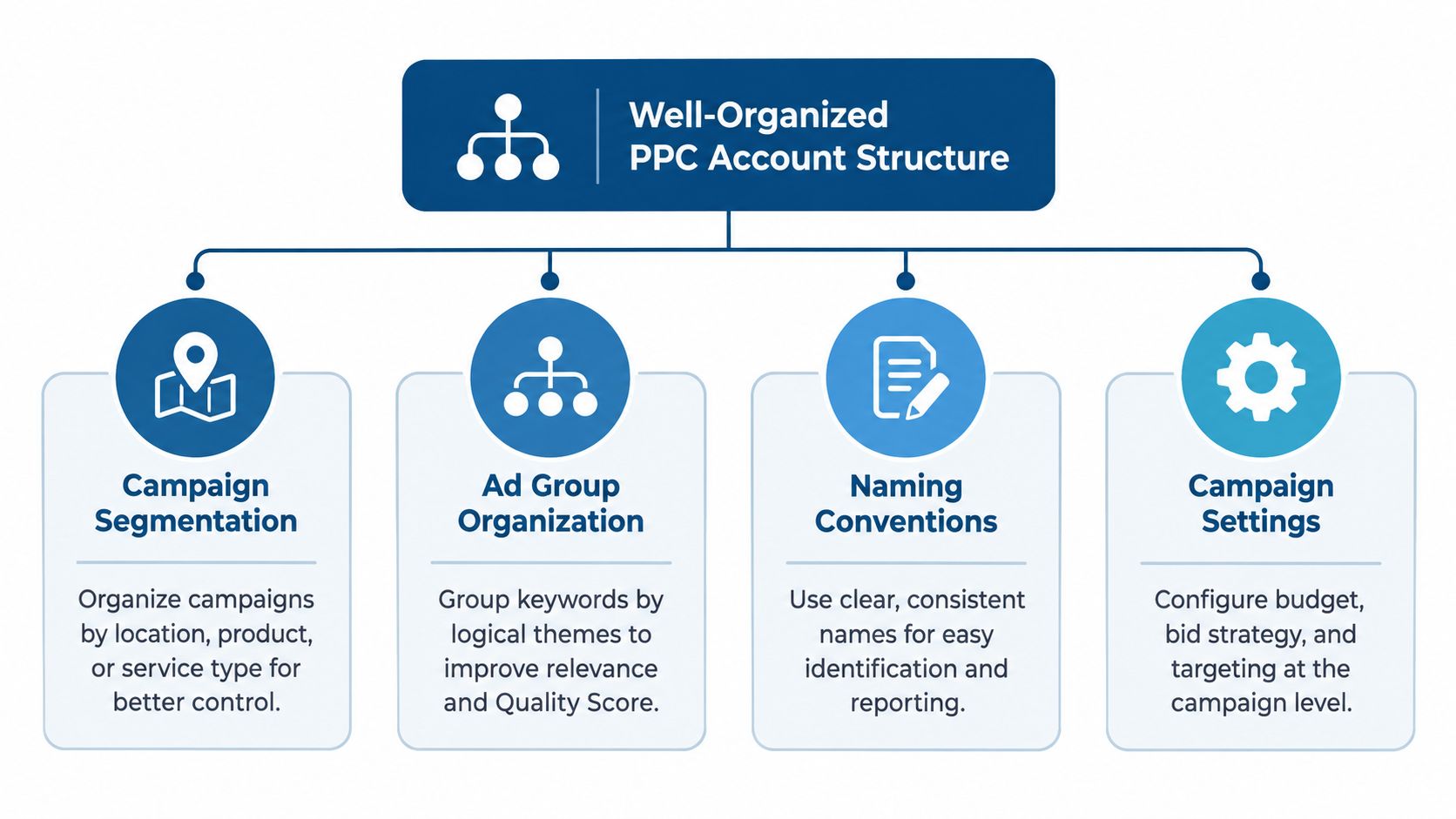
Bad structure hides waste. It blurs intent, mixes locations, distorts reporting and makes optimisation look harder than it is. In UK advertising, search accounted for two in five pounds spent on advertising in 2024, with search spend rising to £16.9bn according to the Advertising Association's UK spend report. That's why structure shouldn't be treated as admin. It controls how effectively a business manages one of the country's most heavily funded channels.
A useful PPC audit checklist tests whether campaigns are segmented by real commercial differences. For self-storage, that usually means location, service type, brand versus non-brand and sometimes urgent need versus research intent. For SMEs with varied services, it often means separating high-margin terms from general awareness terms, rather than bundling everything into one automated campaign.
What to verify
Three checks reveal most structural problems quickly:
- Campaign logic: Campaigns should reflect how budget decisions are made, such as by branch, product line or lead value.
- Ad group discipline: Ad groups should hold tightly related themes, not broad collections of loosely connected keywords.
- Naming control: Names should make reporting readable without opening every settings panel.
When those basics are weak, the commercial consequence is simple. Teams can't tell which budget cuts or increases are safe.
A campaign structure is good only if someone can pause, scale or diagnose it without guesswork.
What usually works and what doesn't
What works is segmentation that mirrors buying behaviour. What doesn't is segmentation built around platform convenience. Many accounts still group multiple services, towns and intent levels into one structure because it launched faster. That approach creates blended data, and blended data usually protects underperformance.
For self-storage operators, a practical scorecard can rank each campaign against four questions: Is the geography clean, is the intent consistent, is the budget decision isolated, and can the landing page match the campaign without compromise? If one answer is no, restructuring usually belongs near the top of the fix list.
Restructuring does carry risk. History fragments, learning periods reset, and performance can wobble if the rebuild is rushed. That's why the fix should be staged. Clone priority campaigns, preserve top-performing assets where they still fit, and move budget only when tracking and search term controls are in place.
3. Keyword Research and Relevance Analysis

Keyword selection often gets reviewed as a traffic issue. It's really a commercial filtering issue. The audit question isn't whether a keyword gets impressions. It's whether the search behind it deserves budget, fits the offer and can land on a page that converts.
That matters because UK cost-per-click behaviour varies sharply by intent. Broad UK averages cluster around £1.55 per click, competitive top-of-page keywords can reach £2.50 to £4.80, and long-tail terms often sit around £0.40 to £0.90 according to this UK PPC cost forecasting dataset. A PPC audit checklist shouldn't judge all keywords against one account-wide CPC target. That usually rewards the wrong terms.
Relevance beats volume
High-intent searches deserve different treatment from exploratory searches. For self-storage, “storage near [location]”, “student storage”, “business storage” and “climate controlled storage” can all require different ads, different landing pages and different budgets. For SMEs, the same pattern applies to branded, problem-aware and solution-aware queries.
The fastest way to audit keyword quality is to compare three things side by side: search term, ad copy and landing page promise. If the keyword suggests urgency but the page reads like a brochure, that click is already under pressure.
Useful audit checks include:
- Match type discipline: Broad, phrase and exact terms should serve different jobs, not duplicate one another.
- Intent separation: Research terms shouldn't borrow the same bids and landing pages as bottom-funnel terms.
- Landing-page alignment: Each priority cluster should point to a page that answers the exact query, not the nearest available page.
- Device review: Mobile keyword behaviour often looks different from desktop, especially for call-led local demand.
What to fix first
The first fixes usually aren't expansion moves. They're exclusions, regrouping and message alignment. Remove queries that keep spending without commercial relevance. Break mixed ad groups apart. Rewrite ads so they reflect the actual search. Then decide whether a keyword cluster still merits aggressive bidding.
That last point matters more now because AI-shaped results pages are changing click economics. Some exact-match terms may still convert, but they can also become structurally weaker if search layouts reduce the quality of available clicks. The audit should test whether expensive terms still justify ownership, not assume they do.
4. Quality Score Optimization
A lot of PPC audits give Quality Score too much attention in the wrong way. It is not a KPI to chase for its own sake. It is a triage signal. Used properly, it helps you find where the account is paying a relevance tax through higher CPCs, weaker ad positions, or clicks that were always unlikely to convert.
That makes this part of the audit operational, not cosmetic. Check measurement first so you are not fixing scores on keywords that only look weak because conversion tracking is incomplete. Then review Quality Score on the terms that absorb real spend or drive meaningful enquiries. A keyword with an average score and strong margins is rarely urgent. A high-spend term with poor expected CTR or landing-page experience often is.
How to audit it without wasting time
Start with your highest-cost non-brand themes. Pull Quality Score and its component ratings alongside spend, conversion rate and CPA or lead quality signals. The question is simple: is a low score creating a commercial problem, or is it just visible in the interface?
Use a basic priority filter:
- High spend plus low Quality Score: Review first. These terms may be inflating CPCs or losing impression share for preventable reasons.
- Low spend plus low Quality Score: Usually lower priority unless the theme is strategically important.
- Good conversion rate plus average score: Monitor, but avoid unnecessary restructuring that resets learning or fragments data.
- Poor landing-page experience on core terms: Escalate quickly. Post-click friction can suppress both Quality Score and conversion rate at the same time.
For SMEs, this often becomes a cost-control exercise. Small budgets feel wasted spend faster, so fixing weak relevance on a handful of expensive terms can create room for profitable traffic elsewhere. For self-storage operators, the pressure point is usually local generic demand, where several nearby providers compete on similar queries and a weak score can mean paying more for the same postcode traffic.
What each component usually means
Expected CTR problems often point to a market-facing issue. The ad is not competitive for that query, the offer is unclear, or the keyword sits in a theme that attracts mixed intent.
Ad relevance issues usually come from account design. Ad groups have broadened over time, search terms no longer fit the original theme, or one RSA is trying to speak to too many jobs at once.
Landing-page experience issues are more expensive than they look. If the page loads slowly, buries the answer, or sends storage users to a generic homepage instead of a unit-size or location page, you can lose both efficiency and conversion intent after the click.
Scorecard: observation to decision
Use a simple audit scorecard so Quality Score findings lead to decisions rather than a list of platform notes.
| Audit finding | Likely consequence | How to verify | Typical fix | Priority |
|---|---|---|---|---|
| High-spend keyword with below-average expected CTR | Higher CPCs or weaker ad rank | Compare CTR against close variants in the same intent group | Rewrite headlines around the actual query and offer. Tighten the theme if intent is mixed | High |
| Below-average ad relevance across a broad ad group | Spend leaking across loosely related searches | Review search terms and RSA asset fit by theme | Split the ad group by intent or service line | High |
| Below-average landing-page experience on commercial terms | Lower conversion rate and avoidable CPC premium | Check page match, load speed, mobile UX and message continuity | Route to a closer page. Improve page clarity and mobile usability | High |
| Low score on low-volume terms with acceptable CPA | Limited financial impact | Check spend share before changing structure | Leave in place or batch with later clean-up | Low |
| Score improved but CPA did not | Relevance improved without better commercial fit | Compare lead quality or downstream conversion rate | Reassess keyword intent and landing-page proposition | Medium |
Fixes that usually hold up
The best gains usually come from cleaner structure and closer message matching. Consolidate where data is too thin to learn, but split where intent is clearly different. Keep those trade-offs in view. Over-segmentation can make reporting look tidy while starving campaigns of data. Under-segmentation usually costs more in the auction and hides weak intent behind blended metrics.
Forced keyword insertion rarely improves relevance. It often makes ads read awkwardly and can reduce CTR instead of lifting it. Near-duplicate ads across broad themes create the same problem. The interface may look organised, but the user still sees a generic message.
For self-storage, practical fixes tend to be location pages that match the searched area, ad copy that reflects access or unit needs, and tighter separation between personal, business and student demand where volume supports it. For resource-constrained SMEs, the better route is usually narrower: fix the top spend themes, improve the pages they already have, and leave low-impact edge cases alone until the account stops wasting money on the basics.
5. Ad Copy and Creative Performance Analysis
Ad copy is where intent either gets sharpened or blurred.
A lot of audits treat ads as a copy test. That misses the commercial point. The job here is to check whether the message helps the account buy the right click at the right price, then pass that user to a page that can finish the job. If measurement is weak, ad testing results are weak as well, so sense-check lead quality before calling any ad a winner.
Responsive search ads make this harder because average performance can hide one bad asset set inside one good ad group. Review them at asset level and query level. Look for headlines that attract traffic without qualifying it, descriptions that repeat the same promise in different words, and pinned assets that force the account into narrow combinations with little room to learn.
A practical audit question is simple. Is the ad helping you spend money on likely buyers, or on curious searchers?
For self-storage operators, weak ads usually show up as broad local claims with no signal on branch, access, security, unit type or terms. That tends to lift clicks while dragging down enquiry quality, especially in dense local markets where several providers sound interchangeable. For resource-constrained SMEs, the cost shows up differently. Generic ads often inflate CPCs on expensive service terms, then leave the sales team sorting through low-intent leads the budget never had room to buy.
Use this check instead of another long list of ad-copy rules:
| Audit check | What it usually means | How to verify it | Fix first if true |
|---|---|---|---|
| High CTR, weak conversion quality | Ad promise is too broad or too easy to click | Compare search terms, lead quality and assisted actions by ad group | Add qualification, tighten CTA, remove vague claims |
| Low CTR, acceptable conversion rate | Message fits buyers but lacks salience in the auction | Review impression share, competitor messaging and asset variety | Improve differentiation before expanding traffic |
| Strong ad strength, weak business results | Platform recommendations improved format, not commercial fit | Compare asset report with downstream conversion data | Rewrite around buyer objections, not keyword repetition |
| Good results concentrated in one asset theme | One message angle is carrying the account | Check served combinations and pinned positions | Build a controlled test around that angle, pause weaker variants |
That scorecard turns observations into decisions. It also stops teams from rewriting everything at once.
The highest-value fixes are usually specific. Match the headline to the query type. Use the description to handle the next objection. Choose a CTA that fits the stage of intent. A search for “self storage near leeds station” needs different wording from “how much storage space do I need”. A search for “emergency plumber coventry” should not get the same ad logic as “boiler servicing prices”.
Extensions deserve the same standard. Sitelinks should reflect real decision paths, not filler. Callouts should add proof, constraints or reassurance. Call and location assets should support fast action where local intent is obvious. If every extension says roughly the same thing, they take up space without improving click quality.
If you want a reference point for how different ad angles work in practice, review these PPC ad examples and why they worked, then compare them against your own highest-spend themes rather than judging ads in isolation.
Two trade-offs matter here. Very tight qualification can improve lead quality but reduce volume. Broad benefit-led copy can raise CTR but waste spend if the landing experience or offer is weak. Audit decisions should rank those trade-offs by wasted spend, conversion impact and effort to fix.
For self-storage, start with the branches or location themes spending the most and check whether ads reflect the actual occupancy challenge. City-centre sites often need access and convenience. Outer-area sites may need price, unit flexibility or business use cases. For SMEs with limited time, rewrite the ads attached to the top-spend search terms first, keep one clear control ad live, and avoid large creative refreshes until tracking and lead-quality feedback are reliable.
6. Landing Page Experience and Conversion Rate Optimization

Want a free audit like this for your own site?
We'll show you exactly what's holding your rankings and conversions back. No sales pitch.
Get My Free AuditA landing-page audit should answer one commercial question first. Is paid traffic failing because the page is weak, or because the account is sending the wrong intent to the page in the first place?
That distinction matters because page changes are often used to hide a traffic problem. If broad, low-intent queries are landing on a service page, a cleaner form will not fix the economics. If high-intent traffic is arriving and dropping off, the page becomes a priority because every missed lead wastes media spend and weakens the conversion signals feeding bidding.
I treat this part of the audit as a decision filter, not a design review. Check measurement first so form submits, calls and key micro-conversions are recorded properly. Then review the path from query to ad to page to action. After that, score the fix by three factors: wasted spend, likely conversion lift and effort to implement.
Here is a practical scorecard:
| Audit check | What failure usually means | How to verify it | Fix priority |
|---|---|---|---|
| High-intent search terms bounce or rarely convert | Landing page mismatch or friction | Compare top search terms with bounce rate, engagement, call clicks and form starts | High |
| Good engagement but poor lead volume | CTA, form or offer problem | Session recordings, form analytics, call tracking and device split | High |
| Strong page metrics but weak lead quality | Wrong search intent or weak qualification | Check search terms, CRM outcomes and call notes | Medium to high |
| Mobile traffic underperforms sharply | Usability or speed issue | Test key pages on common devices and networks | High |
| Generic page used across unlike services or locations | Relevance diluted | Map top-spend ad groups to landing pages | Medium |
The fastest check is message match. A user who searches for a specific service, location or storage need should land on a page that confirms they are in the right place within seconds. If the first screen forces them to interpret the offer, hunt for the branch, or work out whether you cover their area, conversion rate usually drops before trust has even been tested.
For self-storage operators, this is often more operational than creative. Occupancy is won or lost on practical questions: branch location, access hours, unit sizes, security, introductory price, business storage suitability and how quickly someone can reserve or call. A generic national page can still generate clicks, but it often wastes spend for branches that need local intent turned into immediate enquiries.
For resource-constrained SMEs, the trade-off is different. Building a new page for every service variation is rarely realistic. Start with the pages tied to the highest-spend, highest-intent themes. If one page is serving multiple intents, tighten the headline, remove weak secondary actions, shorten the form and move proof higher before committing to a full rebuild.
Three audit findings usually deserve action before visual redesign:
Intent mismatch
The page does not answer the reason behind the query. Verify by comparing top converting and top spending search terms against landing pages. Fix it by routing distinct intents to more specific pages or by reducing traffic from weak-intent terms.Friction near the point of action
Users engage, then stall at the form, phone option or pricing step. Verify with form-drop data, call-click tracking and mobile testing. Fix it by removing unnecessary fields, making the primary CTA obvious and matching the CTA to the buyer's readiness.Weak proof at the moment of hesitation
The offer is clear, but the page does not resolve risk. Verify by checking pages with decent engagement and poor conversion. Fix it by surfacing reviews, guarantees, response times, accreditations or process clarity closer to the CTA.
A page does not need to be perfect. It needs to remove the next reason not to enquire.
That is why this part of a PPC audit should end with ranked actions, not observations. If a self-storage branch page is getting qualified local traffic but hides access details and pricing cues below the fold, that is a high-priority fix because it affects occupancy and can usually be improved quickly. If an SME service page converts poorly because it is attracting mixed intent, cleaning search terms may outrank CRO work. The audit is working properly when it turns landing-page issues into a fix-first roadmap rather than a list of design opinions.
7. Bid Strategy and Budget Allocation
Bid strategy should be judged like an operating decision, not a settings choice. The question is simple. Is the account buying the right clicks at a cost the business can carry, with enough control to shift budget where margin and capacity justify it?
Start with failure risk, not with bid type. If conversion tracking is thin, delayed or mixed across lead quality levels, automated bidding often chases the wrong outcome faster. I check three things before trusting any strategy: whether the primary conversion is commercially meaningful, whether volume is high enough for the strategy in use, and whether campaign segmentation is clean enough to let the algorithm learn from similar auctions.
That changes the audit priority.
A campaign using Maximise Conversions is not automatically a problem. A campaign using Target CPA is not automatically mature. The core issue is whether bidding logic matches business reality. Self-storage operators often need that reality mapped by branch. A site near full occupancy may need tighter coverage or higher efficiency targets, while a branch with empty units may justify broader reach if enquiry quality holds. Resource-constrained SMEs usually need the opposite discipline. Protect spend around the services, locations and device segments that produce sales, then relax control only where measurement is reliable.
I score bid and budget decisions on four checks:
- Measurement confidence: the conversion being optimised reflects revenue or qualified pipeline, not just form fills or page views
- Intent purity: the campaign groups together searches with similar commercial value
- Margin tolerance: the business can absorb the CPA or ROAS target being pursued
- Control need: local variation, sales capacity or cash flow requires tighter oversight than full automation allows
That scorecard turns an audit note into a decision. Keep, isolate, cap, or rebuild.
One common waste pattern sits above campaign level. Budget is technically available, but it is trapped in the wrong places. Brand protects itself, broad non-brand spends freely, and high-margin service campaigns lose impression share because nobody has ranked spend by commercial return. A business comparing likely search competition against current outlay can use Amax's guide on how much Google PPC costs as a planning reference, then test whether the account is funding the right campaigns rather than spending the full allowance.
Use a simple triage model during the audit:
| Finding | Commercial consequence | Verify | Fix |
|---|---|---|---|
| Smart bidding on weak or noisy conversion data | Spend scales faster than sales quality | Compare optimised conversions with closed sales, qualified leads, or booked move-ins | Tighten conversion actions, separate soft from hard conversions, then reassess bid strategy |
| One campaign mixes geographies with different economics | Bids rise or fall for the average, not for profitable locations | Segment performance by location, CPA, lead quality and close rate | Split geographies or apply location-specific targets and budgets |
| Budget favours volume over value | High-value campaigns lose coverage while weaker campaigns keep spending | Review impression share, lost IS by budget, and conversion value by campaign | Reallocate budget toward higher-margin or higher-capacity campaign groups |
| Manual bidding on stable, high-volume campaigns | Time is spent managing bids that could be handled more efficiently | Check conversion volume stability and auction consistency | Test automation in a controlled segment with clear success criteria |
The trade-off is straightforward. More automation reduces manual effort, but it also reduces visibility into why spend moved unless structure and measurement are already strong. More control improves diagnosis, but it can slow growth if teams are adjusting bids manually in campaigns that already have enough clean data to self-optimise.
For self-storage, I would usually rank budget moves against occupancy pressure and branch economics before platform recommendations. For SMEs, I would usually rank them against service margin, sales-team capacity and lead quality by source. If the audit cannot explain why one campaign should receive the next £500 of spend ahead of another, the bidding review is still too shallow.
8. Negative Keywords and Search Term Management
Negative keyword work decides whether paid search behaves like a controlled acquisition channel or an expensive research tool. I treat this part of the audit as intent triage. Which queries deserve budget, which belong in a different campaign, and which should be excluded before they distort performance signals for everything else?
The risk is larger than a few wasted clicks. Poor search term control inflates CPA, weakens lead quality, and trains automated bidding on traffic the business never wanted. Once that happens, the account starts making budgeting and bidding decisions on contaminated inputs.
A useful review starts with the search terms that spent money, not the negative list itself. Pull queries with cost, conversions, lead quality if available, and landing page used. Then sort them into decision groups:
| Query pattern | Commercial consequence | How to verify | Fix |
|---|---|---|---|
| Informational or DIY intent | Spend goes to research traffic that rarely becomes revenue | Check bounce rate, time on site, assisted actions, and sales outcome where available | Add negatives or move relevant terms into a lower-intent research campaign with tighter bids |
| Out-of-area searches | Branches or teams pay for demand they cannot serve profitably | Compare query location signals with service radius, branch coverage, or delivery area | Add location negatives, tighten geo settings, and split campaigns where local intent is being mixed |
| Product or service mismatch | Clicks look relevant in-platform but fail once the visitor reaches the page | Review search term language against actual offer and landing page promise | Exclude mismatched modifiers and tighten keyword themes |
| Low-value variants inside broad themes | Volume masks poor unit economics | Compare term-level CPA, lead quality, and close rate against campaign averages | Add negatives selectively and rebuild ad groups around clearer intent clusters |
That table matters because negatives are a ranking exercise, not a housekeeping task. Excluding a query that spent £12 and excluding a pattern that absorbs 18 percent of non-converting spend are not the same priority.
I also check whether the account is using negatives to compensate for weak structure. If one campaign contains removals, student storage, business storage, packing supplies, and van hire terms, the negative list becomes a fragile patch. The underlying issue is usually that intent categories were never separated properly. In that case, the right fix is structural first, negatives second.
For self-storage operators, the expensive mistakes are usually local and operational. Terms for the wrong town, searches for services the branch does not offer, and demand from customers looking for immediate availability when occupancy is already tight can all burn budget without adding useful enquiries. Audit those against branch capacity, minimum stay rules, and margin by unit type. A branch that is already near full occupancy should not keep paying for low-fit search demand just because the keyword looks relevant.
For resource-constrained SMEs, the pattern is often different. Support queries, existing-customer logins, free templates, salary searches, and broad educational terms drain spend that should have gone to commercially ready prospects. The fix has to respect time. Build a simple negative keyword scorecard and apply effort where the savings are real.
Negative keyword scorecard
- Wasted spend: How much cost has the query pattern consumed?
- Conversion risk: Has it produced poor leads, no leads, or leads that never close?
- Containment value: Will one negative block a wide set of bad variants?
- Implementation effort: Can it be fixed with a list update, or does it require campaign restructuring?
High spend, low lead quality, broad containment, low effort. Do that first.
One practical check catches a lot of problems quickly. Read the paid query beside the landing page headline. If the query implies a different need, audience, or location from the page, either the term should be excluded or the traffic needs its own route through the account.
Be careful with aggressive exclusions. Broad match and smart bidding can still surface profitable variants that were not obvious in keyword research. The answer is controlled exploration. Keep discovery in selected campaigns, review search terms on a schedule that matches spend velocity, and promote good variants into tighter ad groups before adding broader negatives elsewhere.
A strong audit output here is not a long list of blocked terms. It is a decision log that shows which exclusions reduce waste immediately, which findings point to a structure problem, and which queries deserve their own campaigns because the intent is real but currently mishandled. That is how search term management becomes part of the account operating system rather than a weekly cleanup task.
9. Audience Targeting and Remarketing Strategy
Audience targeting is often treated as a rescue tactic. In practice, it works better as a prioritisation layer inside an account that already matches query intent to the right landing page and conversion goal.
A useful audit question is simple. Does this audience setting help the business spend more on likely buyers, or is it masking a relevance problem elsewhere? Accounts with mixed-intent keywords often add audience overlays instead of separating commercial searches from research queries. The result is familiar: higher CPCs, thinner reach, and no clear improvement in lead quality because the core traffic problem was never fixed.
For that reason, audience review should be scored, not admired. If a segment cannot be tied to a commercial action, such as a bid adjustment, an exclusion, a different message or a separate landing-page route, it is usually account clutter.
The measurement problem inside audience strategy
Audience findings are only as reliable as the signals feeding them. If consent handling limits list growth, phone leads are missing, or CRM stages are not fed back into the platform, remarketing lists and customer match audiences can optimise around incomplete outcomes.
That matters more in smaller accounts. Resource-constrained SMEs usually have less traffic, smaller lists and fewer clean data points, so one tracking gap can distort a large share of audience performance. Self-storage operators face a different version of the same problem. Branch calls, reservation enquiries and walk-in conversions often sit outside the ad platform unless call tracking and offline imports are set up properly. An audience may look weak when the measurement is weak.
Use a short validation check before judging performance:
- List eligibility: Are remarketing lists large enough to serve consistently, or are they stuck below platform thresholds?
- Signal quality: Do lists reflect meaningful behaviour, such as pricing-page visits or quote starts, rather than any site visit?
- CRM match quality: Can customer lists be matched cleanly, with consent and formatting handled properly?
- Conversion loop: Are qualified leads, booked move-ins or sales statuses being sent back to inform bidding and exclusions?
What to assess
Audit audience strategy by asking what each segment is supposed to do in the operating system of the account.
- Prospecting support: Are in-market, custom or first-party audiences being used to refine already relevant campaigns, not to broaden weak ones?
- Remarketing logic: Are return visitors seeing a different offer, reassurance point or call to action based on their last meaningful visit?
- Exclusions: Are converted users, existing customers, job seekers and other low-value groups excluded where that improves spend control?
- Stage-based messaging: Does ad copy change for comparison-stage users versus ready-to-book users?
- Landing-page continuity: Does the audience promise match the page, especially for local intent, price sensitivity or urgent need?
For self-storage operators, the practical split is often by urgency and unit type. A user who viewed same-day access or a branch location page may justify a stronger call-focused experience than someone browsing general storage advice. For SMEs with limited time, keep it narrower. One clean remarketing list, one customer exclusion, and one high-intent audience test usually beats five half-maintained segments.
A simple scorecard helps turn findings into decisions:
- Wasted spend risk: Is this audience causing higher spend without better lead quality?
- Conversion impact: If fixed, is there a realistic chance of better close-rate, not just more clicks?
- Implementation effort: Can the change be made in-platform, or does it depend on CRM, consent or dev work?
- Confidence level: Is the underlying measurement good enough to trust the result?
Fix the combinations with high waste, high upside and low effort first. Leave advanced audience experiments until the account can measure them properly. That is how audience strategy supports the audit process as an operating system, rather than becoming another layer of settings with no commercial job.
10. Conversion Tracking and Attribution Analysis
Accounts rarely fail because a setting is missing. They fail because the account reports a conversion that the business would never pay for twice.
That is why measurement sits at the top of the audit operating system, even here in section 10. If the wrong actions feed bidding, every later judgement about keywords, budgets, ads and landing pages is weaker than it looks. A clean dashboard can hide expensive mistakes. Spam form fills, duplicate enquiries, misfired thank-you pages and unqualified calls all train the platform to buy more of the wrong traffic.
Start with a blunt question. Which recorded conversions map to revenue, qualified pipeline, or at least a sales outcome the business recognises? If there is no clear answer, pause optimisation work and verify the measurement chain first.
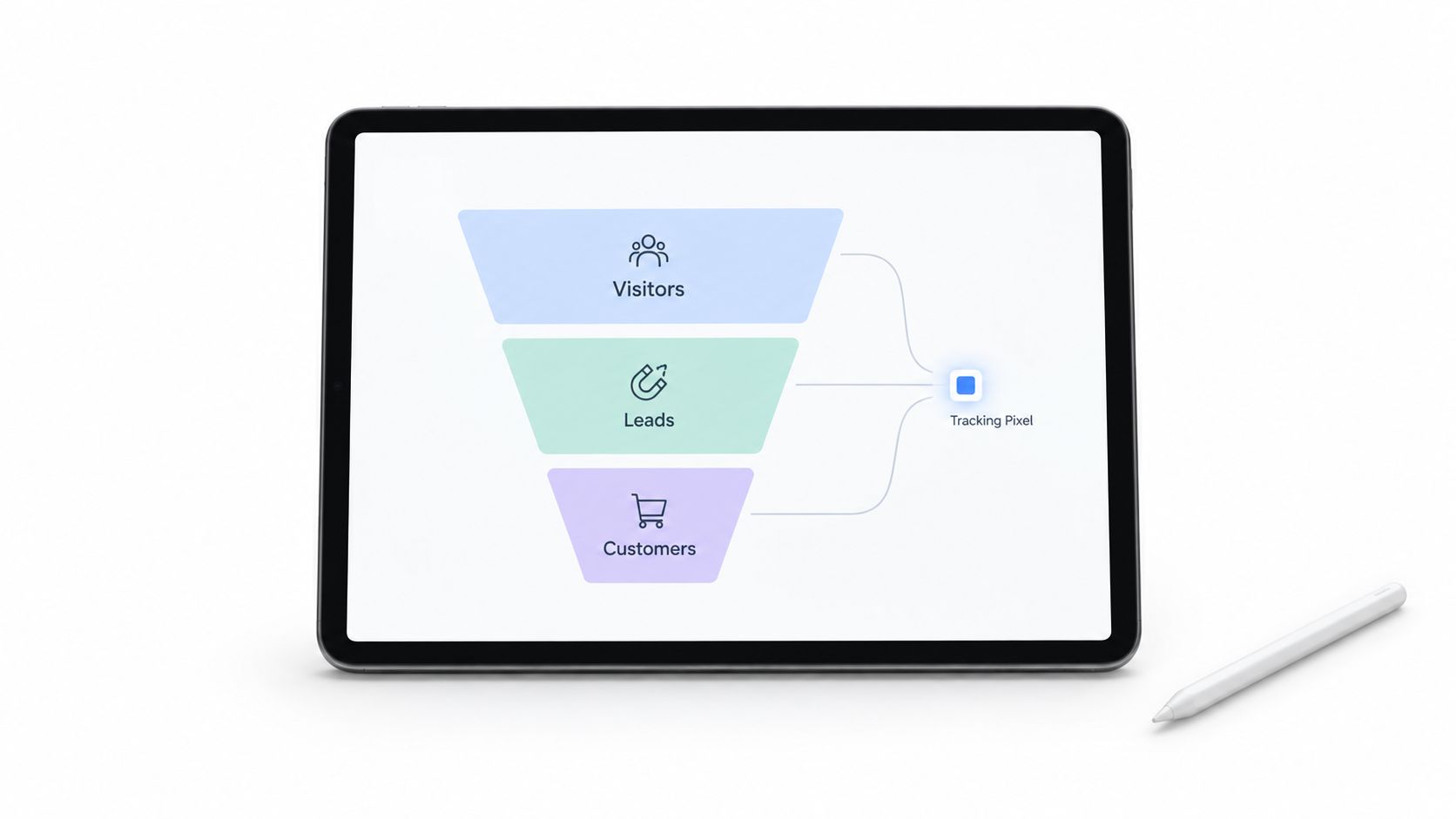
A useful review checks four layers in order:
- Collection: tags fire on the right pages and actions, with consent handled properly
- Definition: primary conversions reflect meaningful outcomes, not soft actions that inflate success
- Reconciliation: Google Ads, GA4 and CRM records line up closely enough to trust directional decisions
- Feedback: qualified leads, booked jobs or sales are passed back into the ad platforms where the sales cycle justifies it
The commercial consequence differs by business type. For self-storage operators, branch calls, reservation forms and location-specific enquiries often carry very different value. If all of them sit in one conversion bucket, budget tends to drift toward the easiest action to generate rather than the branch or unit type that produces profit. For resource-constrained SMEs, the common problem is simpler but just as costly. The account optimises to lead volume because that is what the platform can see, while the owner knows half those leads never turn into work.
Use this as a decision scorecard rather than a box-ticking exercise:
| Audit finding | Wasted spend risk | Conversion impact | Effort to fix | What to do |
|---|---|---|---|---|
| Soft conversions set as primary bidding goals | High | High | Low | Demote them to secondary and keep only revenue-linked or qualified lead actions as primary |
| Call tracking logs short or accidental calls as conversions | High | Medium | Low | Raise duration thresholds and review call source rules |
| GA4 and Google Ads counts differ materially with no explanation | Medium | High | Medium | test tags, attribution settings and import logic before changing bids |
| No offline conversion import for long sales cycles | Medium | High | Medium to High | pass back sales-qualified leads or closed revenue where volume supports it |
| Consent setup suppresses a large share of measurable conversions | Medium | Medium | Medium | review CMP behaviour, tag firing and consent mode configuration |
Verification needs manual work. Submit test forms. Ring tracked numbers. Check whether the thank-you page fires once or several times. Match a sample of leads in the CRM against what Google Ads claims happened on the same dates. Businesses that want a clearer view of commercial return usually need more than platform metrics alone, which is the point behind this guide on how to measure marketing ROI.
One warning matters here. Attribution reports can look precise while hiding bad inputs. A multi-touch model does not fix poor conversion definitions. It only distributes credit across them.
For self-storage, I would usually inspect branch-level routing, missed-call handling and whether same-day intent gets overvalued because calls are easier to trigger than completed reservations. For SMEs with limited admin capacity, a lighter version works well. Keep one or two primary conversion actions, review lead quality with sales each month, and import offline outcomes only after the basics reconcile.
Rank fixes in this order. First, remove false positives that waste budget. Second, improve the signals tied to real sales value. Third, add attribution sophistication only where the business can maintain it. That sequence keeps the audit commercial, not cosmetic.
11. Competitive Analysis and Market Positioning
A competitive audit should answer two commercial questions. Can this account win the right auctions at a sensible cost, and does the ad-to-page journey give buyers a clear reason to choose this business instead of the similar options around it?
Many PPC accounts review competitors too late. They tidy bids and ads first, then discover the market has changed underneath them. Search results pages now absorb more attention with AI summaries, map packs and stronger organic features. That changes the value of a paid click, especially on broad category terms. A recent UK perspective in this article on rising UK PPC costs argues that some affected terms are getting more expensive while offering less room to convert.
The audit job here is prioritisation, not observation. If measurement is already sound, review competitive pressure through three lenses: wasted spend, conversion impact and effort to fix. That turns auction insights into operating decisions instead of a general note that competitors look active.
I use a simple scorecard during this stage:
| Check | What to verify | Commercial consequence | Typical action |
|---|---|---|---|
| Auction pressure | Impression share, overlap, outranking, CPC trend by campaign or keyword cluster | Rising costs can erase margin on terms that still look busy on the surface | Reduce coverage, tighten match types, split out high-value terms |
| Message differentiation | Ad copy side by side with live competitors | Generic claims lower CTR and push more spend into the same enquiry volume | Rewrite around specific proof points, service model or local advantage |
| Landing-page proof | Whether the page supports the promise made in the ad | Weak proof forces the account to pay for clicks it cannot convert efficiently | Add pricing signals, trust cues, turnaround times, FAQs or location detail |
| SERP shape | Presence of maps, AI summaries, comparison modules and strong organic rivals | Some clicks become less valuable even if average position holds | Lower bids, switch to narrower intent, or exit the term |
| Strategic fit | Margin, close rate and operational capacity by service line or location | Winning more traffic in the wrong segment creates work without profit | Protect profitable segments first, deprioritise the rest |
Weak positioning usually shows up here. The account bids broadly across the category, the ads sound interchangeable, and the landing page asks the visitor to do too much interpretation. The result is familiar. CPC rises, CTR softens, and lead quality becomes inconsistent.
For self-storage operators, the useful comparison points are usually local rather than brand-led. Access hours, branch proximity, unit range, security detail, introductory terms and how quickly someone can reserve matter more than polished generic copy. If three nearby operators all say "secure storage" and "competitive prices", ad rank alone will not solve the problem. Verify this by searching priority branch terms from the target area, capturing live ads, and checking whether your page proves the claim with branch-specific information. The fix is often to move budget toward branch and unit-type intent, then write ads and pages around availability, access and booking ease.
For resource-constrained SMEs, the risk is different. Broad category coverage often survives because nobody has time to challenge it, even when the business only wins profitably in a few sub-services, postcodes or job sizes. Audit those segments against actual sales value, not just lead count. Then cut or downweight the generic terms that absorb spend without producing enough qualified demand. A smaller footprint with stronger intent usually outperforms a visible but diluted one.
One practical test helps separate cosmetic concerns from real problems. Pull the top spend terms, review the live SERP, compare the ad message with three direct rivals, then ask four questions:
- Would a buyer see a clear reason to click this ad?
- Does the landing page prove that reason quickly?
- Is this keyword still worth paying for given the current SERP layout?
- If this term became 20% more expensive, would the business still want to own it?
If the answer is no on several points, the fix is rarely "bid harder". It is usually one of three moves: narrow the intent, improve the proof, or stop treating the term as strategically important.
Selective aggression works better than blanket coverage. Defend the searches where the business has a real commercial edge. Reduce exposure where the market has become expensive, undifferentiated or structurally less valuable. That keeps competitive analysis tied to decisions, which is the standard an audit should meet.
11-Point PPC Audit Comparison
| Item | Implementation complexity | Resource requirements | Expected outcomes | Ideal use cases | Key advantages |
|---|---|---|---|---|---|
| PPC Geeks | Low for client (outsourced); agency handles setup complexity | Agency fees, access to accounts/data, minimal client time | Faster campaign setup, improved ROI, time saved for client | UK SMEs, ecommerce brands, busy marketing managers | Full-service PPC expertise, audits, transparent reporting |
| Account Structure and Campaign Organization | Medium, planning and careful migration needed | PPC specialist time, naming standards, regular governance | Improved Quality Score, scalable management, clearer reporting | Multi-location businesses, multi-product ecommerce | Better relevance, easier scaling and troubleshooting |
| Keyword Research and Relevance Analysis | Medium, ongoing research and refinement | Keyword tools (Planner, Ahrefs), analyst time | Reduced wasted spend, higher CTR, improved targeting | Niche markets, intent-driven campaigns | Identifies high-value & long-tail opportunities |
| Quality Score Optimization | Medium–High, requires cross-team changes | Ad testing, landing page work, analytics | Lower CPC, better ad positions, higher CTR | Budget-constrained advertisers seeking efficiency | Cost-effective CPC reduction, improved ad performance |
| Ad Copy and Creative Performance Analysis | Medium, iterative testing process | Copywriters/designers, A/B testing time | Higher CTR and conversions, clearer messaging | Competitive niches, brand-differentiation campaigns | Better engagement, insights for broader marketing |
| Landing Page Experience and CRO | High, development and A/B testing required | Web dev, CRO tools, analytics, UX resources | Higher conversion rates, improved Quality Score | Campaigns with significant traffic needing conversion lift | Direct uplift in conversions and reduced CPC |
| Bid Strategy and Budget Allocation | Medium, strategic setup and monitoring | Conversion data, bid tools, analyst oversight | Improved ROAS, more efficient spend allocation | Conversion-focused campaigns with clear goals | Smarter budget use, automation where data allows |
| Negative Keywords and Search Term Management | Low–Medium, routine maintenance | Analyst time, search term reports | Reduced wasted spend, improved relevance | Broad-match or large accounts with high irrelevant traffic | Significant cost savings and better targeting control |
| Audience Targeting and Remarketing Strategy | Medium, segmentation and privacy work | CRM/first‑party data, audience tools, analytics | Higher conversion rates and customer retention | Repeat-purchase businesses, B2B lead gen, remarketing | Precise reach, improved ROI via tailored messaging |
| Conversion Tracking and Attribution Analysis | High, technical setup and validation | Developers, GA4/analytics, tag management | Accurate ROI measurement, better optimization decisions | Multi-channel advertisers and data-driven teams | Reliable performance data and attribution clarity |
| Competitive Analysis and Market Positioning | Medium, research and ongoing monitoring | Competitive tools (SEMrush/Ahrefs), analyst time | Clear differentiation, identified opportunity gaps | Highly competitive markets or crowded niches | Strategic insights for messaging, bidding, and offers |
Turn Audit Findings Into a Fix-First Roadmap
A PPC audit checklist only matters if it produces decisions. The strongest sequence is simple. Fix measurement and conversion-definition errors first. Stop clearly wasteful traffic next. Repair major relevance and landing-page gaps after that. Then move into bidding, audience and creative tests once the account is learning from cleaner signals.
That order prevents a common mistake. Teams often jump into bid changes because the platform makes them easy. But easier changes aren't always the ones with the highest commercial value. If call tracking is broken, broad match is leaking budget and the landing page undermines high-intent traffic, a smarter bid strategy won't solve the core problem.
A useful scorecard should be built around evidence and action, not commentary. The fields can stay simple:
- Finding: A short description of the issue
- Evidence: Search term examples, screenshots, CRM mismatch, landing-page observations or conversion test results
- Affected spend or conversions: A qualitative note, or a specific internal figure if the business has one
- Business impact: Wasted spend, weak lead quality, lower occupancy, lost sales opportunity, reporting distortion
- Implementation effort: Low, medium or high
- Owner: PPC manager, web team, CRM admin, branch manager or agency
- Priority: Immediate, this month, this quarter
- Review date: The date the change should be checked again
That scorecard format works especially well for SMEs because it stops audit findings turning into a backlog nobody owns. It also suits self-storage operators because branch, web and paid media issues often overlap. A branch manager may need to validate lead quality. A web team may need to simplify forms. A PPC specialist may need to split campaigns by location or intent. If those tasks sit in one document with deadlines, the audit becomes operational rather than theoretical.
A practical cadence helps keep that discipline in place.
A 7-day cadence
In the first week, fix anything that makes the data unreliable or the waste obvious. Test forms, calls and thank-you journeys. Check consent-dependent tracking. Review search terms and add urgent negatives. Pause campaigns or ad groups that are clearly mismatched to the offer. For self-storage operators, confirm branch-level routing and location targeting. For SMEs, confirm that lead notifications, CRM capture and qualification rules are working.
A 30-day cadence
Within a month, tackle the structural and post-click issues that need slightly more coordination. Resegment campaigns where mixed intent or mixed geography is blocking clear budget decisions. Rewrite weak ads around actual search behaviour. Improve the most important landing pages first, especially where the account is already buying relevant traffic. Revisit bid strategies only after the cleaner conversion signals have had time to feed back into the platforms.
The best first month result isn't prettier reporting. It's cleaner decision-making.
A quarterly cadence
Each quarter, review whether the account still deserves to compete in the same places and in the same way. Search behaviour changes. SERP layouts change. Local competition changes. A keyword cluster that once looked efficient may no longer justify the bid pressure. This is also the right point to review audience strategy, offline imports, creative refreshes and any campaigns that need a stronger branch-specific or product-specific structure.
For businesses that want outside scrutiny, Amax Marketing can be considered as a natural option because it offers a complimentary marketing audit and works across PPC, SEO and web performance. The main takeaway, though, isn't to collect more opinions. It's to make each finding earn its place in the roadmap with evidence, business impact and a named owner.
A solid PPC audit checklist doesn't end with recommendations. It ends with measurable remediation.