
A self-storage operator in London can spend days researching “storage units” and still miss the customer searching for “storage near me” from a phone, or “self storage in Croydon” after seeing a facility on social media. A national keyword may look impressive in a spreadsheet, but it won't necessarily put a nearby buyer in front of a staffed facility, a map listing, or a call button.
Local keyword research works when it connects real wording with a real place, a real service, and a likely next action. For service-area businesses, that action may be a phone call, a request for directions, a visit to a Google Business Profile, or a booking completed without a website click. The practical task is therefore broader than finding phrases with search demand. It is identifying which queries create visibility in Maps, the local pack, organic results, and emerging answer surfaces, then assigning each cluster to the asset most likely to convert it.
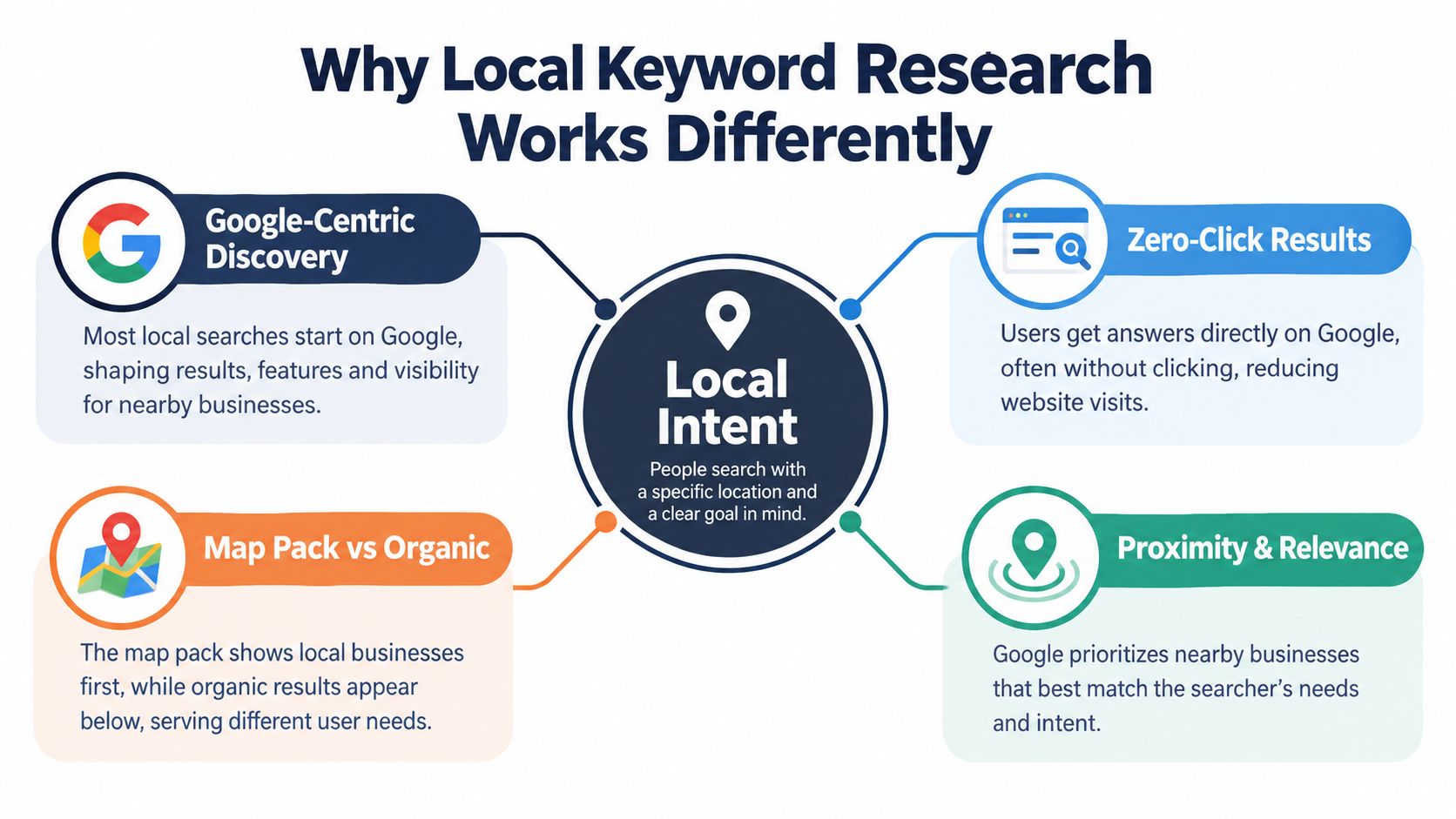
Why Local Keyword Research Works Differently
A self-storage customer searching “storage” might be comparing unit sizes, checking prices, or looking for somewhere they can use today. Add “near me”, a borough, postcode, or “open now”, and the query carries stronger local intent. It signals that distance and availability may affect the decision, while giving the operator clues about the next action to support.
That changes how the research should be organised. Broad terms can generate visibility without creating a useful local opportunity. A more specific phrase, such as “self storage in Croydon”, “storage units Croydon”, “business storage near me”, or a nearby postcode search, may expose a clearer need. A South London facility should group these queries by service, location, customer type, and likely action rather than treating every variation as the same keyword.
Google is the main UK search environment. Statcounter reported Google at 91.47% of all-device search market share in the UK in April 2026, compared with 5.88% for Bing, 1.37% for Yahoo!, 0.65% for DuckDuckGo, 0.30% for Ecosia, and 0.28% for Yandex in the same dataset (UK search engine market share data). That concentration puts Google Maps, Google Business Profile relevance, location modifiers, and mobile discovery at the centre of UK local planning. Technical coverage for other engines still makes sense, but it should not distract from the surfaces that drive local enquiries.
Search intent changes the results page
The often-cited 46% local-intent benchmark originated as an industry estimate first circulated in 2018, not as a recent UK-only measurement. Its relevance is the underlying principle: location-sensitive searches represent a substantial part of search behaviour (UK local search market context).
Google also changes the results it shows according to intent. “Self-storage Croydon” may trigger a local pack, Maps listings, reviews, opening hours, directions, and call actions before traditional organic results. “How much storage space do I need” is more likely to need an explanatory page. The phrase alone is not enough. Record the visible result types, because they show whether Google expects a map interaction, a call, a visit, or an informational answer.
Practical rule: A good local keyword matches the service, points to an area the business can reach, and supports an action the business can fulfil.
Website clicks are only one outcome. UK coverage estimates that over 54% of searches end without a click to an external website, while a UK local-search summary reports that 84% of consumers use Google Maps (UK zero-click search coverage). For self-storage, that makes map-pack visibility, calls, route requests, profile views, and booking actions valid measures of research quality. A keyword that produces fewer organic visits can still matter if it places a nearby facility in front of a ready customer.
Regional wording and user behaviour need equal attention during planning. This practical guide to mastering localized keyword research provides broader context. The working model is simple: local keywords are signals in a discovery system, not merely phrases inserted into a landing page.
Tools and Data Sources You Actually Need
A lean local research stack is more reliable than a large export filled with national estimates. The essential discipline is configuring every source around the exact service area, then checking what Google displays for each candidate term.
Start with Google Keyword Planner. Set the target to the relevant city, borough, county, or defined service area before entering the seed terms. A self-storage operator shouldn't assess “storage units” only against UK-wide demand if the facility serves a limited radius around one London location. Keyword Planner often provides grouped ranges rather than exact figures, but those ranges still support prioritisation when relevance, competition, CPC, and SERP features are recorded alongside them (UK local keyword workflow).
Google Search Console supplies a different kind of evidence. It shows queries already generating impressions and rankings for the site, including unexpected combinations, neighbourhood names, and service variations. Export queries by page, then mark whether each phrase is producing visibility for the right location. A page receiving impressions for “business storage near me” may need stronger service language, clearer local relevance, or a better conversion path.
Build a practical keyword sheet
A working spreadsheet should contain more than a keyword and a volume estimate. Useful columns include:
- Search term: Preserve the wording returned by the tool or observed in Google.
- Service cluster: Group phrases such as household storage, business storage, archive storage, or vehicle storage.
- Area: Record the city, borough, town, neighbourhood, postcode, or implicit local intent.
- Local volume range: Keep the location-filtered estimate and its source.
- Keyword difficulty: Record the local or city-level difficulty where available, not only a national score.
- CPC: Treat it as a commercial signal, not a forecast of organic performance.
- SERP features: Mark local pack, Maps prominence, reviews, FAQs, People Also Ask, or AI Overviews.
- Destination: Assign a location page, service page, blog article, or Google Business Profile asset.
- Outcome: Choose calls, directions, profile actions, form completions, or website visits.
Semrush or Ahrefs can help with competitor gaps and difficulty comparisons. Google Business Profile Insights adds profile-level interaction data, while Google autocomplete, People Also Ask, and related searches reveal language that formal keyword tools may group together. AlsoAsked can help organise question-based demand into useful FAQ themes.
For a wider comparison of platforms and workflows, the small-business SEO tools guide can sit alongside the Google data rather than replacing it. Paid tools are valuable for scale, but no tool can decide whether a keyword describes an area the business serves.
Check the result before trusting the metric
Search every important candidate manually from the target area or with a consistent local search setup. Record whether the page is dominated by the local pack, whether the businesses shown are true competitors, and whether the results favour a specific service or a broad category.
The UK dataset analysed 979 keywords, with the local pack appearing on 95.6% of trades queries and above 90% for most service sectors. Healthcare was an outlier at 79% local-pack presence, while AI Overviews appeared on 20.5% of local healthcare queries (UK local SEO SERP data). The implication is practical: classify the SERP before building the page. A keyword with a strong pack may require profile and review work as much as on-page optimisation.
Finding Seed Keywords and Geo Modifiers That Match Real Demand
The most useful seed terms usually come from the business, not a keyword database. A self-storage operator can begin with the services customers buy, such as household storage, business storage, student storage, document storage, furniture storage, and short-term storage. Facility staff, enquiry emails, call recordings, review wording, and Google Business Profile questions often reveal phrases that spreadsheets miss.
The next step is to add geography without forcing every possible place name into a page. Build combinations around the areas the facility can serve profitably. For a Croydon facility, potential clusters might include “self storage Croydon”, “storage units Croydon”, “business storage Croydon”, “storage near Purley”, and postcode-led searches that reflect how local customers move through the area.
Separate explicit and implicit location signals
Explicit terms name the place directly. They include service-plus-city phrases, borough searches, neighbourhood searches, and postcodes. Implicit terms use language such as “near me”, “nearby”, “open now”, or “closest”, where the searcher's device and Google Business Profile location carry much of the geographic meaning.
“Near me” shouldn't be treated as a licence to create awkward copy. A business doesn't need a page titled “self storage near me” if the page already demonstrates its address, service area, access details, and relevance. Those terms are better used as intent signals for the profile, local landing page, service descriptions, and measurement plan.
Want a free audit like this for your own site?
We'll show you exactly what's holding your rankings and conversions back. No sales pitch.
Get My Free AuditGoogle autocomplete is particularly useful here. Enter the core service followed by different area names, then repeat with variations such as “prices”, “units”, “business”, “24 hour”, and “near me”. Save suggestions only when the business can satisfy the need. A competitor may rank for “cheap storage” but that doesn't make the phrase appropriate if the facility's proposition depends on security, access, or premium unit conditions.
Cluster before assigning pages
A clean list should be de-duplicated by meaning, not just spelling. Group terms by service, area, and next action:
- Household storage: Moving, decluttering, renovation, furniture, or temporary storage needs.
- Business storage: Stock, records, equipment, office moves, and flexible commercial space.
- Area discovery: Borough, neighbourhood, town, and postcode variants.
- Immediate action: “Near me”, “open now”, availability, access, price, call, or directions.
- Question intent: Unit sizes, insurance, access arrangements, security, and contracts.
A single page can naturally cover close variants within one cluster. Separate pages are justified when the service or location changes the customer's decision, not merely because another suburb has been added to the title tag. Guidance on how to find high-intent local keywords can help sharpen the distinction between attractive wording and commercially useful demand.
National volume remains a poor shortcut. A term with a modest local estimate can be more valuable than a large UK-wide phrase when the searcher is close enough to visit and the facility can answer immediately. The final list should therefore carry an intent label before any page is drafted.
Mapping Local Intent to Pages and Google Business Profile
A keyword should answer two questions before it receives a destination. What does the searcher want next, and where does Google appear to send similar searchers? A service-area business often loses relevance by sending every query to a generic homepage, even when the results show a location page, a service explanation, or a Maps action.
The four useful intent groups are informational, service-led, transactional, and navigational. Informational searches ask for guidance, such as choosing a unit size. Service-led searches identify a need, such as business storage. Transactional searches signal readiness around availability, price, access, or booking. Navigational searches seek a named facility, address, or route.
Use the SERP as the decision filter
A page should match the dominant result pattern rather than the team's preferred format. If the local pack occupies the prominent space, the Google Business Profile needs accurate categories, services, location information, photos, reviews, and useful updates. If organic location pages dominate, the website needs a useful local page with distinct information. If questions and AI-generated answer features appear, concise, well-supported explanations can earn visibility even when the final action occurs elsewhere.
The following matrix keeps destinations aligned:
| Intent and SERP Signal | Best Destination | Content Focus |
|---|---|---|
| Informational, People Also Ask or question-led results | Guide, FAQ, or service-support page | Explain unit sizes, access, insurance, contracts, and suitability |
| Service-led, local pack plus service pages | Location service page and GBP service | Describe the service, facility, area served, and practical differentiators |
| Transactional, Maps, calls, prices, or availability actions | Location page, booking path, and GBP | Make contact, directions, availability, and enquiry actions obvious |
| Navigational, branded Maps or address results | Google Business Profile and location page | Confirm name, address, phone, opening details, access, and route information |
Keep website and profile signals aligned
The website page should explain what the business offers in the target area. The profile should make the same service discoverable in the surfaces where users may never reach the site. That can include the primary category, relevant services, business description, Q&A content, posts, photos, and review responses that naturally clarify services and locations.
Businesses should avoid copying one location page across every branch with only the town name changed. Each page needs local proof, such as access information, nearby landmarks, facility features, service limitations, and relevant FAQs. A page for a facility near a railway station may need different practical guidance from one located on an industrial estate.
The Google Business Profile optimisation service offers a useful reference point for aligning profile assets with local visibility. The central principle is consistent: the page and profile should support the same customer decision without becoming duplicate versions of each other.
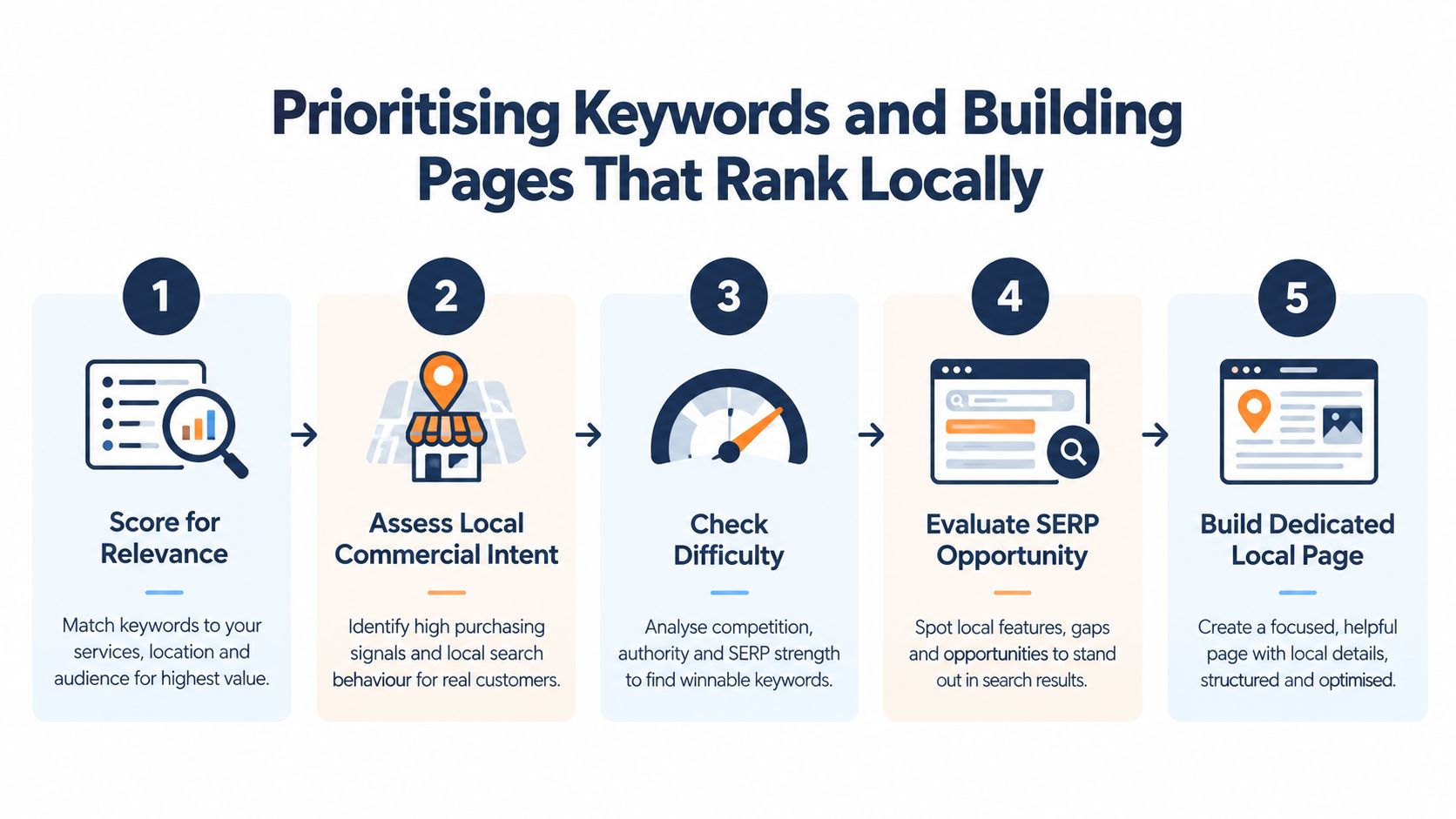
Prioritising Keywords and Building Pages That Rank Locally
A useful priority list doesn't start with volume. It starts with the clusters the business can fulfil, then weighs local commercial intent, ranking difficulty, SERP opportunity, and the asset required to win visibility.
A self-storage team can score each cluster qualitatively as high, medium, or low across four fields:
- Relevance: Does the phrase describe a real service and a reachable area?
- Commercial intent: Is the searcher likely to call, request directions, check availability, or enquire?
- Difficulty: Are established local brands, strong domains, and well-developed profiles already competing?
- SERP opportunity: Is there an achievable opening in Maps, organic results, FAQs, or profile actions?
The first publishing wave should usually contain highly relevant clusters with clear action intent and a realistic SERP opening. Competitive head terms can remain in the roadmap, but they shouldn't consume the entire budget while easier service-area opportunities remain untouched.
Build one complete cluster at a time
For a location service page, the on-page pattern should be useful rather than repetitive:
- Title and H1: State the service and location naturally.
- Opening copy: Confirm who the facility serves and what problem it solves.
- Service detail: Explain unit options, access, security, contracts, collection arrangements, or other genuine features.
- Local proof: Include the facility address, nearby areas, access routes, and location-specific practical information.
- Conversion path: Make calls, enquiries, directions, and availability easy to complete.
- FAQs: Answer real objections and questions found in Search Console, reviews, staff conversations, and People Also Ask.
- Internal links: Connect the location page to relevant service pages, size guides, moving resources, and contact paths.
Neighbourhood terms should appear where they help a reader understand the service area. They shouldn't be placed in a long list of suburbs or repeated in every heading. Google Business Profile content can reinforce the same cluster through services, posts, photos, and responses, but it shouldn't become a copy of the page.
For practical guidance on creating useful local pages, the local landing page SEO resource provides a relevant companion to this workflow. Multi-location businesses should also check for cannibalisation before publishing. If two pages serve the same audience, offer the same service, and show the same local pack results, strengthening one authoritative page may be more effective than creating another thin variation.
Publishing test: If a page could be moved to another town by changing only the place name, it probably lacks enough local substance.
Tracking What Matters Beyond Clicks and Keeping Research Fresh
A local keyword programme should measure what happens after a result appears, not only website sessions. A customer may call from a Google Business Profile, request directions in Maps, save a listing, or visit after finding the address without opening the site. For self-storage, these actions often sit closer to a completed enquiry than an organic click.
A practical monthly report can combine:
- Map-pack and local rank visibility: Check priority clusters from consistent locations and devices.
- Google Business Profile actions: Track calls, direction requests, website visits, and other available interactions by location.
- Search Console performance: Review impressions, clicks, queries, and pages, then identify new service-area wording.
- Lead quality: Separate enquiries for the target service from irrelevant requests and locations outside the operating radius.
- Page and profile changes: Record new pages, review themes, service updates, opening details, and seasonal demand shifts.
The UK's zero-click search situation makes this combined view necessary. Local searches can end in calls, directions, or visits rather than website sessions, as noted earlier. A self-storage operator should connect profile actions and enquiry records to each location and service cluster, while accepting that attribution will remain imperfect.
Refresh the list without starting again
Search Console can reveal new modifiers. Monthly rank checks show whether each page is gaining visibility for its intended cluster. Competitor profile reviews can expose new services, changed opening information, review language, and pages appearing for valuable local queries.
Expand the keyword set when customers use a new phrase the business can fulfil. Consolidate terms when several pages compete for one intent. Remove terms from the priority list when the business cannot serve the location, does not offer the service, or cannot provide a credible answer.
Semantic analysis can help organise related entities and destinations. This guide to harmonic centrality explained provides context for relationships between topics, services, places, and supporting pages. Apply that thinking practically: keep the core service page central, then connect it to local proof, relevant questions, Google Business Profile assets, and clear conversion paths.
Refresh research when customer language, SERP layout, service coverage, or measurable local actions change. That does not require rebuilding the strategy each month. It requires reviewing the clusters that influence map-pack visibility, profile actions, and qualified enquiries.
Amax Marketing can audit local keyword opportunities, compare nearby competitors, and build a prioritised plan for Maps, Google Business Profile, and location pages. Visit Amax Marketing to discuss a local SEO review for a self-storage facility, multi-location business, or service-area operation.