
The UK Government's 2024 Business Data Survey found that 99% of large businesses had a website, compared with only 65% of sole traders and 74% of microbusinesses. That gap changes how a free website SEO audit should be understood. A website is no longer evidence of digital competitiveness. It's only the starting point.
For a self-storage operator, local retailer, online shop or growing service business, the practical question is whether the site can be found, understood and used by people ready to enquire or buy. A useful audit looks beyond an automated score to identify the barriers between search demand and commercial outcomes.
Table of Contents
- Why a Free Website SEO Audit Matters for UK Businesses
- Executing the Core Technical and Performance Checks
- Integrating Accessibility into Your SEO Workflow
- Turning a Free Audit Into Enquiries: The seopaslaugos.io Approach
- Evaluating Content for AI Overviews and Commercial Intent
- Prioritising Your Audit Findings for Maximum Impact
- Moving from DIY Checks to a Tailored Growth Strategy
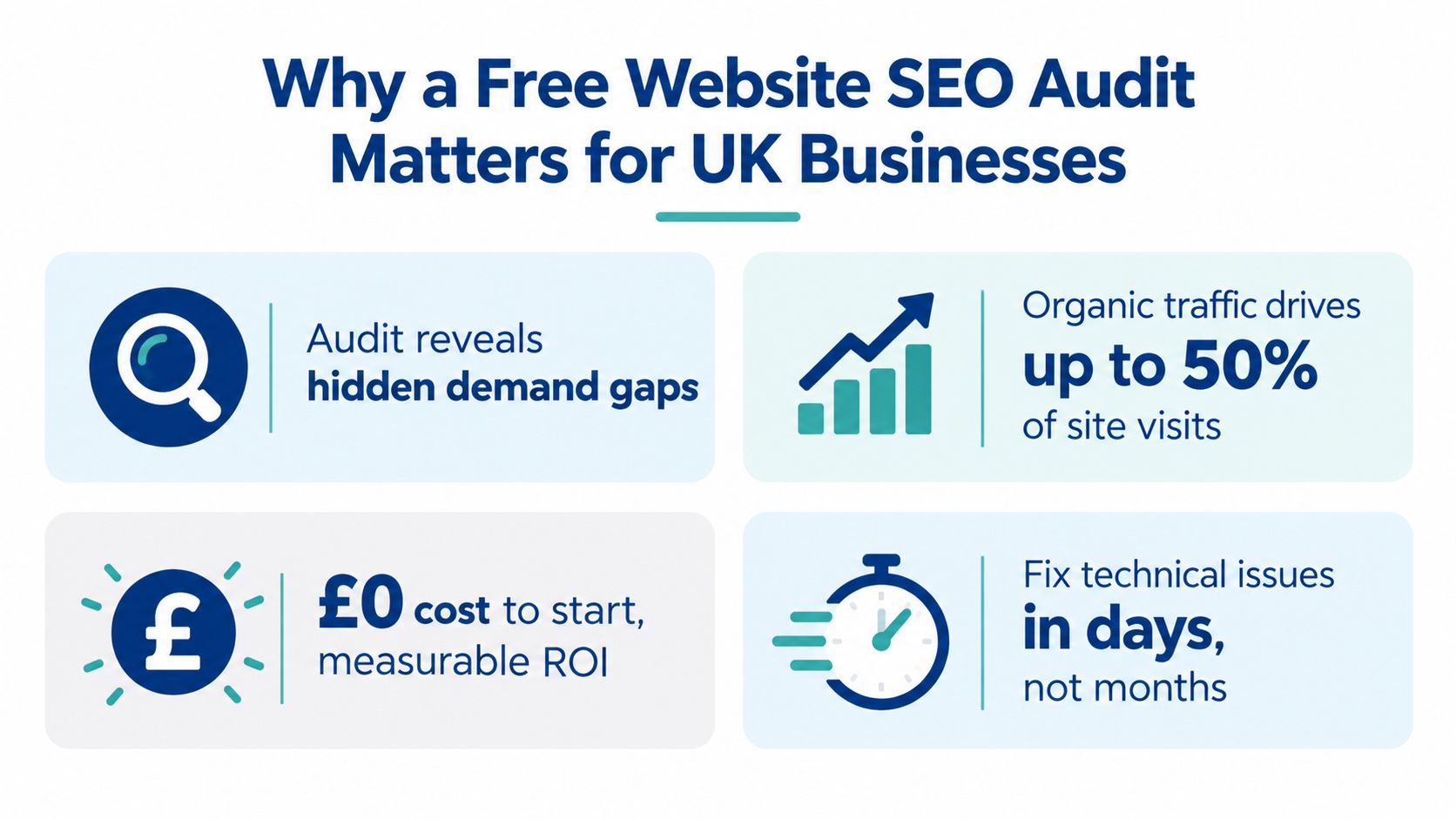
Why a Free Website SEO Audit Matters for UK Businesses
Website ownership varies sharply across UK businesses. The UK Government's 2024 Business Data Survey recorded websites among 99% of large businesses, 97% of medium-sized businesses, 93% of small businesses, 74% of microbusinesses and 65% of sole traders. Those figures show why smaller organisations often need a practical diagnostic before they commit money to a broad SEO or development programme.
A site can look polished while blocking search engines from important pages. It can also attract visitors who can't find prices, locations, availability or a working enquiry form. A free audit creates a low-cost way to examine those weaknesses before a business invests in redesigns, content production or link acquisition.
Search visibility is a commercial issue
Google's position in UK search makes discoverability particularly important. The Competition and Markets Authority reported that Google accounted for more than 90% of general search queries in the United Kingdom, as discussed in this UK search market overview. Ofcom separately recorded Google Search reaching 82% of UK online adults in May 2025, with approximately 3 billion UK web searches per month. These measures describe different aspects of search use, but both point to the scale of the ecosystem an audit needs to address.
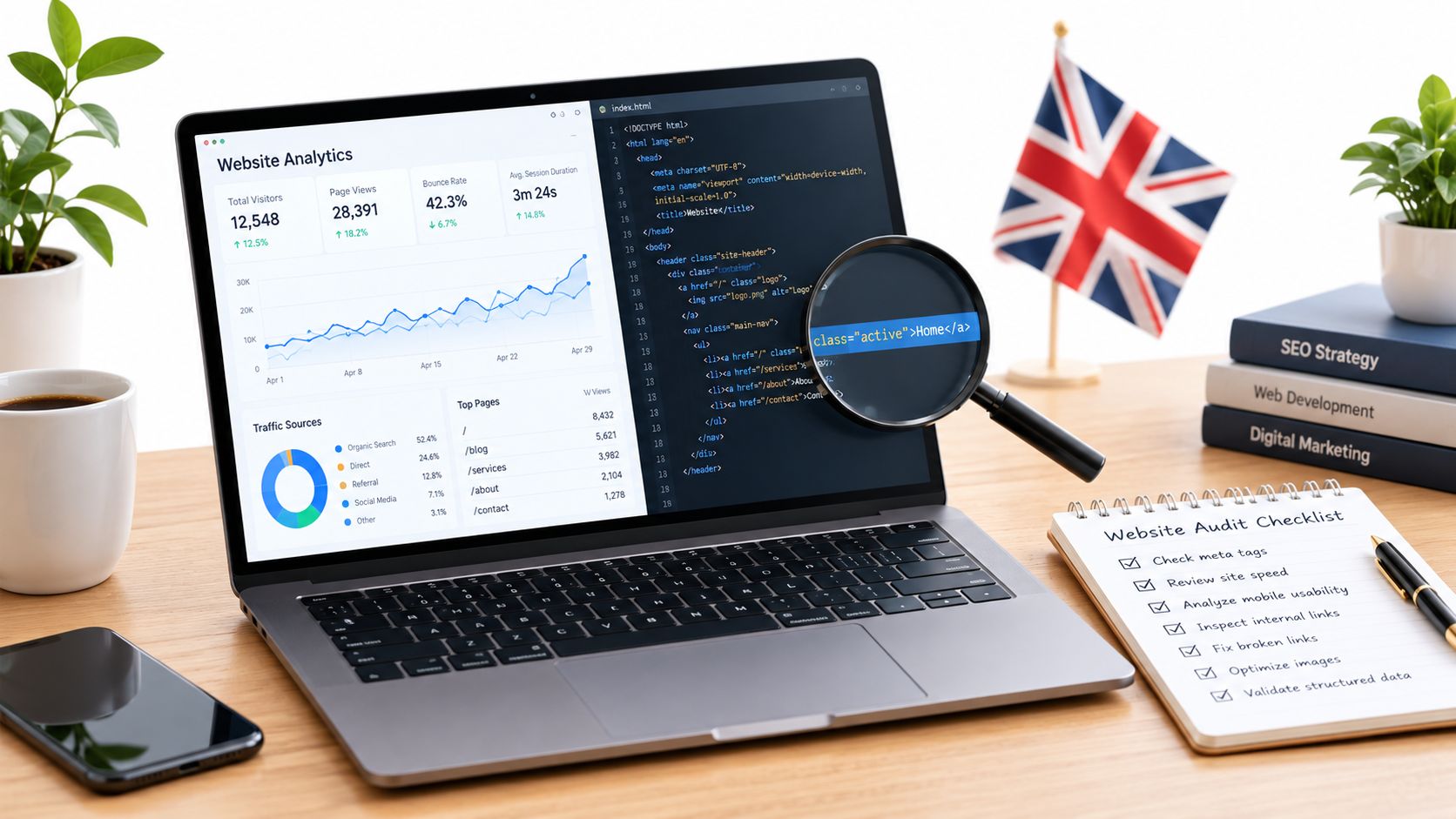
The audit doesn't promise rankings. It tests whether search engines can access, interpret and present the site effectively. That includes indexation, page structure, local signals, internal links, mobile usability and conversion paths.
Practical rule: A high audit score means little if the pages that generate enquiries aren't indexed, locally relevant or easy to use.
A self-storage company may need its location pages, unit-size pages, pricing information and booking journey reviewed before a low-value blog archive. A local retailer may need consistent business details, strong category pages and clear opening information. A startup may first need to establish whether its core service page can be crawled at all.
The free SEO audit from Amax Marketing can provide an initial view of technical health, rankings, content gaps, links and competitor performance. Used properly, that type of check should start a prioritised conversation rather than end with a coloured score.
What the audit should reveal
A useful report should answer practical questions:
- Can search engines crawl the site? Important pages shouldn't be blocked by robots.txt, broken links or poor architecture.
- Are valuable URLs indexed? Service, product and location pages need individual checks.
- Does the site match local intent? Business details, service areas and Google Business Profile information should support the areas served.
- Can visitors convert? Forms, calls, bookings and purchases need a clear path on mobile and desktop.
- Which findings matter commercially? An issue affecting a booking template usually deserves attention before an isolated article URL.
The result should be a baseline for decisions, not a vanity metric. It should show which structural weaknesses prevent relevant services from appearing for high-intent searches and which improvements can be measured through clicks, enquiries, calls or sales.
Executing the Core Technical and Performance Checks
A free audit should start with crawlability and indexation. Content improvements can't compensate for a service page that search engines can't reach or a canonical signal that points to the wrong URL.
Check access before content
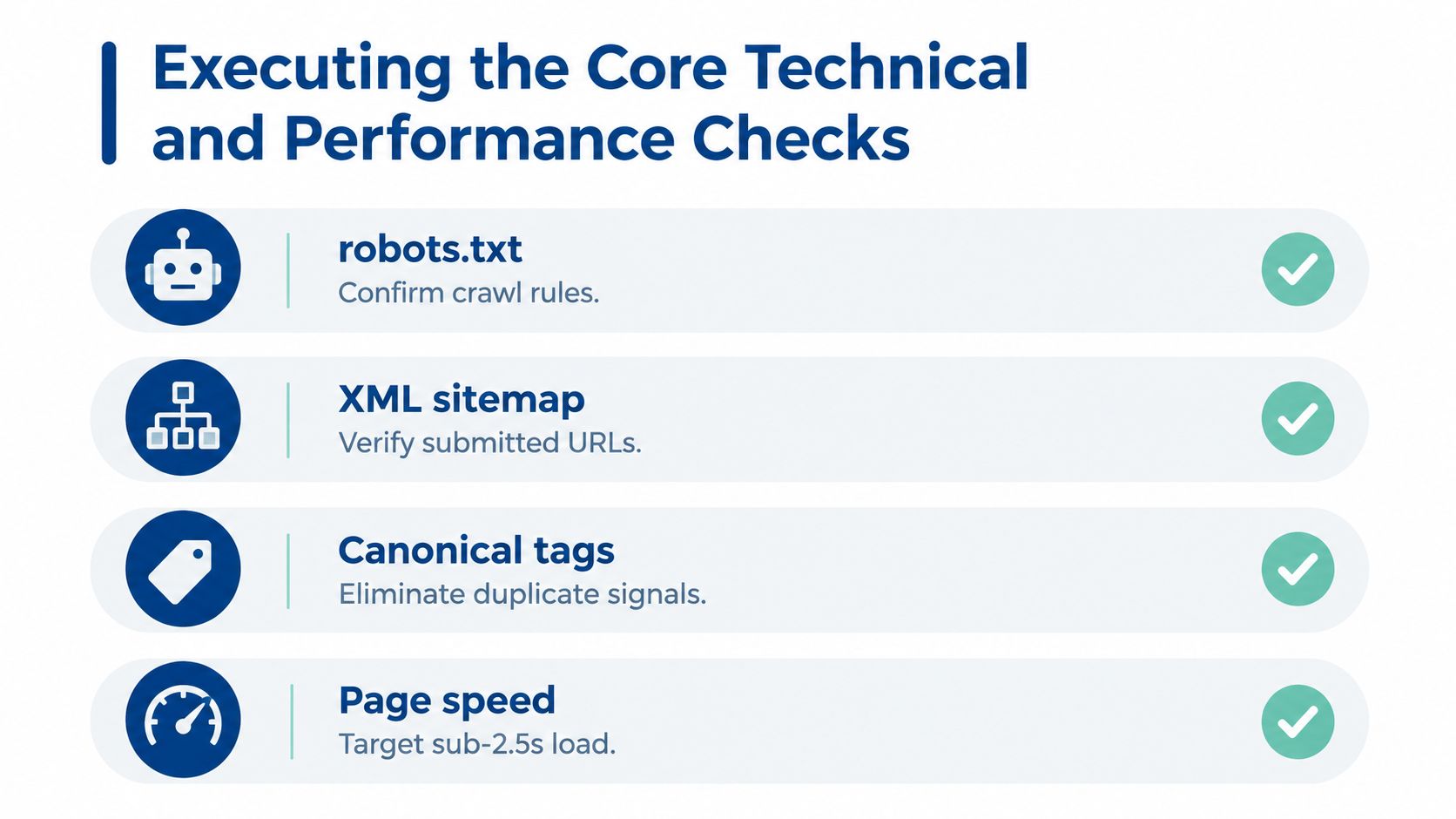
Open the site's robots.txt file and review whether important folders or templates are disallowed. Then inspect the XML sitemap. It should contain the preferred, indexable URLs, not redirected, broken or duplicate versions.
Google Search Console provides the most useful free evidence for indexation. Its Page Indexing report and URL Inspection tool can show whether a page is indexed, which canonical Google selected and whether a crawl problem is preventing inclusion. A crawl can supplement that evidence by identifying status codes, redirect chains, orphaned pages and broken internal links.
The technical SEO audit checklist can help teams organise these checks, but the findings still need business context. A redirected pricing page and a redirected historical blog post shouldn't automatically receive the same priority.
Review these signals in order:
- Robots.txt and rendering: Confirm that important content isn't blocked and that key copy is available to crawlers.
- Sitemaps and indexation: Compare submitted URLs with indexed pages and investigate unexplained exclusions.
- Canonical tags: Check that similar or duplicate URLs identify the version the business wants indexed.
- Status codes and redirects: Resolve broken URLs, loops and unnecessary redirect chains.
- HTTPS and architecture: Ensure the preferred secure version is consistent and important pages are easy to reach through internal links.
Validate real-world performance
PageSpeed Insights is useful for identifying technical bottlenecks, but a homepage score isn't a complete performance audit. Test representative templates, including a location page, product page, service page and booking or enquiry page. Run tests on mobile and desktop, then compare them with field data in Search Console's Core Web Vitals report where that data is available.
Google's current thresholds for a good page experience are LCP of 2.5 seconds or less, INP below 200 milliseconds and CLS below 0.1, as stated in the Ofcom Online Nation report. LCP reflects the loading of the main visible element, INP reflects interaction responsiveness and CLS captures unexpected layout movement.
These thresholds are useful targets, not guaranteed ranking levers. Google treats Core Web Vitals as part of broader page-experience systems, so a technically fast page can still underperform if it lacks relevant content, local evidence or a usable conversion journey.
Record each issue with:
- Affected URLs or templates
- Observed user impact
- Implementation effort
- Conversion relevance
- Validation method after deployment
That creates a backlog a developer and marketing manager can act on, rather than a list of warnings no one owns.
Integrating Accessibility into Your SEO Workflow
Accessibility belongs inside the technical and conversion audit, not in a separate cosmetic review. A missing form label can make an enquiry journey difficult for a disabled visitor, weaken the page's semantic clarity and reduce the number of completed leads.
For UK businesses serving customers in Europe, the legal context also deserves attention. The European Accessibility Act became enforceable on 28 June 2025 and covers in-scope digital services, including e-commerce platforms, according to this European Accessibility Act guide. The Equality Act 2010 also requires service providers to make reasonable adjustments for disabled users, although public-sector accessibility rules don't automatically apply to every private business.
That doesn't mean an automated SEO scan can establish legal compliance. It means accessibility findings can carry search, conversion, reputational and legal significance at the same time.
Audit the journeys that produce revenue
Start with the pages that generate action. Test a booking flow, quote form, product purchase and contact journey, rather than scanning only the homepage.
A practical review should cover:
- Keyboard navigation: Can users reach menus, fields, buttons and modal windows without a mouse?
- Focus states: Is the active control visibly clear?
- Heading structure: Do headings describe the page hierarchy in a logical order?
- Form labels and errors: Can assistive technology identify each field and understand failed validation?
- Alternative text: Do meaningful images have useful descriptions, while decorative images remain unobtrusive?
- Colour contrast: Can users distinguish text, controls and status messages?
- Zoom and mobile behaviour: Does content remain usable when enlarged or viewed on a small screen?
- Link text: Do links explain their destination without relying on surrounding text?
WCAG 2.1 AA provides a practical benchmark for this work. Automated tools can identify missing attributes and some contrast problems, but they can't reliably judge whether instructions make sense, whether a booking widget is usable or whether an error message helps someone complete a form.
Treat accessibility findings operationally
A report should export issues by URL and component, classify them by severity and assign an owner. Third-party booking tools deserve specific testing because a compliant page can still contain an inaccessible embedded journey.
UK public-sector monitoring illustrates why retesting matters. The Government Digital Service reviewed 1,203 websites and mobile apps between January 2022 and September 2024, finding 29,787 accessibility issues. Organisations fixed 16,482, or 55.3%, during monitoring, according to GDS's accessibility monitoring findings.
The commercial lesson is straightforward. Fixing heading structure, labels, focus states and form errors can improve semantic clarity while removing friction from lead generation. A website user experience guide can support the broader review, but the audit should still test real customer journeys and verify fixes after release.
Want a free audit like this for your own site?
We'll show you exactly what's holding your rankings and conversions back. No sales pitch.
Get My Free AuditTurning a Free Audit Into Enquiries: The seopaslaugos.io Approach
A free audit is useful when it identifies a problem. It becomes more valuable when someone connects that problem to calls, enquiries and sales.
seopaslaugos.io is run by Mantas Tamošaitis, an SEO specialist from Lithuania, and clients work with him directly rather than through an account manager. The work covers SEO for service businesses and online shops: technical SEO, commercial content, local search, external signals, AI visibility and conversion tracking. That combination is relevant to a business whose site has plenty of impressions but few meaningful leads.
Six Problems the Work Covers
The offering covers several connected problems:
Technical barriers: Slow templates, weak architecture, indexing problems and duplicated URLs.
Commercial page gaps: Missing service, town, category, product or manufacturer pages aligned with buying intent.
Local visibility: Google Business Profile improvements and location-specific pages for businesses serving defined areas.
E-commerce complexity: Filter control, catalogue indexation, duplicate prevention and category optimisation.
AI discoverability: Structuring evidence and content so AI systems can understand and potentially cite the business.
Measurement: Tracking calls, forms, enquiries and e-commerce conversions instead of relying only on traffic or positions.
There are two ways of working: ongoing SEO on a client’s existing site, and a partnership option for some service businesses. The partnership is paid from agreed orders rather than a standard monthly fee. That model may suit an owner who wants to limit fixed costs, but the commercial terms, attribution and lead qualification should be agreed in writing.
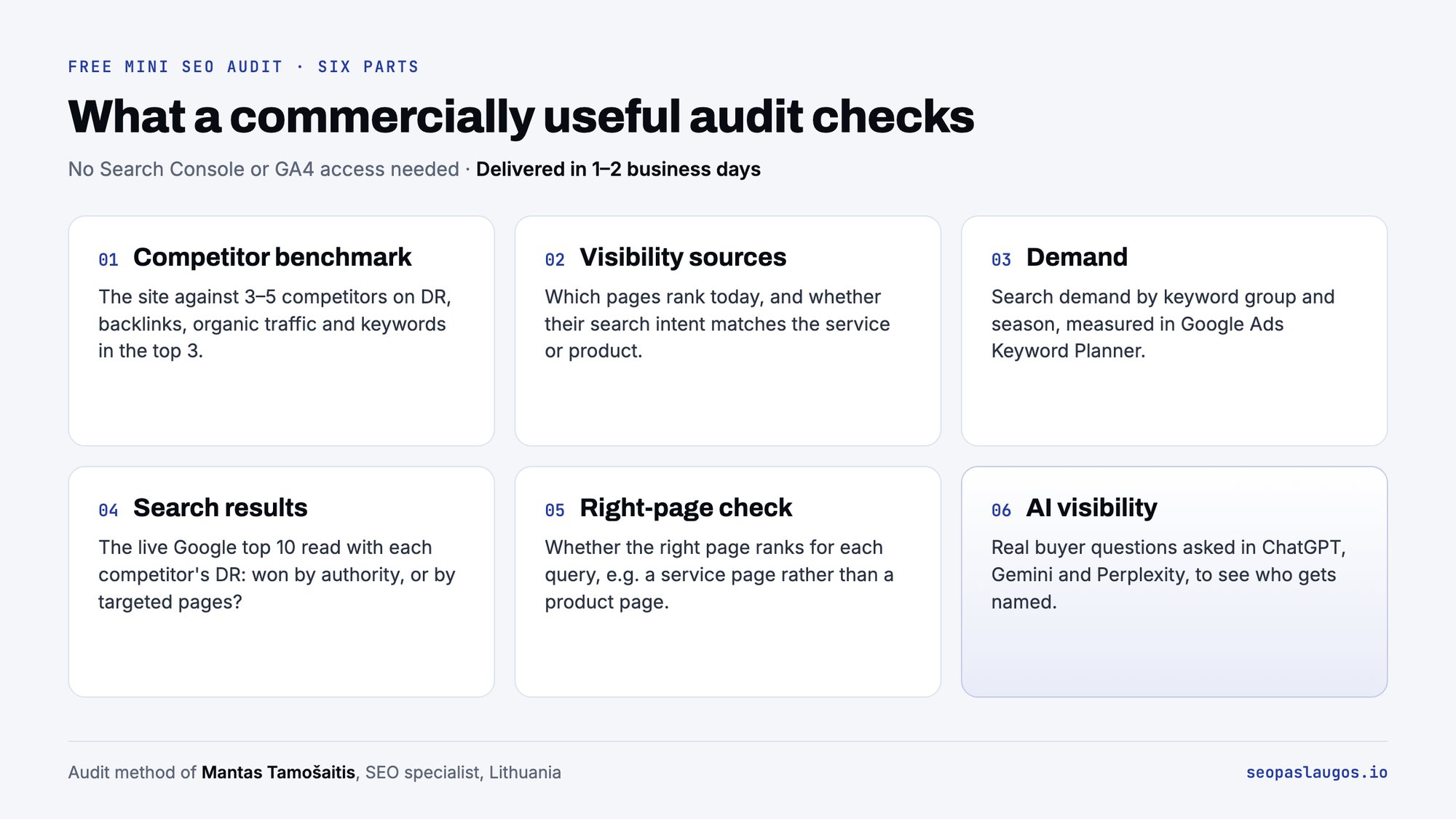
For a business still at the diagnostic stage, the free website SEO audit can be a sensible starting resource. Mantas carries it out himself. He compares the site with 3–5 competitors, measures demand by keyword group and checks live Google results to see whether the right pages rank. He also tests real buyer questions in ChatGPT, Gemini and Perplexity. The audit needs no Search Console or GA4 access and comes with an SEO proposal within 1–2 business days. It’s the right choice when the business needs more than a scanner but isn’t ready to commission a broad strategy. It’s less suitable for a team that only wants a quick technical check.
The main distinction is measurement. A traditional audit asks whether a site ranks. A commercially useful audit asks whether the right pages attract the right prospects and whether those prospects can contact or purchase from the business.
Evaluating Content for AI Overviews and Commercial Intent
A page can rank traditionally and still fail to create business value. It may answer an informational question without explaining the service area, evidence, availability, pricing approach or next step that a potential customer needs.
Recent UK reporting indicates that Google AI Overviews visibility rose from 6.49% of searches in January 2025 to 24.61% in July, before falling to 15.69% in November, making a traditional rankings-only audit incomplete, as reported in the SME Digital Adoption Taskforce publication. The movement also shows why AI Overview visibility should be treated as volatile, not as a guaranteed traffic source.
Compare visibility with business value
The audit should examine whether important pages contain clear, verifiable information that search systems and customers can interpret quickly. For a self-storage facility, that might include exact locations served, access arrangements, unit types, security information, availability and a straightforward enquiry route. For an online shop, it includes accurate product attributes, delivery information, stock status and returns guidance.
A useful comparison looks like this:
| Audit question | Traditional search emphasis | AI and commercial emphasis |
|---|---|---|
| Can the page be discovered? | Crawlability and indexation | Crawlability, indexation and clear page purpose |
| Does it answer the query? | Keyword relevance and search intent | Direct answers, structured evidence and factual clarity |
| Is the business credible? | Links, author signals and content quality | First-party proof, consistent details and trustworthy explanations |
| What counts as success? | Impressions, clicks and positions | Citations, qualified enquiries, calls, bookings and sales |
| What should be improved? | Titles, headings and topical coverage | Those fundamentals plus extractable facts and frictionless next steps |
Build pages that can be understood without guesswork
AI systems may summarise a page, but vague marketing language gives them little reliable material to use. Clear service definitions, named locations, transparent policies, author information, relevant structured data and consistent business details make the page easier to interpret.
That doesn't mean writing for a machine or filling pages with repetitive questions. It means putting the answer where a customer can find it, supporting claims with first-party evidence and keeping commercial information current.
Commercial test: If an AI answer or search snippet mentions the business, can a prospect understand what it offers, where it operates and how to take the next step?
Measure the outcome through Search Console queries, calls, form submissions, bookings and revenue. AI visibility can be recorded as an additional signal, but it shouldn't replace evidence that customers are taking profitable actions.
Prioritising Your Audit Findings for Maximum Impact
A long issue list encourages the wrong behaviour. Teams fix whatever is easiest, celebrate a better score and leave the pages responsible for enquiries untouched.
A stronger process scores each finding against business impact, implementation effort and conversion relevance. The same technical issue can deserve different treatment on different sites. A canonical error affecting a location hub may be urgent, while the same warning on an obsolete archive page may have little practical importance.
SEO Audit Prioritisation Matrix
| Issue Category | Business Impact | Implementation Effort | Priority Level |
|---|---|---|---|
| Important pages blocked or excluded from indexation | Prevents search visibility for commercial URLs | Medium | Critical |
| Broken booking, quote or purchase journey | Directly restricts leads or sales | Medium to high | Critical |
| Incorrect canonical or redirect chain on a revenue template | Dilutes signals and creates access friction | Medium | Major |
| Poor mobile interaction or Core Web Vitals on key templates | Can weaken usability and completion rates | Medium to high | Major |
| Missing location, service or product content | Limits relevance for valuable searches | Medium | Major |
| Weak headings, alt text or form labels | Reduces clarity and accessibility | Low to medium | Major |
| Low-value duplicate blog URLs | Creates management and indexation clutter | Medium | Minor unless strategically important |
| Cosmetic metadata inconsistency on low-value pages | Limited immediate commercial effect | Low | Minor |
Segment by business value
The first pass should separate pages into commercial groups:
- Revenue templates: Product, service, pricing, booking and quote pages.
- Demand capture pages: Location hubs, category pages and pages targeting high-intent queries.
- Support content: Guides, FAQs and educational articles that assist evaluation.
- Low-value inventory: Thin archives, duplicate filters and obsolete URLs with no clear role.
A self-storage business should usually inspect location pages, unit-size pages, pricing and availability before spending time rewriting an old blog post. An e-commerce team should review category templates, product data, filters and checkout paths before polishing metadata on pages that attract no qualified demand.
Prioritisation principle: Fix the barrier closest to a valuable customer action, not the warning with the most alarming colour.
Turn findings into owned work
Every critical or major issue needs a responsible person, an implementation note and a validation step. “Improve speed” isn't a task. “Reduce the largest above-the-fold asset on the service template, then recheck field data in Search Console” is a task.
Professional interpretation earns its value here. A scanner can identify symptoms, but a practitioner connects them to the business model, technical constraints and realistic delivery sequence. That's also where a complimentary audit can help, especially when a niche business needs local visibility, competitor context and content priorities rather than a generic checklist.
Moving from DIY Checks to a Tailored Growth Strategy
A free website SEO audit is a sensible first diagnostic, particularly for a small business that needs to understand where its site stands. It becomes insufficient when the business needs to explain why traffic is unqualified, why important pages don't convert or which fix should receive development time first.
Automated tools are strong at presence checks. They can identify missing titles, broken links, blocked resources, status-code problems and some performance issues. They don't reliably determine whether a page matches the buying journey, whether a location page is credible or whether a technically valid form creates enough trust for someone to submit it.
What human review adds
A customized review joins several evidence sources:
- Technical data: Crawling, indexation, redirects, canonical signals, structured data and template performance.
- Search behaviour: Search Console impressions, clicks, queries, landing pages and trend changes.
- Commercial evidence: Calls, forms, bookings, purchases and lead quality.
- Local context: Google Business Profile consistency, map visibility, service areas and location-page usefulness.
- Competitive context: The content, structure and authority signals that appear around the searches the business needs.
- Content strategy: Pages to consolidate, expand, create or remove based on intent and business value.
For self-storage operators, that may mean connecting facility locations, unit sizes, access details and booking friction into one roadmap. For an e-commerce brand, it may mean resolving catalogue duplication before expanding category content. For a local service company, it may mean strengthening town pages and call tracking rather than producing more generic blog articles.
Choose the next level based on the decision required
A DIY check is usually enough when a developer needs a launch sanity check, a small site has no material search ambition or the owner only needs to find obvious technical errors. A human-led audit becomes more appropriate when the site has existing impressions but weak enquiries, a redesign or migration has introduced uncertainty, several teams need a shared backlog or AI and local visibility matter to acquisition.
Amax Marketing offers a complimentary marketing audit that combines technical review, content and competitor analysis with local search considerations. It can be considered alongside independent consultants and other agencies, with the decision based on scope, access to first-party data, deliverables, ownership of implementation and how clearly success is defined.
The final output should be a roadmap tied to business actions. It should identify the pages that matter, the barriers preventing them from working and the measurements that will show whether the changes helped.
The next practical step is to run a free website SEO audit, export the findings and mark every issue that affects a service page, product page, location page or conversion journey. Then request a customized review from a qualified SEO practitioner, agree which fixes will be implemented first and connect the work to calls, forms, bookings or sales rather than an isolated audit score.