

A national retailer has just acquired ten regional branches. The website still points every service-area page at a London postcode, several Google Business Profiles share similar names, and branch managers are updating opening hours in different formats. The marketing manager responsible for the rollout has inherited a visibility problem, but also a data-governance problem.
That distinction matters. Multi-location SEO in the UK isn't a clone-and-swap exercise. Each branch needs to provide evidence that it is a real, useful and independently relevant place to do business. That evidence includes accurate NAP details, branch-level opening hours, useful local content, genuine reviews, supporting citations, structured data and measurable customer actions. The brand can centralise the process, but it can't manufacture local relevance from a template.
Why Multi-Location SEO in the UK Is a Different Problem
A Manchester branch may need to win within a two-mile postcode cluster, while a Devon branch must prove coverage across a twenty-mile service area. The same template cannot evidence both. One location needs strong proximity signals and branch-specific relevance. The other must make its service territory, access arrangements and customer coverage clear without pretending to operate from every town it serves.
The UK market is also large and fragmented. Independent operators can compete with national chains through stronger local knowledge, more relevant reviews and better-maintained profiles. Internet use is widespread, as noted in the UK local SEO statistics reference, so a weak branch presence can affect discovery well beyond the immediate postcode.
Treat every branch as an evidence system, not a page to clone. That system should connect accurate NAP details, branch-level hours, genuine reviews, local services, supporting citations, structured data and measurable customer actions. Central templates create control, but they cannot supply local proof.
Practical rule: A branch page should contain facts that the local team can confirm on the phone. If staff cannot defend a detail, do not publish it as local evidence.
Sequence the rollout around operational dependencies. Establish the location data and site structure first. Then clean and verify Google Business Profiles, build pages with branch-specific evidence, manage reviews at branch level, align citations and schema, and report failures that need an owner. GDPR consent also applies when teams photograph premises, staff or customers. Useful imagery still needs a lawful, transparent process.
Central ownership should cover standards, templates, permissions and escalation. Branch teams should confirm hours, services, access information and review context. That division preserves consistency without flattening genuine local differences.
Invented addresses, virtual offices, keyword-stuffed names and duplicate profiles are shortcuts that can trigger suppression or removal under Google's representation rules, as explained in the Google guidance for businesses with multiple locations. Each branch needs defensible local evidence, not a polished variation of the same national record.
Building the Location Master File and Site Architecture
The master file should be the operational source of truth, not another spreadsheet maintained beside the website. Every GBP profile, location page, directory submission, call-tracking record and reporting dashboard should draw from the same controlled record. Assign one owner, record change history, and require branch approval before sensitive fields are updated.
At minimum, the file should hold the following information. Some fields will be internal governance data, while others will be published publicly.
| Column | Example value | UK-specific note |
|---|---|---|
| Branch ID | BR-ED-01 | Use a stable internal identifier that survives rebrands |
| Trading name | Example Storage Edinburgh | Match the real-world name used at the premises |
| Registered company number | Illustrative internal value | Keep this for governance, not as a substitute for public NAP |
| Full address | Example Street, Edinburgh, EH1 1AA | Format the postcode consistently in capitals |
| Latitude and longitude | Illustrative map coordinates | Source from a dependable address record and verify against the premises |
| Primary category | Self-storage facility | Choose the category that best describes the actual business |
| Secondary category | Illustrative supporting category | Add only categories that genuinely apply |
| Service radius | Branch-approved local coverage | Keep service-area claims realistic and operationally deliverable |
| Opening hours | Branch trading hours | Record regular, Sunday and bank holiday variations separately |
| Manager name | Branch manager | Restrict personal data access to the people who need it |
| Local telephone | Branch telephone number | Use the number customers actually reach for that location |
| Landing-page URL | /locations/edinburgh/ | Make the URL stable, crawlable and branch-specific |
| Verification status | Pending, verified or review required | Record the date and evidence owner |
The site architecture then determines how authority and maintenance effort are distributed. Subdirectories, such as /locations/edinburgh/, usually suit a UK brand with one main website because they keep branch content within a single domain and make internal linking straightforward. Subdomains can separate systems or regional teams, but they introduce more technical governance and can fragment reporting. Separate microsites are appropriate only where a branch or acquired brand genuinely needs a distinct identity, proposition and operating model.
Choosing the right architecture
A subdirectory is the default for most organisations. It gives the national site one coherent navigation system, supports a central location hub and allows regional pages to link naturally to nearby services.
A subdomain may be justified where business units operate with separate platforms or compliance requirements. It still needs a shared master file, consistent branding and clear ownership. A microsite should be treated as a strategic exception, not a shortcut for creating extra local pages.
The hybrid option works when flagship branches have enough services, facilities or regional importance to justify a hub page, while smaller branches remain within the standard location template. The decision rule is simple: give a branch extra architecture only when it has extra information and a genuine audience for that information.
Setting Up and Verifying Google Business Profiles at Scale
A ten-branch rollout can fail before the first profile is created. Start by checking eligibility and existing listings for every proposed branch. Search by business name, telephone number and address, then resolve duplicates before adding anything. An old or suspended listing left live can split reviews, confuse customers and prevent the correct profile from appearing consistently in Search or Maps.
Google allows one profile for each legitimate location where separate staff and service areas support that distinction. It does not allow several profiles for the same business or premises. Virtual offices, PO Boxes, invented branches and keyword-stuffed names are poor shortcuts that can trigger suspension and leave customers without a reliable point of contact.
Use a controlled verification workflow
The location group should manage the estate, rather than individual staff sharing credentials. Businesses with more than 10 locations of the same business must complete individual or bulk verification, according to Google's business-profile guidance. Document the process before uploading the location set:
- Confirm that each branch is eligible and staffed.
- Search for existing, duplicate or claimed profiles.
- Standardise the master-file fields.
- Add the branches to the appropriate location group.
- Submit the required verification evidence.
- Record status, ownership and any duplicate or suspension flags.
Verification may use video or postcard, depending on what Google offers for the profile. Postcard verification can delay a launch, so build contingency time into the rollout instead of promising every branch will activate together. Video evidence must show the premises and business activity accurately. Any staff shown must work at that location.
Keep owner access with a small central governance group. Branch managers usually need manager access for photos, hours and customer responses. Corporate owners should retain control of users, removals and major changes. This division limits the impact of staff turnover and prevents an impulsive bulk edit from affecting the estate.
After verification, audit every branch for hours, categories, photos, service details and landing-page links. Add UTM-tagged appointment or enquiry URLs where they support measurement, and include each profile in the launch checklist so no listing becomes dormant. A Google Business Profile optimisation service can support governance and quality checks, but branch accountability still belongs with the business. Categories should match services delivered at that branch, not whatever terms appear to offer the largest search opportunity. The profile must describe the operation customers can visit or contact.
Creating Location Pages That Are Genuinely Local
A useful location page answers the questions a customer has before contacting the branch. It should show the real name, address, telephone number, opening hours, available services, access details and conversion route for that location. For a self-storage facility, that may include loading arrangements, parking, access hours, security information and the unit types available there. For a clinic, it may include named practitioners, appointment options and accessibility information.
Want a free audit like this for your own site?
We'll show you exactly what's holding your rankings and conversions back. No sales pitch.
Get My Free AuditA cloned page that swaps “Manchester” for “Birmingham” fails this test. It might contain the right keyword, but it offers no evidence that the branch exists as a distinct operation. A materially local page contains facts that differ because the branches themselves differ.
Build from branch evidence
The page should connect to the master file without becoming a data dump. Use a clear NAP block, branch-specific calls to action, a map that points to the actual entrance, and local access instructions that match what customers see on arrival. Include a short introduction grounded in verifiable detail, such as the branch's relationship to a nearby transport route, business district or service area, provided the detail is accurate and useful.
Opening hours deserve special attention. Google's UK local-search research, cited in the Google documentation on business information, identifies business hours as the most frequently sought local feature across verticals. Regular hours, Sunday trading and bank holiday exceptions should agree across the page, GBP and relevant directories.
On-page signals should reinforce, not contradict, the user-facing information:
- Title and H1: Include the branch location naturally, with the UK postcode where it helps distinguish nearby premises.
- Schema: Use
LocalBusiness, or a more specific subtype, with a branch-specific identifier, telephone, address, geo data and opening-hour information. - Internal links: Link from the location hub, relevant service pages and regional navigation. Don't leave the page orphaned.
- Meta description: Write a unique description that reflects the actual branch, service and next action.
- Media: Use street-level imagery and branch-specific photographs, with appropriate consent and descriptive alternative text.
Run a pre-publish quality check
A marketing manager should ask whether the page contains a genuinely unique 150 to 200 word introduction, rather than a paragraph with a town name replaced. The same review should check for duplicate boilerplate, inaccurate street imagery, mismatched hours, broken maps, incorrect canonical tags, blocked indexability, invalid structured data and poor mobile performance.
The page is ready when a branch employee can validate its claims quickly and a searcher can decide what to do next without returning to the results page. That standard is more useful than a page count.
Managing Reviews Branch by Branch
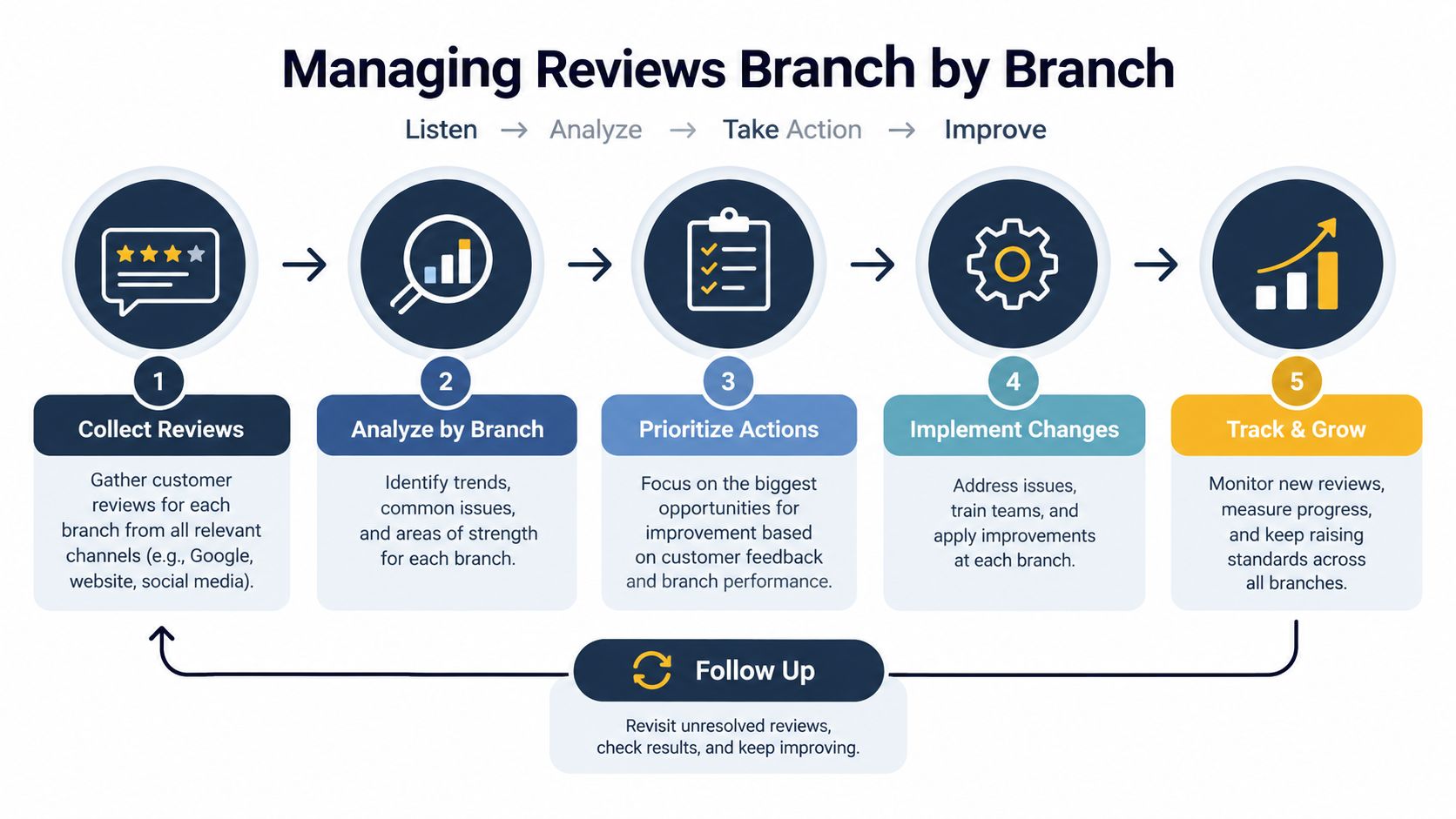
Reviews should be managed as a branch-level evidence system. A strong corporate reputation doesn't erase poor feedback at an individual facility, especially when the customer is choosing between nearby locations. UK consumer evidence supports the scale of this decision-making behaviour: 83% of consumers use Google to read reviews for local businesses, according to the UK local review statistics reference.
A separate UK survey of 2,012 consumers found that 61% had read local-business reviews, 62% trusted a business more after positive reviews, and 48% were more likely to use it, as reported in the verified research cited above. Those figures point to a practical conclusion: review operations need to connect reputation with branch performance, not just add ratings to a national dashboard.
Central standards, local judgement
A central team should define the playbook, escalation routes, response standards and reporting fields. Branch managers should then request and respond to reviews through their own approved access, using a tone that reflects the brand without sounding copied from another site.
The review record should capture more than a star rating. Tag feedback by service, staff member, complaint type, access, parking, security, loading arrangements or billing. For self-storage, these categories can reveal operational issues that a generic sentiment score hides.
A generic “please leave us a review” message often produces weak evidence because it gives customers no reason to describe the experience. A better prompt asks about the service received at that branch. It must still remain voluntary and truthful. Review gating, incentives, bulk posting from one IP address and artificial review patterns can trigger filtering or enforcement. Regulated sectors also need wording reviewed against applicable advertising and professional requirements, including relevant ASA or FCA expectations.
Repairing a damaged branch reputation
A branch with inherited poor reviews shouldn't attempt to bury the history with a sudden burst of requests. The safer response is to acknowledge specific complaints, fix the underlying process, record the change and invite future customers to review their genuine experience. A renamed branch also needs careful reconciliation, so customers and platforms can understand whether it is the same location or a genuinely new business.
The branch dashboard should show rating, recency, response coverage, recurring themes and conversions from Maps. Google Business Profile completeness is associated with consumers being 2.7 times more likely to consider a business reputable, according to the same verified UK review research, so the review workflow belongs alongside profile accuracy and operational follow-through.
Citations, Local Links, and the Technical Layer
Citations, local links, schema and internal linking work best as one connected evidence layer. A directory listing confirms the branch's identity, a local link places it in a community context, schema clarifies its entities for machines, and internal links show how the branch fits into the wider website.
Start with the master file. Audit the name, address, telephone number, opening hours and URL across relevant UK sources, including Yell, Thomson Local, Scoot, 192.com and Central Index where appropriate. Then add sector-specific directories and trade publications that customers and industry organisations use. A citation is useful when it is accurate and relevant, not merely because it exists.
| Source | Tier | Approval time | Critical NAP fields |
|---|---|---|---|
| Google Business Profile | Core | Varies by verification route | Name, address, telephone, hours, URL |
| Major UK directory | Core | Varies by directory | Name, address, telephone, category |
| Sector directory | Priority by industry | Varies by editorial process | Trading name, location, service, URL |
| Local publication | Authority opportunity | Depends on editorial schedule | Branch name, town, accurate description |
| Community organisation | Authority opportunity | Depends on partnership | Brand, branch location, relevant contact |
Earn local relevance without manufacturing it
A multi-branch brand can sponsor a regional sports club, provide useful commentary to a local newspaper, host a community event or support a local CPD event. The activity needs to be real and documented. A press release should describe the event or contribution, not disguise a paid link as independent editorial coverage.
Teams assessing wider franchise support may also find a marketing agency for franchises useful when the programme includes local campaigns, franchisee coordination and regional authority building. For citation hygiene specifically, citation management support can help central teams identify inconsistent records and route corrections through an approval process.
The schema stack should reflect the site's entity structure. Use Organization on the root, LocalBusiness or a relevant subtype on each location, and include the branch telephone, geo details, opening hours and areaServed where the claim is accurate. Add BreadcrumbList to clarify hierarchy.
Internal links should move logically from the national site to regional hubs, branch pages and relevant services. Every location URL should be reachable through navigation or contextual links. The purpose isn't to create a dense web of keywords. It's to make each branch discoverable to users, crawlers and the teams responsible for maintaining it.
Tracking, Reporting, and Scaling Without Breaking Things
A rollout becomes a programme when every branch has a measurable operating record. Google Business Profile reporting should be reviewed for impressions, clicks, calls and direction requests, while profile data can also expose photo views and search queries. Location pages should use UTM-tagged links, tracked forms and call extensions so the team can connect visibility with enquiries.
The report should compare branches against their own baselines and operational context. A rural branch and a city branch shouldn't be judged by identical demand expectations. The useful comparison is whether the branch is becoming more accurate, more visible for relevant searches, more responsive to customers and better at turning local actions into enquiries.
| KPI | Data source | Quarterly target | Branch owner accountable |
|---|---|---|---|
| Profile impressions | Google Business Profile | Improve from the agreed baseline | Branch manager |
| Website clicks | GBP and analytics | Increase qualified local actions | Marketing and branch manager |
| Calls | GBP and call tracking | Improve answerable, relevant enquiries | Branch manager |
| Direction requests | GBP | Identify and improve visit intent | Branch manager |
| Review response coverage | Review platform and workflow log | Respond consistently within policy | Branch manager |
| Citation consistency | Master-file audit | Resolve identified discrepancies | Central marketing |
| Local Pack visibility | Local rank tracker | Improve for agreed branch queries | SEO lead |
| Location-page conversions | Analytics and CRM | Increase completed enquiries or bookings | Marketing and operations |
Give operations a report they can use
A quarterly review should flag branches with outdated hours, falling review recency, unresolved complaints, inconsistent citations, declining visibility or content that no longer reflects the facility. The local SEO reporting service is one possible way to structure branch-level and roll-up reporting, provided the underlying tracking and ownership rules are agreed.
Scaling from a small estate to a larger network exposes governance weaknesses quickly. Shared logins create access risk, staff turnover breaks review workflows, and location pages decay when no branch owns the approval process. A single-dashboard provider also isn't automatically safe. Any third party must respect Google's permissions and representation rules, preserve business ownership and avoid bulk actions that could trigger mass suspensions.
The marketing manager should hand operations a short action list, not a ranking spreadsheet. Each branch needs a named owner, a due date, a verified source record and an escalation route. That's how central control and local accountability work together without turning the rollout into a fragile set of shortcuts.
Amax Marketing supports multi-location programmes with Google Business Profile optimisation, citation consistency, branch-specific location pages, review management and reporting for local rankings, calls and conversions. Visit Amax Marketing to discuss an audit-led roadmap for a UK branch network and identify the location-level issues that need attention first.