


Top-ranked local businesses average 86 citations, while 50 accurate, regularly maintained listings often outperform 200 scattered ones. In UK local search, citation management is less about volume and more about trust, consistency, and control.
The businesses that keep winning usually do the boring things better. Their names, addresses, phone numbers, categories, and opening hours line up across the places customers look, and that clarity helps search engines and people alike.
Table of Contents
- What Citation Management Actually Changes in Local Search
- Running a Complete Citation Audit for Your Locations
- Prioritising Directories and Building Authoritative Citations
- How Synup Can Help
- Claiming, Cleaning, and Removing Duplicate Listings
- Outreach Templates and Tools for Ongoing Citation Builds
- Monitoring Citation Health with Practical KPIs and Reports
- Building a Sustainable Citation Maintenance Schedule
What Citation Management Actually Changes in Local Search
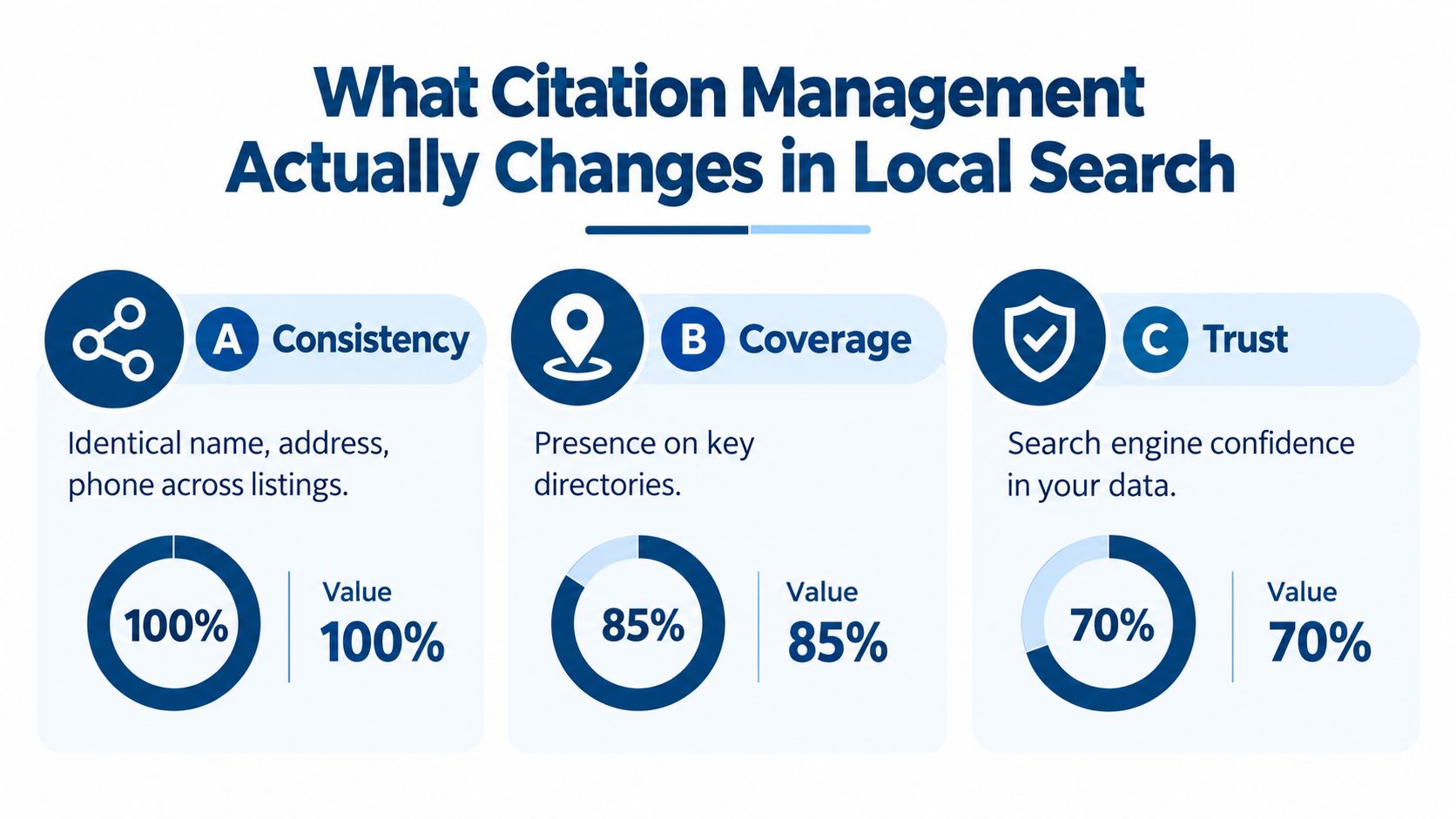
Citation work changes how reliably a location is understood, not just how often it is mentioned. In a local market, that distinction matters because search engines need confidence that every branch is the same business entity wherever it appears. A UK study covering more than 122,000 businesses found that top-ranked local businesses averaged 86 citations, while businesses in positions 7 to 10 averaged 75 citations, and it also argued that 50 accurate, regularly maintained citations can outperform 200 scattered listings containing errors or outdated details (designstack local citation research).
That is the true shift. The winning profile is not the one with the longest list of profiles, it is the one with the cleanest data footprint. For multi-location brands, that means every branch needs the same core identifiers, plus location-specific detail where it properly belongs.
Why consistency beats raw listing count
A search engine can forgive a business that appears on fewer directories if the underlying data is stable. It struggles much more when a branch is listed under slightly different names, phone numbers, or service areas across multiple platforms. That inconsistency creates noise, and noise weakens trust.
Practical rule: fewer listings with clean, current data usually beat a bigger footprint full of drift, duplicates, and stale hours.
The same logic applies to customers. If a user finds one phone number on a directory and a different one on a map app, that user often leaves before contacting the business. For a local SEO consultant, citation management is therefore a governance task, not a one-off submission task.
What search engines and customers read from citations
Citations signal whether a business is stable, reachable, and worth surfacing. When the business name, address, phone number, category, and opening hours match across the web, the local result feels less risky to rank and less risky to click.
That matters even more for chains and franchises. A single branch with messy data can pull down the credibility of the wider location set, especially if several directories echo the same error. Clean citations reduce that drag and make the rest of local SEO work, including reviews and landing pages, easier to trust.
Running a Complete Citation Audit for Your Locations
A proper audit starts with one simple rule, compare everything against a single master record before fixing anything. That record should hold the official business name, address format, phone number, website URL, category set, and opening hours for each location. Without that baseline, teams end up correcting one directory at a time and creating new inconsistencies as they go.
The quickest way to expose problems is to pull the live listings from Google Business Profile, Apple Maps, Bing Places, and the core UK directories that matter in your sector. Then compare each listing field by field against the master sheet. Teams catch the issues that usually get missed here, such as an old phone number still live on a directory, a branch name with extra keywords, or a postcode formatted differently from the approved version.
The fields that deserve a hard check
A useful audit looks at the full stack, not just the headline details.
- Business name: Check for keyword stuffing, old trading names, or small spelling changes that create separate records.
- Address format: Confirm suite numbers, building names, postcode formatting, and branch-specific formatting.
- Phone number: Make sure the primary number is current and consistent, especially where call tracking is used.
- Website URL: Confirm the final destination still resolves to the right location page.
- Categories and hours: Verify that the category matches the service offer and the hours match the actual operating schedule.
This is also the point to look for duplicates, merged records, and unclaimed listings. Those are often the fastest way to lose trust in a multi-location profile set, because the same branch can appear several times with slightly different details.
A strong audit does not just find errors, it shows which errors are affecting multiple profiles at once.
For teams that want a structured starting point, a local SEO audit framework like Amax Marketing's local SEO audit process can be adapted into a location-by-location checklist. The key is not the tool itself, it is the discipline of comparing live records against one approved source.
How to organise the findings
Once the data is collected, sort it by branch and severity. A missing phone number on a primary platform deserves a faster fix than a low-value directory with an outdated category, and a duplicate that is still collecting traffic needs a separate escalation path. This prioritisation keeps the team focused on the listings that influence discovery.
For multi-location brands, the audit output should also show what is claimed, what is unclaimed, and what needs owner verification. That simple status view turns a messy set of listings into a workable action plan. It also gives marketing, operations, and branch managers one shared picture of what needs to change.
Prioritising Directories and Building Authoritative Citations
Directory work pays off fastest when you start with sources that shape wider listings, then move into the directories that customers in that market use. That keeps effort focused on places that can improve consistency across several touchpoints, instead of spreading time across low-value submissions.
Primary data sources come first because they affect how business details circulate. After that, the useful layer is made up of industry directories, regional UK business directories, and relevant chamber or membership listings where the brand has a genuine presence. Those sources help customers confirm the business is legitimate, local, and active.
A practical priority stack
A clear order keeps teams from wasting time on weak submissions.
- Claim core profiles first. Control the listings already live on major platforms before creating anything new.
- Fix the source data next. Update the exact business name, address, phone number, website, and category against the master sheet.
- Expand selectively. Add industry and regional citations only where they support visibility or customer trust.
- Avoid directory clutter. Skip spammy sites and thin portals that add noise without adding reputation.
The trap is chasing volume. More listings can feel productive, but the bigger gain usually comes from tighter control of the listings already in circulation.
What authoritative citations do differently
Authoritative citations usually sit on platforms users already trust or search often in your category. They also tend to hold up better over time, which makes maintenance easier. If a platform allows a branch to be edited, claimed, or merged cleanly, it deserves attention before a new submission goes anywhere else.
The same logic applies across multi-location businesses. A location serving a defined region may need a chamber listing, a trade directory entry, and a small set of high-quality local directories, while another branch may need very few. Treating every site the same wastes effort and creates the illusion of coverage.

How to decide what is worth the effort
Ask two questions before pursuing a directory. Can the listing be controlled cleanly, and does it help a real customer confirm the branch? If the answer to both is no, the listing belongs near the bottom of the list.
A mixed workflow helps here. Manual outreach works well for difficult directories, while structured platforms can handle repetitive updates across many locations. For teams that need a centralised workflow, a dedicated citation management platform can sync listing data, review changes, and manage multi-location updates in one place. It makes more sense for businesses with many branches or frequent data changes than for a single-site operator with a small footprint.
Want a free audit like this for your own site?
We'll show you exactly what's holding your rankings and conversions back. No sales pitch.
Get My Free AuditHow Synup Can Help
For multi-location teams, citation management works best when the source data is controlled once and pushed out consistently. Synup is built around listing management, reputation work, local publishing, visibility tracking, and audit trails across locations, so the same team can monitor changes without juggling separate tools. Its AI agent, Sydekick, can handle tasks with chat, memory, skills, playbooks, approval steps, and a full action log, which gives managers a clear record of what changed and why.
For citation work, the main value is continuous syncing and correction. That matters for franchises, agencies, and smaller teams that cannot check every directory by hand. It also helps when a branch changes phone number, address, service area, or category, because the update can move through the system with less manual re-entry. The broader workflow includes review monitoring, response drafting, local posts, rank tracking, locator pages, and AEO checks, so citation management sits inside day-to-day local SEO operations instead of becoming a separate cleanup project.
The trade-off is straightforward. Automation reduces repetitive edits, but it still depends on clean source data and clear approval rules. Smaller businesses with a few locations may want tighter manual control, while larger groups usually need a system that can keep pace with constant changes. For more information, see the official overview at Synup's citation management platform.
Claiming, Cleaning, and Removing Duplicate Listings
Duplicate listings are one of the most common reasons local visibility gets muddled. A single branch can surface several times with slight variations in name, address, phone number, or category, and search systems often treat those entries as separate signals. That fragments authority and makes the business look less settled than it really is.
The first move is to claim everything that can be controlled. After that, merge duplicates where the platform supports it, then request deletion or suppression for records that belong to closed, moved, or consolidated locations. Keep proof for every request, because cleanup often takes longer than expected and the evidence helps when platforms ask for confirmation.
What to record during cleanup
A strong cleanup process keeps more than just before-and-after screenshots.
- Original listing details: Save the exact name, address, phone number, and URL as they appeared before the change.
- Action taken: Note whether the listing was claimed, merged, edited, or submitted for removal.
- Confirmation trail: Keep emails, case IDs, and timestamps so the team can prove the request was made.
- Outcome status: Mark whether the fix is live, pending, or disputed.
This is the part of citation management where discipline pays off later. Without records, teams re-open old issues, duplicate work, and lose track of what has already been resolved.
How to tell the cleanup is working
The proof is not just that the old listing disappears. The better sign is that the master record and the visible listings start to converge, with fewer conflicting branches and fewer customer-facing errors. A cleaner profile set usually makes it easier for search engines to recognise which location should rank for a local query.
For businesses with relocations or mergers, cleanup is especially important because old records can linger for months. That is why a steady maintenance habit matters more than occasional bursts of correction. A branch that changes location without a controlled citation cleanup often inherits both the old data and the new data, which only makes the trust problem worse.
For teams working specifically on Google's business profiles, Amax Marketing's Google Business Profile optimisation guidance is a useful companion to cleanup work. It helps anchor the profile data while the duplicate removal process catches up.
Outreach Templates and Tools for Ongoing Citation Builds
Manual outreach still has a place, especially when a directory has no self-serve claim flow or when an outdated record is locked behind an editor. The best messages are short, direct, and specific. They should state exactly what needs to change, show proof of ownership where appropriate, and avoid vague requests that create back-and-forth.
A practical outreach set only needs a few template types. One should request a correction, one should ask for duplicate removal, one should verify contact details, and one should confirm a change after a relocation or rebrand. The tone should stay professional, because directory editors are far more likely to act quickly when the request is easy to verify.
What a good template needs
A useful request includes the business name, the current incorrect detail, the corrected detail, and the reason for the update. If the branch has moved or changed phone numbers, that context should be included briefly and clearly. The fewer assumptions the editor has to make, the faster the fix usually happens.
Practical rule: make every request easy to approve in one pass, with no extra interpretation needed.
Tools can reduce the repetitive part of this process. Citation management platforms centralise listing creation, edits, and monitoring, which is helpful when multiple branches need the same updates across many sites. That does not remove the need for review, because software can still push the wrong information if the source record is wrong.
When automation helps and when it doesn't
Automation is strongest when the business has repeated patterns, such as standardised branch names, fixed categories, and similar operating hours. It becomes weaker when locations have special rules, seasonal schedules, or location-specific service menus that need human judgement. In those cases, the final review still matters more than the speed of distribution.
Manual outreach and tooling work best together. The tool handles scale, while the person handles nuance, exceptions, and disputes. For an SMB with one or two branches, a lighter process may be enough. For a larger group, the cost of human-only workflows grows quickly, and the risk of inconsistencies rises with every extra login and every extra directory.
Monitoring Citation Health with Practical KPIs and Reports
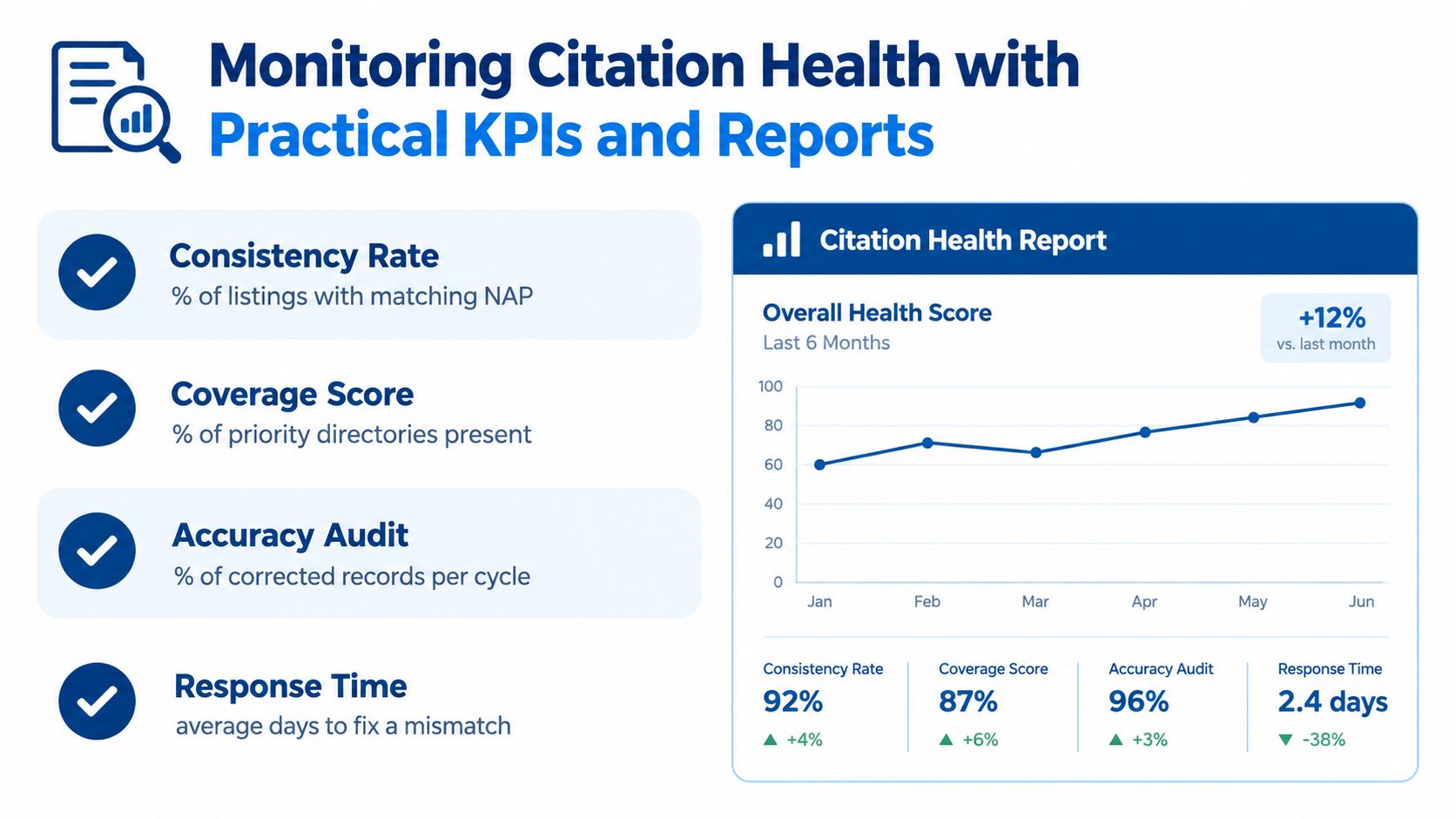
Citation management only matters if the data stays healthy after the initial fixes. That means the right reporting needs to focus on consistency, coverage, and accuracy, not just how many listings exist. A recent UK local SEO analysis found that citation count now explains only 4.2% of ranking variation, with its correlation dropping to 0.34, while NAP consistency across top directories remains a trust signal. The same analysis reported that 64% of SMBs have NAP inconsistencies in at least one major directory (visionary-marketing UK local SEO ranking factors).
Those figures point in a clear direction. Monitoring should be built around mismatches, fix speed, and profile completeness, not vanity counts. A team that checks whether every priority directory matches the master record will usually get more value than a team that adds more profiles to a spreadsheet.
The metrics that actually help
A reporting pack should be simple enough for operations and marketing to use together.
- Consistency Rate: Share of listings with matching NAP details across priority directories.
- Coverage Score: Share of priority directories where the business is present and claimed.
- Accuracy Audit: Share of corrected records per reporting cycle.
- Response Time: Average time it takes to fix a mismatch once it is found.
These measures help teams spot drift before it affects local visibility. They also create accountability, because each mismatch has a clear owner and a clear timeline for closure.
What a disciplined reporting cycle looks like
A branch with steady reporting rarely waits for customers to notice bad data first. The team checks the profile set, flags new duplicates, reviews whether hours have drifted, and corrects any mismatches before they spread. That rhythm keeps local search work from slipping into a reactive scramble.
For teams that need a reporting workflow tied to local search performance, Amax Marketing's local SEO reporting approach is a sensible reference point. The important part is not the report format itself, it is using the report to trigger action.
A useful benchmark is simple. If a location keeps producing new errors every month, the problem is usually not the directory, it is the upstream process. That means the reporting dashboard should feed back into operations, store management, and marketing, not sit in a folder after a monthly meeting.
Building a Sustainable Citation Maintenance Schedule
Citation data decays if nobody watches it. Branch moves, seasonal opening hours, phone changes, rebrands, and platform edits all introduce drift, and the drift usually appears in more than one place at once. A sustainable schedule treats citation management like ongoing governance, not a one-time project.
Quarterly audits work well for catching duplicates, stale details, and branches that have slipped out of sync. Monthly checks should focus on the most important directories and the primary business profile, especially after any operational change. That rhythm keeps the highest-value records current without overwhelming the team.
A workable maintenance rhythm
A practical schedule can stay simple.
- Monthly: Check core profiles, hours, phone numbers, and recent edits on the highest-value listings.
- Quarterly: Run a full audit across major directories, duplicates, and location pages.
- After change events: Review citations immediately after relocations, rebrands, service changes, or branch closures.
Regional ownership matters. If one team or person is responsible for a cluster of locations, updates are less likely to fall through the gaps. Shared responsibility without clear ownership usually turns into no ownership at all.
What to log every time
Every change should have a brief record showing who made it, what was changed, and when it was verified. That log becomes useful when a listing reverts, a duplicate reappears, or a directory asks for proof of ownership. It also helps identify patterns, such as the same branch repeatedly drifting because the source data is outdated.
Automated alerts can support the process, but they shouldn't carry it alone. Some issues are too subtle for alerts to catch, especially category mismatches or missing location-specific information that still looks “close enough” on the surface.
The businesses that keep citations healthy usually do one thing well, they keep a small, disciplined routine running all year. That routine is what turns citation management from cleanup work into a stable local ranking asset. For multi-location SMBs, the winning move is not more listings, it's tighter control, clearer ownership, and regular proof that every location still looks the same everywhere it matters.
If a location set is still drifting between old phone numbers, mixed hours, and duplicate profiles, the fastest win is a proper audit and a maintenance calendar, not another batch of new listings. Start by checking the core profiles, fix the source record, then keep the process alive with monthly and quarterly reviews.