Digital PR is really about building a powerful online reputation. It’s a modern take on public relations that focuses on boosting your search engine rankings, positioning your brand as an expert in its field, and genuinely connecting with the people you want to reach. Think of it as a blend of traditional PR, smart content marketing, social media savvy, and search engine optimisation (SEO), all working together to earn high-quality backlinks and mentions from online sources people trust.
Understanding Digital PR In A Modern Marketing World
Let's cut through the jargon. If traditional PR was about getting a feature in a glossy magazine or a mention on the evening news, digital PR is about earning that same kind of feature on influential blogs, high-authority websites, and the social media feeds your customers scroll through every day. It's the art of shaping your online presence to deliver real, measurable results for your business.
This isn't just about getting your name out there. A solid digital PR strategy is designed to:
- Improve Your Search Engine Rankings: When reputable websites link back to you, it’s a massive vote of confidence in Google's eyes. These backlinks signal that your site is a credible source, which helps you climb the search results.
- Build Genuine Authority: Consistent, positive coverage across the web cements your reputation as a go-to expert. This builds incredible trust with potential customers long before they even think about making a purchase.
- Connect With Your Target Audience: It’s about being part of the conversation. Digital PR puts your brand right where your ideal customers are already spending their time online, making your message feel natural and relevant.
The Shift From Traditional To Digital
At its heart, the goal of PR hasn't changed—it’s still all about managing how the public sees your brand. What has changed are the tools, tactics, and channels we use to do it.
Digital PR is data-driven and directly plugs into your wider marketing efforts. Instead of collecting a folder of newspaper clippings, we’re now analysing referral traffic, tracking improvements in keyword rankings, and measuring the authority of the sites that link to us. It's a much more precise and accountable way of working.
This evolution is plain to see in the data. Here in the UK, search interest for 'digital PR' has shot up by 49% since 2020, a pace that leaves the global average in the dust. This spike shows just how much UK businesses are focusing on online visibility, especially as Google keeps doubling down on authority and trust as key ranking factors.
This concept map breaks down how all the pieces of digital PR fit together to support your marketing goals.
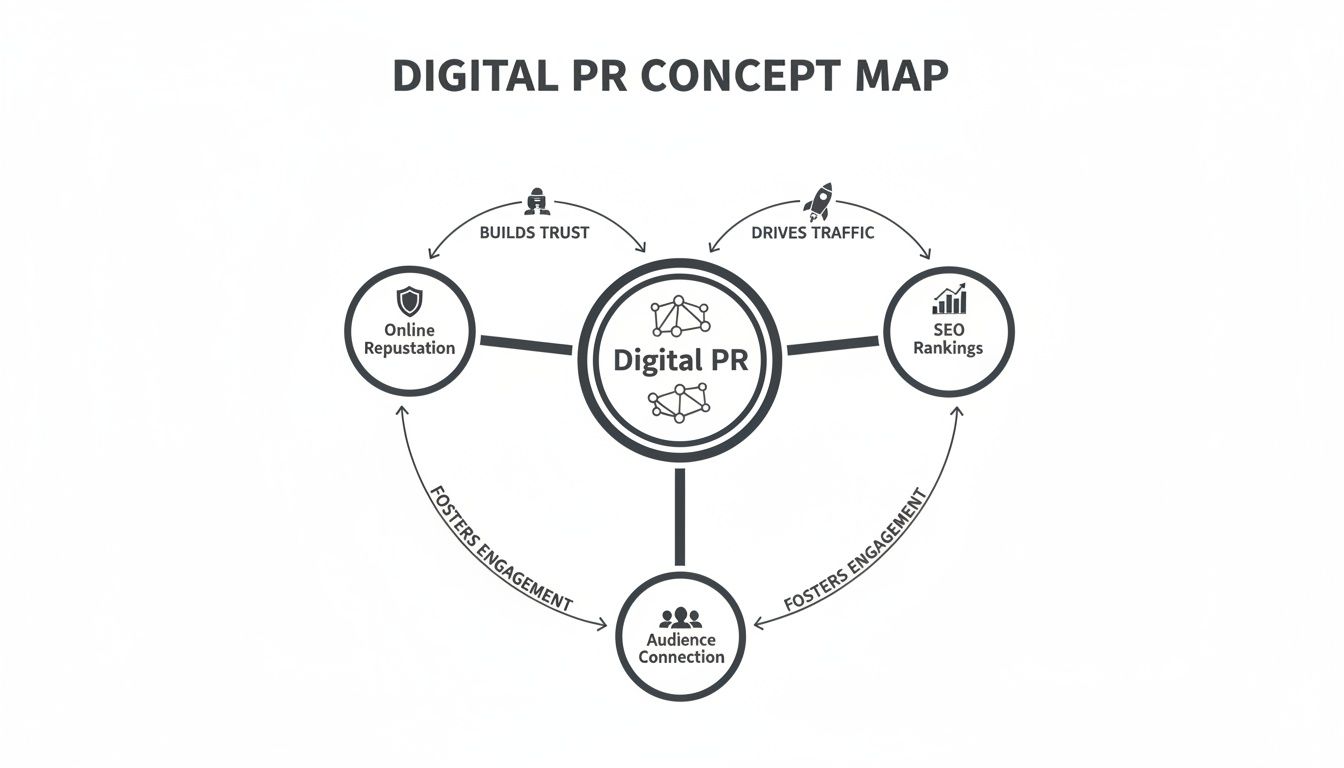
As you can see, building your online reputation and engaging with your audience are the core activities that directly fuel better SEO performance.
To make the distinction clearer, here’s a quick look at how the old and new schools of PR stack up.
Digital PR vs Traditional PR: A Quick Comparison
| Aspect | Traditional PR | Digital PR |
|---|---|---|
| Primary Channels | Print (newspapers, magazines), TV, radio | Online publications, blogs, social media, podcasts, forums |
| Main Goal | Brand awareness, managing public perception | Brand awareness, SEO, lead generation, online reputation |
| Key Metrics | Media impressions, advertising value equivalency (AVE) | Backlinks, referral traffic, search rankings, social shares |
| Audience Reach | Broad, often untargeted (e.g., general newspaper readership) | Highly targeted, reaching specific online communities and demographics |
| Longevity | Short-term impact (e.g., yesterday's news) | Long-term value (a backlink can drive traffic for years) |
| Interactivity | One-way communication (broadcast model) | Two-way dialogue (comments, shares, direct engagement) |
This table shows that while the foundational goal of building a positive brand image is the same, digital PR offers a more targeted, measurable, and lasting impact.
Why It's More Than Just Link Building
It’s easy to think of digital PR as just another name for link building, but that’s missing the bigger picture. While earning backlinks is a fantastic and crucial outcome, the strategy itself runs much deeper. It’s about creating genuinely interesting stories, data-led reports, and expert commentary that journalists and editors actually want to feature.
The real power of digital PR lies in its ability to build brand credibility at scale. Each earned media placement acts as a third-party endorsement, telling both search engines and consumers that your brand is trustworthy and relevant.
This kind of earned trust is fundamental when you're figuring out how to build brand awareness in a noisy marketplace. For a deeper dive into the specific components, this overview of digital public relations services is a great resource that explains what a full-scale campaign involves.
What Digital PR Actually Does for Your Business
It’s one thing to know the definition of digital PR, but it's another to see what it can really do. A smart strategy delivers concrete results that feed directly into a company’s bottom line. We're not just talking about seeing your name in print; we're talking about turning that spotlight into real, measurable growth.
The impact really boils down to three core benefits that all work in sync: supercharging your performance on search engines, building rock-solid brand credibility, and sending high-quality traffic to your site that actually turns into customers. Get these three elements working together, and the results can be game-changing.
Supercharge Your SEO With High-Authority Backlinks
The most immediate and powerful benefit of digital PR is the boost it gives your SEO. When a respected online magazine, industry blog, or news outlet links to your website, Google sees it as a massive vote of confidence. These aren't just any old links; these are high-authority backlinks you've earned because your business has something valuable to say.
A single link from a source people trust can be worth more than a hundred low-quality ones. Search engines view these editorial links as a clear sign that your content is credible and relevant, which directly pushes your site up the rankings.
Think of it this way: a local self-storage company in Manchester gets a feature in a regional business journal's online edition. That one backlink signals to Google that this company is a legitimate, noteworthy player in the local area. This can make a huge difference in them showing up in the local map pack when someone searches "self-storage Manchester".
Build Unshakeable Brand Credibility and Trust
In a world where nearly 93% of all web sessions begin with a search engine, trust is the ultimate currency. Digital PR is one of the best ways to earn it. Every time a genuine third-party source mentions, quotes, or features your brand, it builds up another layer of credibility.
It’s not about what you say about yourself; it’s what others are willing to say about you. This kind of social proof is incredibly powerful. When potential customers see your brand being discussed on platforms they already know and trust, it dissolves their initial scepticism.
A key goal of any digital PR campaign is to shape a positive public image and ultimately build brand equity that lasts. This earned trust makes all your other marketing—from paid ads to sales calls—work that much harder.
This credibility gives customers the confidence to choose you. If a prospect is weighing up two companies and sees that one has been featured in several well-known industry publications, the decision becomes a lot easier. That authority is often the tipping point.
Drive High-Quality Referral Traffic That Converts
While backlinks are a gift for SEO, they also do something else just as important: they send genuinely interested people directly to your website. This isn't just random traffic. This is referral traffic – visitors who are already warmed up because they've just read something positive about you.
Someone reading an article where your company is positioned as an expert is already engaged with your industry. When they click a link to find out more, they land on your site with context and purpose, which is worlds away from someone who just stumbles across it.
This means the visitor is far more likely to:
- Stick around for longer: They’ve come to explore a topic they’re already invested in.
- Have a lower bounce rate: They won't leave immediately because the source has already vouched for you.
- Become a lead or a customer: They are much further down the buying journey and primed to take action.
For a niche business, like a company selling specialist software, a single mention on a respected tech blog can create a steady stream of highly qualified leads for months, even years. That’s how digital PR becomes a sustainable engine for growth.
Your Toolkit of Core Digital PR Tactics
Your strategy is the blueprint, but your tactics are the tools you actually use to build your online reputation. A really effective digital PR campaign is never a one-trick pony. Instead, it’s about blending several proven approaches to get a result that’s bigger than the sum of its parts. Let's break down the core tactics the pros use to turn great ideas into high-authority media coverage and real business results.
Think of each tactic as serving a different purpose. Some build that foundational credibility every brand needs, while others are all about reacting quickly to what’s happening in the market. Once you understand how they all work, you can see how a complete campaign comes together to make your brand visible and trusted online.
Crafting Data-Driven Stories
Without a doubt, one of the most powerful things you can do is data storytelling. Journalists, and their readers, are hungry for original data because it cuts through the noise. It offers a fresh angle on a topic they might already know about. You don’t need a massive research department for this, either. Often, the most compelling stories are hiding in your own internal data or information that's already publicly available.
A business can look at its own sales figures, customer survey results, or even public government data to spot interesting trends. The trick is to find a narrative within that data that’s surprising, relevant, or genuinely useful to a specific audience. This unique insight is what becomes the hook for your pitch to the media.
- Example: A self-storage company in London could dive into local council data on new housing developments and compare it against the number of storage units available. They might uncover a "storage space deficit" in certain boroughs. This nugget of information can be spun into a press release and pitched to London property journalists and local news outlets, instantly positioning the company as an expert on urban living.
Building Authentic Media Relationships
At its heart, digital PR is all about people. Just blasting a generic press release to hundreds of journalists is a surefire way to get ignored. The campaigns that truly work are built on genuine, two-way connections with writers, editors, and bloggers who live and breathe your industry.
This means doing your homework. Take the time to understand what a particular journalist writes about, what their audience is interested in, and how your story can genuinely help them. It involves sending personalised emails, offering yourself up for expert commentary when they need it, and simply being a reliable source. These relationships become valuable assets that pay off again and again.
Good relationships turn a cold pitch into a warm conversation. When a journalist trusts you as a source, they’re far more likely to open your emails and consider your stories, leading to consistent, high-quality coverage.
Strategic Guest Posting for Authority
Guest posting—writing an article for another website—is a classic way to build your authority and earn valuable backlinks. The goal here isn't just to snag a link; it's to provide real value to another site's audience. A well-written guest post shows off your expertise, gets your brand in front of new people, and creates a powerful editorial link back to your own website.
To work well, guest posts have to be insightful, well-researched, and written in the style of the publication you're targeting. When you get this right, you send a strong signal to both readers and search engines that you're a credible voice in your field. It's a key part of many campaigns, and you can learn more about how these links work by understanding what is link building in SEO in more detail.
- Example: The marketing manager for a company that sells inventory management software could write a guest post for a popular e-commerce blog. An article titled, "5 Common Inventory Mistakes Costing Retailers Thousands," offers practical advice and naturally links back to a helpful resource on their own company's blog.
Partnering with Niche Influencers
Influencer marketing isn't just for big fashion and beauty brands anymore. In B2B and more niche sectors, working with respected industry experts or micro-influencers can be incredibly powerful. These are the people who have built a dedicated, trusting following among your ideal customers.
A partnership could be anything from a co-authored report, a joint webinar, or simply having the influencer review your product. Their stamp of approval acts as powerful social proof, and when they share the content, its reach can explode. The secret is to find creators whose audience and values are a perfect match for your brand.
Managing Your Online Reputation
Finally, a crucial but often overlooked part of digital PR is actively managing what people are saying about you online. This means responding to customer feedback on sites like Google and Trustpilot, and keeping an eye on social media for any mentions of your brand. A proactive approach shows you care about what your customers think and that you're transparent.
Encouraging your happy customers to leave positive reviews is also a great way to generate a constant stream of user-generated content that builds trust. This digital word-of-mouth is the foundation of a strong online reputation and it quietly supports all your other PR efforts.
How Do You Measure Digital PR Success? (Hint: It’s Not Just About Backlinks)

Running a creative digital PR campaign is one thing, but proving it actually worked is where the real skill lies. It’s easy to get fixated on the number of backlinks you’ve earned, but that’s like judging a football match purely on the number of passes made. It's a useful statistic, but it doesn't tell you who won the game.
To get the full story, you need to look at metrics that tie your PR efforts directly back to your business goals. It's about understanding the quality of your press coverage, the visitors it sends your way, and how it’s shaping your brand's reputation online.
Focus on Quality, Not Just Quantity
Let's be clear: not all backlinks are created equal. A single link from a major industry publication is worth more than a hundred from obscure, low-quality blogs. That's why the first thing you should look at is the quality of the linking domains.
Tools like Ahrefs or Moz give websites a Domain Authority (DA) or Domain Rating (DR) score, which is a great indicator of their credibility. Think of it as a recommendation. A glowing review from a recognised expert in your field carries a lot more weight than one from a complete stranger. By aiming for placements on high-DA sites, you’re ensuring your backlinks are genuinely boosting your authority in the eyes of search engines.
Look at Referral Traffic and What People Do Next
A great backlink doesn't just pass SEO value; it sends real, interested people to your website. This is what we call referral traffic, and you can track it right inside Google Analytics. It shows you exactly how many people are clicking through from the articles that mention you.
But don’t stop there. The real magic is in seeing what those visitors do once they land on your site.
- Time on Page: Are they actually reading your content or bouncing straight off?
- Pages per Session: Are they curious enough to explore other parts of your website?
- Conversion Rate: Are they taking a valuable action, like filling out a contact form or signing up for your newsletter?
This is what high-quality referral traffic looks like – engaged visitors who are genuinely interested in what you have to offer. Properly tracking this is a cornerstone of figuring out how to measure marketing ROI and proving your PR is delivering tangible results.
Track Your Rankings and Share of Voice
Ultimately, a long-term goal of digital PR is to make you more visible in search engines. As you earn more high-quality backlinks and your brand gets mentioned more frequently, you should see your rankings climb for your most important keywords. Using an SEO tool to keep an eye on your positions is crucial for tracking this progress.
Beyond just your rankings, you should also be measuring your Share of Voice (SOV). This metric essentially tells you how much of the online conversation in your industry is about you versus your competitors. It’s a brilliant way to benchmark your brand's visibility.
A rising Share of Voice indicates that your digital PR efforts are successfully cutting through the noise, making your brand a more prominent and recognised name in your market.
This whole measurement piece is a well-known challenge in the industry. In fact, a recent survey found that 31% of UK PR professionals find measurement the single hardest part of their job. Yet with 80% of UK SEOs convinced that brand mentions boost rankings, it's never been more important to get it right. You can find more of these insights into digital PR challenges over on energypr.co.uk.
To help you get a clearer picture of what to track, here's a breakdown of the most important metrics.
Key Metrics for Evaluating Digital PR Campaign Success
This table summarises the essential metrics you need for a holistic view of your digital PR performance and its impact on your business goals.
| Metric Category | Key Performance Indicator (KPI) | What It Measures |
|---|---|---|
| SEO Impact | Backlinks (quantity and quality via DA/DR), Keyword Rankings | The direct effect on your website's search engine authority and visibility for your target search terms. |
| Website Traffic | Referral Traffic, New vs. Returning Users | The volume and source of visitors driven to your site directly from your PR coverage. |
| User Engagement | Time on Page, Bounce Rate, Pages per Session | How interested and engaged visitors from PR placements are with your website's content once they arrive. |
| Brand Visibility | Share of Voice (SOV), Brand Mentions (linked and unlinked), Social Media Mentions | Your brand's prominence and visibility within your industry's online conversations compared to competitors. |
| Business Outcomes | Conversion Rate (from referral traffic), Leads Generated, Sales Attributed to PR | The tangible, bottom-line impact of your PR efforts, connecting campaigns to actual revenue and customer acquisition. |
By tracking this mix of KPIs, you move beyond vanity metrics and start painting a clear picture of success.
Ultimately, measuring digital PR is about connecting the dots. It’s about being able to show a stakeholder exactly how a feature in an online magazine led to a spike in website visitors, who then went on to become loyal, paying customers. That's how you prove the powerful, bottom-line value your campaigns deliver.
Why Partnering With a Digital PR Agency Accelerates Growth
Knowing the theory of digital PR is one thing. Actually putting it into practice, day in and day out, is another beast entirely. Many businesses give it a go in-house, only to find it's a far bigger and more demanding job than they ever imagined. This is exactly where a specialist agency steps in, not just as a supplier, but as a strategic partner to close that gap between knowing and doing.
When you move from a great idea on a whiteboard to actually trying to get it published, the real-world roadblocks quickly appear. Without the right expertise and resources on hand, even the most brilliant campaigns can fall completely flat. Businesses soon learn that getting consistent results requires a level of focus that’s almost impossible to maintain while also running the company.
Overcoming Common In-House Hurdles
One of the first brick walls teams hit is the lack of genuine media contacts. Building solid relationships with journalists, editors, and influential bloggers isn't something you can do overnight—it takes years of professional, reliable interaction. A good agency arrives on day one with a ready-made network of people who already trust their pitches, which slashes the time it takes to land those valuable placements.
Then you have the sheer time it takes. To create a single, high-quality, data-led story, you need to cover research, writing, design, and a highly personalised outreach plan. For a small team, that process can easily soak up hundreds of hours, pulling everyone away from their core jobs.
Finally, there’s the technical skill of weaving PR into your wider SEO strategy. It’s not just about getting a mention anywhere; it’s about getting the right kind of backlink, on the right website, with the right surrounding text to make a real impact on your search rankings.
By partnering with an agency, you’re not just offloading tasks—you're bringing in a team that has already cleared these hurdles hundreds of times. They have the proven processes, the specialist tools, and the dedicated time to run campaigns at scale.
The Strategic Advantages of an Agency Partnership
Think of a digital PR agency as an extension of your own marketing team—one that comes with a deep well of specialist knowledge and resources that are incredibly difficult to build from scratch. Their experience helps them spot opportunities others miss, sidestep potential pitfalls, and run campaigns with an efficiency that delivers a much higher return on your investment.
Here are the key benefits an agency brings to the table:
- Established Journalist Relationships: Agencies have spent years building their reputation with the media. That credibility means their emails actually get opened, their calls get returned, and their stories are taken seriously. The result? Better placements, secured much faster.
- Campaign Expertise and Creativity: After running hundreds of campaigns, an agency has a sixth sense for what works. They know how to dig for compelling data, write headlines that are impossible to ignore, and frame a story to match what journalists are actively searching for.
- Powerful Tools and Measurement: Professional agencies invest in a suite of top-tier tools for everything from media monitoring and outreach to performance analytics. This allows them to be incredibly precise with their targeting and provide clear, data-driven reports showing the tangible impact on your business.
Ultimately, working with an agency like Amax Marketing frees you up to focus on what you're best at: running your business. It lets you tap into the full power of digital PR without the steep learning curve and resource black hole of trying to build an entire department from the ground up. It’s a partnership designed to accelerate growth, build a much stronger online footprint, and deliver measurable results.
Getting Started With Your First Digital PR Campaign
Right, let's move from theory to actually getting things done. Kicking off your first digital PR campaign isn't as daunting as it might seem. If you break it down into a few clear steps, you'll build a solid foundation for earning that valuable media coverage, whether you're doing it yourself or bringing in an agency.
Think of this as your pre-flight checklist. Nailing these core elements from the get-go gives your campaign a clear purpose and a much better shot at success. It’s all about being strategic before you even think about writing a single email to a journalist.
Define Your Campaign Goals
First things first: what are you actually trying to achieve? A campaign without a clear goal is like a ship without a rudder—you'll be busy, but you won't get anywhere meaningful.
Are you aiming to get powerful backlinks from specific websites to boost your SEO? Or is the main goal to drive traffic and get leads for a new service?
Your primary objectives could be to:
- Build high-quality backlinks to a key page on your site.
- Increase brand awareness in a new town or region.
- Position your company founder as the go-to expert in your field.
- Drive sign-ups for a webinar or a free trial.
Pick one or two main goals. This keeps your efforts sharp and focused.
Identify Your Audience and Target Media
Next, you need to get really specific about who you want to reach. Who are your ideal customers? And just as importantly, what online publications, blogs, or news sites do they actually read and trust?
Start by making a "dream list" of publications. This could be anything from major industry blogs and national papers to the local news sites that matter in your area. For each one, do a bit of digging to find the right journalist or editor—look for writers who already cover your industry or topics related to your campaign. A personalised pitch to the right person is infinitely more effective than a generic email blasted out to a news desk.
Remember, the goal of digital PR isn't just to get a mention anywhere. It’s to get mentioned in the places your target audience already pays attention to. That’s how your message makes a real impact.
Brainstorm Your Story Angle
With your goals and targets sorted, now comes the creative part. What's the story? What can you offer that a journalist would find genuinely interesting and newsworthy?
Maybe you have some unique data from your business, or perhaps you've hit an unusual company milestone. You could even offer an expert opinion on a trending topic in your sector. Your story is the hook that will grab a journalist's attention and make them want to know more. This early planning is easily the most critical part of the entire process; it sets the stage for everything that follows.
Frequently Asked Questions About Digital PR

To wrap things up, let's tackle some of the most common questions we hear from businesses just starting to explore digital PR. These answers should clear up any lingering doubts about how it all works.
What Is the Difference Between Digital PR and SEO?
It’s best to think of them as two sides of the same coin. They work together, but they handle different jobs.
SEO is all about the technical groundwork—making sure your website's structure, content, and keywords are set up perfectly so that search engines can easily find, understand, and rank you. On the other hand, digital PR is the outreach that builds your website's credibility and reputation out on the wider web.
A digital PR campaign is designed to earn high-quality backlinks and brand mentions from other respected websites. Think of these as powerful "votes of confidence." They signal to search engines that your site is a trustworthy source of information, which directly boosts your SEO performance. So, SEO gets your own house in order, while digital PR builds your reputation around the neighbourhood.
How Long Does It Take to See Results From a Digital PR Campaign?
Patience is key here. Digital PR is a long-term play, not an overnight sensation. You might see a quick jump in referral traffic from a press feature within a few days, but the deep-rooted SEO benefits take a bit longer to mature.
Generally, you can expect to see meaningful improvements in your keyword rankings and organic traffic within three to six months of consistent effort.
Of course, the timeline can shift depending on a few things:
- How competitive your industry is.
- The authority of the publications you get featured in.
- The current SEO strength of your own website.
The real magic is in the compounding effect. Every new mention and backlink adds another brick to your foundation, making your online presence stronger and more resilient over time.
Can Digital PR Work for a Small Local Business?
Absolutely! In fact, it can be a game-changer for smaller local businesses trying to punch above their weight and compete with the big guys.
For a local business like a self-storage facility, the goal isn't to get a mention in a national newspaper. It's about securing coverage in local online news, popular regional blogs, or niche websites that your actual customers read and trust.
A single feature in a well-regarded local publication can do wonders. It can drive real foot traffic, make you more visible in local searches (like on Google Maps), and build a huge amount of trust within your community. It levels the playing field by focusing on local relevance, not just a massive budget.
Ready to see how a smart digital PR campaign can build your brand's authority and drive genuine growth? The team at Amax Marketing has spent over a decade creating campaigns that get real, measurable results. Book your complimentary marketing audit today to find out what's possible for your business.