If you run a small business, local SEO is your most direct route to finding customers who are right on your doorstep and already looking for what you sell. It’s all about making sure your business pops up in local search results, especially on Google Maps, connecting you with people in your area who are ready to buy. Simply put, it turns online searches into real-life customers walking through your door.
Why Local SEO Is Your Biggest Opportunity
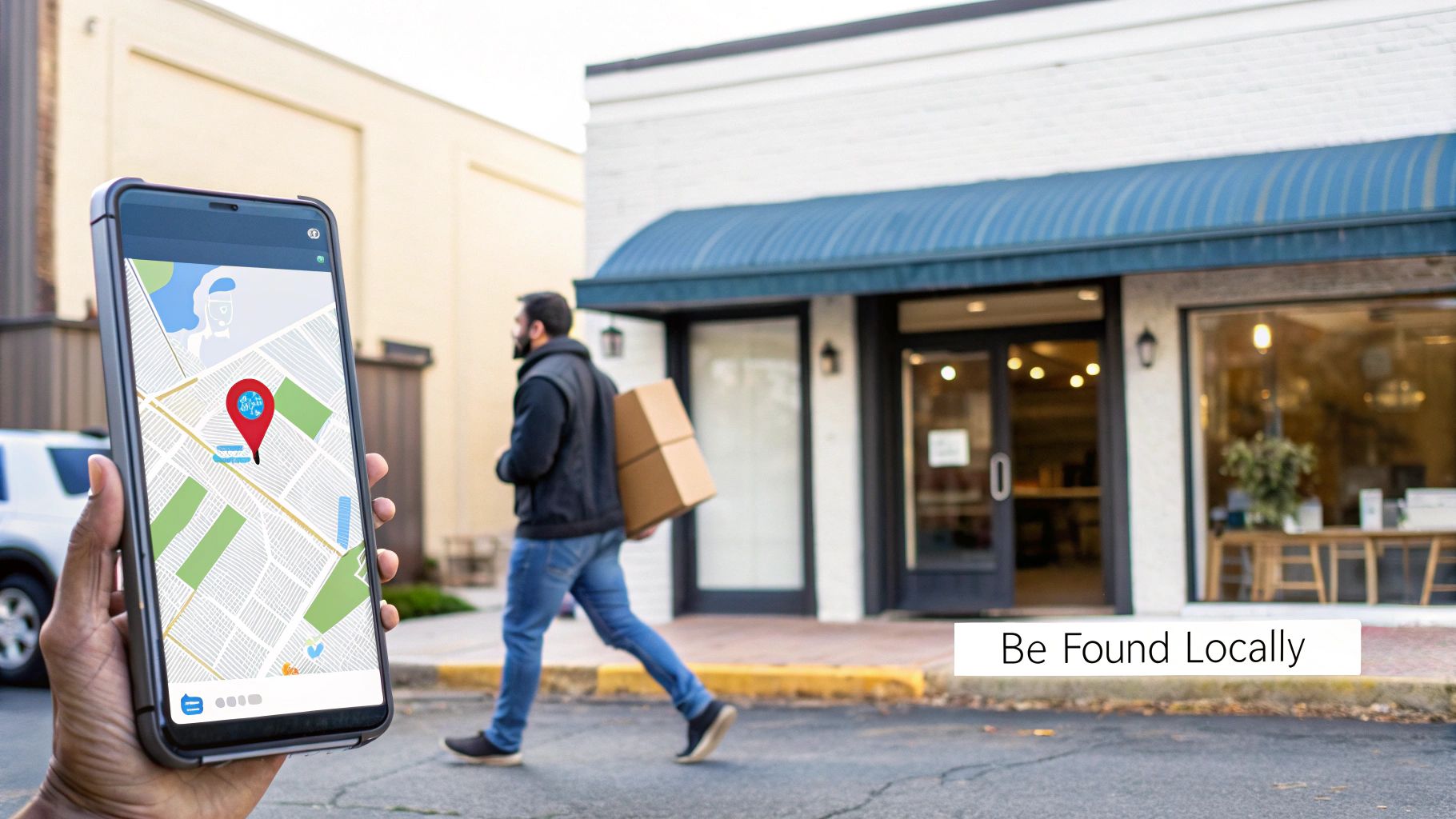
Let's cut through the marketing noise. At its heart, local SEO is about being the go-to answer when someone nearby has a problem you can solve. It’s making sure your business shows up when a family in Camden searches for a "self-storage unit near me" or when a professional in Manchester is looking for the "best bakery nearby."
These moments are where modern business is won or lost. The customer journey today almost always starts with a search engine, and for local services, that means Google Maps and the "Local Pack" results. This isn't just about getting found online; it’s about being visible at the exact moment a customer needs you.
The Shift to Hyper-Local Search
The days of relying purely on word-of-mouth or a leaflet drop are long gone. Your digital storefront is now your most crucial asset, and its online location is just as important as its physical one.
Here in the UK, local search is a massive growth engine. Why? Because nearly everyone uses Google to find things. With Google dominating around 93.5% of the UK search market, it's the ecosystem where almost all your local customers are looking.
Even more critically, the Local Pack—those top three map listings—gets an incredible 42% of all clicks. This gives a huge advantage to the businesses that have their local profiles properly dialled in. You can learn more about these powerful UK search trends and their implications for businesses here: https://amaxmarketing.co.uk/small-business-digital-marketing/.
If you’re not showing up in those results, you’re basically invisible to a massive chunk of your market. And you can bet a competitor is there waiting to take your place.
Local SEO isn't just another box to tick on your marketing list. It's the bridge that connects your business directly to the community you serve. It turns your online presence from a passive listing into an active, customer-finding tool that works 24/7.
Turning Proximity into Profit
The goal is simple: turn nearby searches into paying customers. A solid local SEO plan sends all the right signals to search engines, telling them that your business is the most relevant, trustworthy choice for a specific geographic area.
It’s about more than just having a website. It’s about building a powerful local presence. To start figuring out how to turn those local searches into loyal customers, have a look at these effective strategies for local SEO for small business. Consider this your playbook for making sure that when opportunity knocks in your neighbourhood, your business is the one that answers.
For those just starting, it can feel like a lot to take on. The good news is that some of the most effective actions are also the quickest to implement. Here are a few quick wins that can make a real difference, fast.
Local SEO Quick Wins for Immediate Impact
| Action Item | Why It Matters | Time to Implement |
|---|---|---|
| Claim & Complete Google Business Profile | This is your digital storefront on Google. A complete profile ranks higher and provides customers with critical information instantly. | Under 1 hour |
| Add 10-15 High-Quality Photos | Pictures of your team, premises, and work build trust and increase engagement. Profiles with photos get 42% more requests for directions. | 30 minutes |
| Get Your First 5-10 Reviews | Reviews are a massive trust signal for both customers and Google. Actively ask happy customers to leave feedback. | Ongoing (1-2 weeks for first batch) |
| Ensure NAP Consistency | Your Name, Address, and Phone number must be identical everywhere online. Inconsistencies confuse search engines and hurt rankings. | 1-2 hours (initial check) |
| Answer a Question on Your GBP | The Q&A section is prime real estate. Answering common questions proactively shows you're engaged and helpful. | 15 minutes |
Focusing on these foundational steps first will give you the best return on your time and set a strong base for everything else that follows.
Making Your Google Business Profile Unmissable
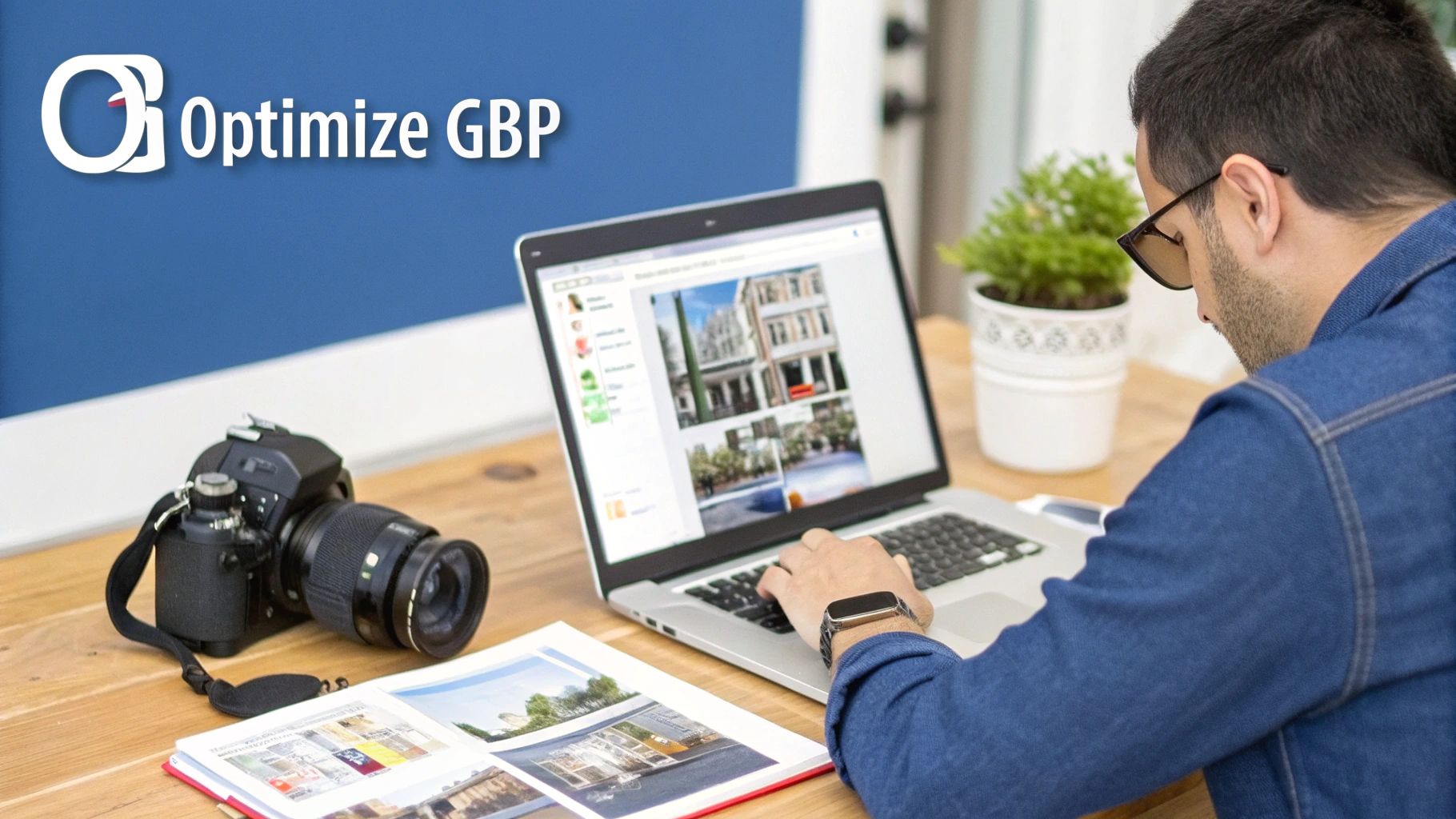
Let's get one thing straight: your Google Business Profile (GBP) is your new digital front door. For most potential customers, it's the very first interaction they'll have with your business. Just having a profile isn't nearly enough.
You need to think of it as a living, breathing part of your business. A sparse, neglected profile with missing information sends a clear message: this business doesn't care about the details. But a rich, active, and helpful profile builds instant trust. It makes choosing you over the competition a no-brainer.
The effort here pays off, literally. We’re not just talking about visibility; this is about driving real-world actions. The numbers back this up: in the UK, 46% of all Google searches are looking for local information. Even more compelling, a massive 78% of local searches on mobile lead to an offline purchase, often within just 24 hours.
For a business like a self-storage facility, a well-optimised profile directly translates into phone calls, new bookings, and filled units. You can see more on these crucial UK local search stats and how they impact people's buying habits.
Selecting Categories That Capture Everything You Do
Your choice of categories on GBP is one of the most powerful ranking signals you can send to Google. Your primary category needs to be spot-on. It should be the single most accurate description of what you are.
For instance, a self-storage business should always select "Self-storage facility" as its primary category. Don't be tempted by something generic like "Storage." That one specific choice tells Google exactly who you are, making sure you show up for the most relevant searches.
But so many businesses stop there, and that’s a huge missed opportunity. Google lets you add secondary categories to show the full scope of what you offer.
- Self-Storage Example: Do you also hire out moving vans or sell boxes and bubble wrap? Add "Truck hire agency" and "Packing supply shop" as secondary categories.
- Café Example: Maybe you function as a quiet workspace during the week. Why not add "Co-working space" to attract a different crowd?
This simple step ensures you're visible for a much wider range of local searches, not just the obvious ones.
Crafting a Business Description That Actually Sells
You have 750 characters for your business description. Don't waste them. This is your chance to tell people why they should choose you over the place down the road.
Lead with your most compelling information. What makes you different? Is it your 24/7 access, climate-controlled units, or top-notch security? Mention your services and location to include keywords, but always write for a human first.
Pro Tip: Your business description isn't a major ranking factor on its own, but it’s a massive conversion factor. A great description can be the final nudge someone needs to click "Directions" or "Call."
For our self-storage business, a weak description is: "We offer self-storage units in Camden."
A much stronger one would be: "Secure and affordable self-storage in the heart of Camden. We offer 24/7 access, climate-controlled units for sensitive items, and a full range of packing supplies on-site. Get a free quote online in minutes!" See the difference?
Using Google Posts and Photos to Build Trust and Engagement
Your GBP isn't a "set it and forget it" tool. It’s a dynamic channel where you can actively market your business. Two of the most underused features are Google Posts and photos.
Google Posts are like mini-adverts that show up right on your profile. They're perfect for:
- Promoting offers: "Get your first month of storage for £1!"
- Announcing news: "Our new ground-floor units are now available."
- Sharing useful tips: "5 Tips for Packing Fragile Items Safely."
Posts expire after seven days, which is actually a good thing. It encourages you to post consistently, which keeps your profile looking fresh and active.
Photos and Videos are absolutely vital for building trust. People want to see what they're getting. Upload a steady stream of high-quality images of:
- Your premises (inside and out)
- Your friendly team at work
- Specific features (e.g., a shot of a clean, well-lit storage unit)
Fresh photos show you're an active, transparent business. It gives potential customers a clear idea of what to expect, making them far more likely to get in touch.
Building Local Trust: Citations and Reviews Are Your Secret Weapons
Right, let's get down to the nitty-gritty. Beyond your Google Business Profile, there are two other things that really prove to Google—and to your customers—that you're a real, trusted local business: citations and reviews.
Think of them as the modern-day version of word-of-mouth. Citations act like digital breadcrumbs, confirming your business exists all over the web. Reviews? That’s your reputation, plain and simple. Getting both right isn't just a nice-to-have; it's a cornerstone of any solid local SEO plan.
Get Your Story Straight with Citations and NAP Consistency
What on earth is a citation? It’s just any online mention of your business's Name, Address, and Phone number (what we call NAP in the biz). You’ll find them in online business directories, on your social media profiles, and on websites specific to your industry.
The absolute golden rule here is consistency. Your NAP details must be a perfect match everywhere they appear. Even a seemingly tiny difference, like using "St." on one site and "Street" on another, can throw a spanner in the works for search engines.
That kind of inconsistency muddies the waters. It makes Google less sure about who you are and where you are, which can directly tank your local rankings.
It's like giving a friend two slightly different addresses for a party. Some might get lost, some might not bother showing up at all. That’s exactly what inconsistent NAP data does to Google. Consistency gives them confidence.
So, where do you start? You need to build these citations on good quality, relevant directories. For businesses here in the UK, that means getting listed on the platforms your actual customers are using.
Key UK Citation Sources to Focus On:
- The Big General Directories: Think Yelp, Yell.com, Thomson Local, and The Independent Business Directory (ibd-uk.co.uk).
- Mapping & Data Hubs: Make sure you're on Apple Maps, Bing Places, and Foursquare.
- Industry-Specific Sites: This is crucial. If you're a plumber, you absolutely need to be on a site like Checkatrade. Running a B&B? TripAdvisor is a must.
Building these out manually spins a web of trust around your business online. Every consistent entry is another vote of confidence, reinforcing who you are and where you are. In many ways, citations function a bit like backlinks, which are vital for your website's overall authority. If you want to go deeper on that, we have a whole guide on what link building is in SEO.
Turn Your Customer Reviews into Your Best Marketing Tool
Reviews are powerful. They are the social proof that tips a potential customer over the edge from just browsing to actually buying. A steady flow of positive, genuine reviews is one of the strongest signals you can send about your business.
Getting them doesn't have to feel awkward or pushy. Honestly, most happy customers are more than willing to leave a good word if you just make it easy for them. A simple, polite email or text after they've used your service, with a direct link to your Google review page, can work absolute wonders.
But your job isn't done once the review is posted. How you respond to every single one—good or bad—is where you really forge a brilliant reputation.
Responding to the Good Stuff
When someone leaves a glowing review, always thank them by name. Try to mention something specific they talked about in their review. It shows you’ve actually read it and you're not just copy-pasting a generic reply.
- Example of a Great Response: "Hi Sarah, thank you so much for the lovely feedback! We're so glad you were happy with the secure access and that our team looked after you. We look forward to seeing you again!"
Tackling Negative Reviews Like a Pro
A negative review isn't a disaster; it's an opportunity. Seriously. A thoughtful, calm response can often win back an unhappy customer and, just as importantly, it shows everyone else reading that you care and take feedback seriously.
I always recommend the Four A's approach:
- Acknowledge: First, acknowledge their complaint and thank them for taking the time to give you feedback.
- Apologise: Offer a genuine apology that their experience wasn't up to scratch. No excuses.
- Action: Explain what you're doing to investigate or offer to resolve the issue directly.
- Away: Try to take the rest of the conversation offline. Give them a direct email or phone number to a real person.
- Example of a Professional Response: "Hi David, thank you for bringing this to our attention. We're very sorry to hear that your experience didn't meet our usual high standards. We'd really like the chance to discuss this with you and put things right. Please could you contact our manager, Jane, directly at [email]?"
This simple approach turns a public complaint into a public display of fantastic customer service. By actively managing your citations and reviews, you're not just ticking SEO boxes—you're building a resilient, trusted local brand that both people and search engines will love.
Turning Your Website into a Local Magnet
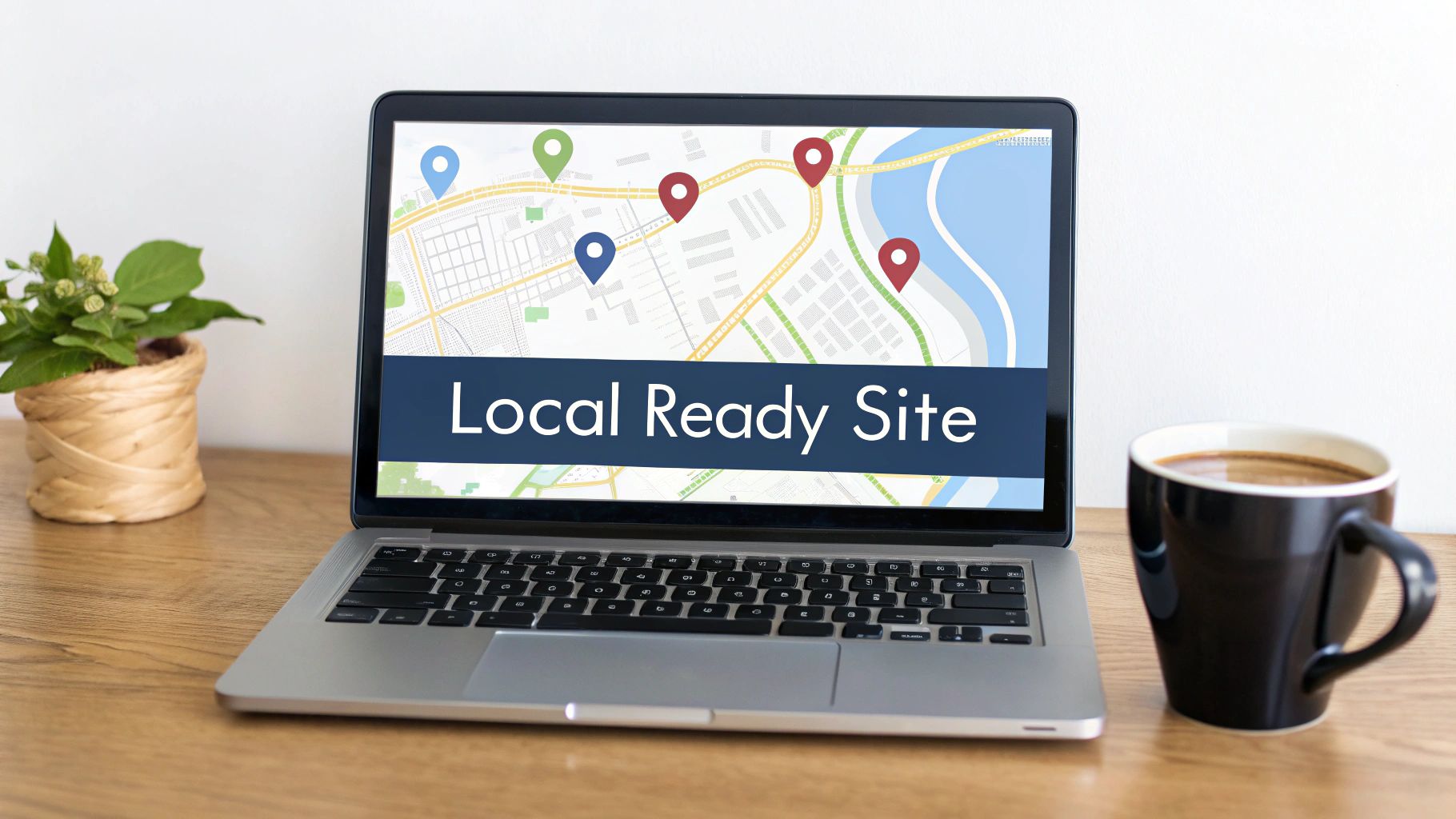
While your Google Business Profile is brilliant at getting that first glance from a searcher, your website is where the magic really happens. It’s your digital shop front, the place you convert a curious click into a loyal customer. A well-tuned site gives visitors that instant feeling of relief: "Yes, I've found the right local expert."
Getting your website right is a cornerstone of local SEO. This goes way beyond having a pretty design; it’s about strategically weaving your location into the very fabric of your site. The goal is to make it crystal clear to both Google and your potential customers exactly where you are and what you do. We call this on-page SEO, and it’s all about clarity and relevance.
Weaving Your Location into Your Website
First things first: make your location obvious. Don't force people to go on a treasure hunt for your address or the areas you cover. This information needs to be front and centre, signalling your local credentials the second someone lands on your page.
A great place to start is with the basics, like your page titles and meta descriptions. These are the little text snippets that show up in Google's search results, and they pack a surprising punch. Simply including your primary town or city here is a powerful signal.
For instance, if you run a self-storage business in Camden, your title could be "Secure Self-Storage Units in Camden | Your Company Name" rather than a generic "Our Services". See the difference? That small tweak instantly tells search engines and people what you do and where you do it.
Taking this a step further, creating dedicated pages for each of your key service areas or physical locations is a fantastic strategy. If your plumbing business is based in Manchester but you have a lot of customers in Stockport, a specific "Plumbers in Stockport" page lets you speak directly to that audience. You can feature testimonials from Stockport clients or mention local landmarks to make the page hyper-relevant.
Your website should feel like it belongs to the community it serves. Sprinkling in local keywords, mentioning nearby areas, and showcasing local case studies all reinforce your position as the go-to choice for people in the vicinity.
Of course, none of this matters if your website is a pain to use. You can send all the right local signals, but if your site is slow, confusing, or broken on a mobile phone, visitors will be gone in a flash. We’ve got a whole guide on how to improve website user experience that dives into the practical side of this.
Demystifying Local Business Schema
Right, let’s talk about something a little more technical but incredibly effective: Local Business schema markup. Don't let the name put you off. In simple terms, schema is a bit of code you add to your website that acts as a translator for search engines.
Think of it like this: instead of Google just reading your address and opening hours from a block of text, schema presents this information in a perfectly structured, machine-readable format. It's like handing Google a neatly organised file on your business, leaving absolutely no room for misunderstanding.
By implementing this special code, you allow Google to pull key details from your site and feature them as "rich results" directly in search. This can include:
- Your exact address shown with a map pin.
- Customer ratings and the total number of reviews.
- Your up-to-date opening and closing times.
- A click-to-call phone number.
These rich details make your business stand out from the crowd, giving you more digital real estate and providing potential customers with instant answers. The result? Better visibility and a serious boost in clicks.
Implementing Schema for Your Business
While schema does involve adding code to your website, you don't have to be a developer to get it done. There are plenty of online tools and website plugins that can generate the code for you.
The key is to tell it what type of local business you are. The options here get very specific, from SelfStorage and Plumber to Bakery and Dentist. It’s crucial to pick the one that fits your business best.
Once you’ve selected your business type, you just fill in the blanks—your NAP (Name, Address, Phone number), opening hours, and website URL. The tool will then spit out a snippet of code. From there, you or your web developer can pop it into your site’s header. It’s a simple action that feeds search engines clear, unambiguous information, cementing your local authority and helping you connect with more nearby customers.
Creating Content That Actually Connects with Your Community
Let's be clear: the whole point of local content is to become a genuinely useful resource for your neighbours. Forget chasing viral hits. Your real job is to publish stuff that solves actual problems for people nearby, proving to search engines that you belong right where you are.
When you nail this, you build a powerful moat around your business. Competitors can't easily copy true local authority. Becoming the go-to source for local information isn't just about ranking for "plumber in Peckham"; it's about building deep, lasting trust.
This means you need to think beyond a boring company blog. Look outwards and weave your business into the very fabric of your local area.
Think Like a Local, Not Just a Business Owner
The best local content answers the questions people in your specific town or city are asking. It’s about getting inside their heads. What are their unique challenges? What information do they really need?
Imagine we're running that self-storage business in Camden. A generic article like 'Top 10 Storage Tips' is fine, but it's forgettable. What about something like, 'How to Declutter a Tiny Camden Flat'? Now you're talking. That headline speaks directly to a real-world pain point for thousands of Londoners, making your content instantly relevant.
Expert Tip: Your most powerful content often has little to do with what you sell. It's about the problems your customers face in their specific environment. Solve their local problems, and they’ll remember you when they need your service.
Here are a few ideas to get you started:
- Create a super-helpful local guide. If you run a removals company, why not publish a 'Complete Guide to Moving House in Manchester'? You could recommend trusted estate agents, local cleaners, and even the best cafes for that all-important moving day coffee. You instantly become a helpful hub.
- Share a local client story. Write a case study on how you helped a well-known local shop or charity. It’s fantastic social proof and shows you’re invested in the community’s success.
- Interview a local personality. Sit down with a respected community leader or the owner of a neighbouring, non-competing business. This is a brilliant way to build local links and get your brand in front of their audience.
Content That Builds Authority and Brings in Customers
This hyper-local approach does more than just make you look good. It sends incredibly strong signals to Google that you are a major player in your service area. Every time you mention a local landmark, a neighbourhood event, or a nearby business, you're reinforcing your geographic relevance.
For instance, our self-storage facility could create a page called 'Student Storage Solutions Near University College London'. This isn't just a sales page. It could detail the perfect unit sizes for students, mention key term dates, and maybe even offer a student discount. The content is laser-focused, attracting precisely the right person at the exact moment they need you.
Ultimately, you're creating a web of local relevance. Your content becomes the evidence that you are deeply embedded in and committed to the community you serve. This doesn't just drive highly qualified traffic; it builds the kind of brand loyalty that turns one-time customers into your biggest fans.
Your First 90 Days: A Practical Action Plan
Feeling a bit overwhelmed by all the moving parts? Don't be. Succeeding with local SEO isn't about doing everything at once; it's about doing the right things in the right order. This practical 90-day roadmap breaks the whole process down into manageable, bite-sized pieces.
Think of the first month as pouring a solid foundation. You’ll be focusing on the absolute essentials—the things that have the biggest immediate impact. From there, you'll layer on website optimisations and start building social proof. Finally, you’ll get into creating valuable content and learning to measure what truly matters.
This structured approach is designed to prevent burnout. It helps you build momentum week by week, turning small, consistent efforts into significant long-term gains.
Month 1: The Foundational Blitz
The first 30 days are all about claiming your digital territory and getting your details straight. This is the non-negotiable groundwork that everything else gets built on. Your top priority is to get your core online presence organised, accurate, and consistent.
Your tasks this month should centre on two key areas:
- Google Business Profile Mastery: Go through your GBP and complete every single section. I’m serious—every one. Upload at least 10 high-quality photos, write a compelling business description, and proactively add answers to common questions in the Q&A section.
- Core Citation Building: You have to ensure your business Name, Address, and Phone number (your NAP) are 100% consistent everywhere. Once you've nailed that down, start manually building listings on essential UK directories like Yell, Yelp, and Thomson Local.
By the end of month one, your goal is simple: have a fully optimised Google Business Profile and consistent NAP information across the web's most important directories. This alone will put you ahead of so many of your competitors.
Month 2: Website Optimisation and Reputation Building
With your foundational listings sorted, month two is when you turn the focus to your own digital property—your website—and kickstart your reputation engine. This is where you begin converting the visibility you've built into genuine customer interest.
Here’s where to concentrate your efforts:
- On-Page Local SEO: Get into your website’s back end and update your title tags and meta descriptions to include your primary location (e.g., "Secure Self-Storage in Camden"). It's also a great idea to create a dedicated page for each key service area you cover.
- Kickstart Your Review Strategy: Put a simple process in place to ask every happy customer for a review. It doesn't have to be complicated. Then, create a few templates so you can respond promptly and professionally to all new feedback, whether it’s good or bad.
To help with these tasks, looking into the best SEO tools for small business can really streamline your process and give you some valuable insights.
Month 3: Content Creation and Performance Tracking
In the final month of this initial push, you’ll shift from setup to active growth. Now you'll start creating content that shows off your local expertise and learn how to track your progress effectively so you know what's actually working.
It helps to visualise how your local content will evolve over time. You might start with a foundational guide and later move toward more specific case studies and blog posts.
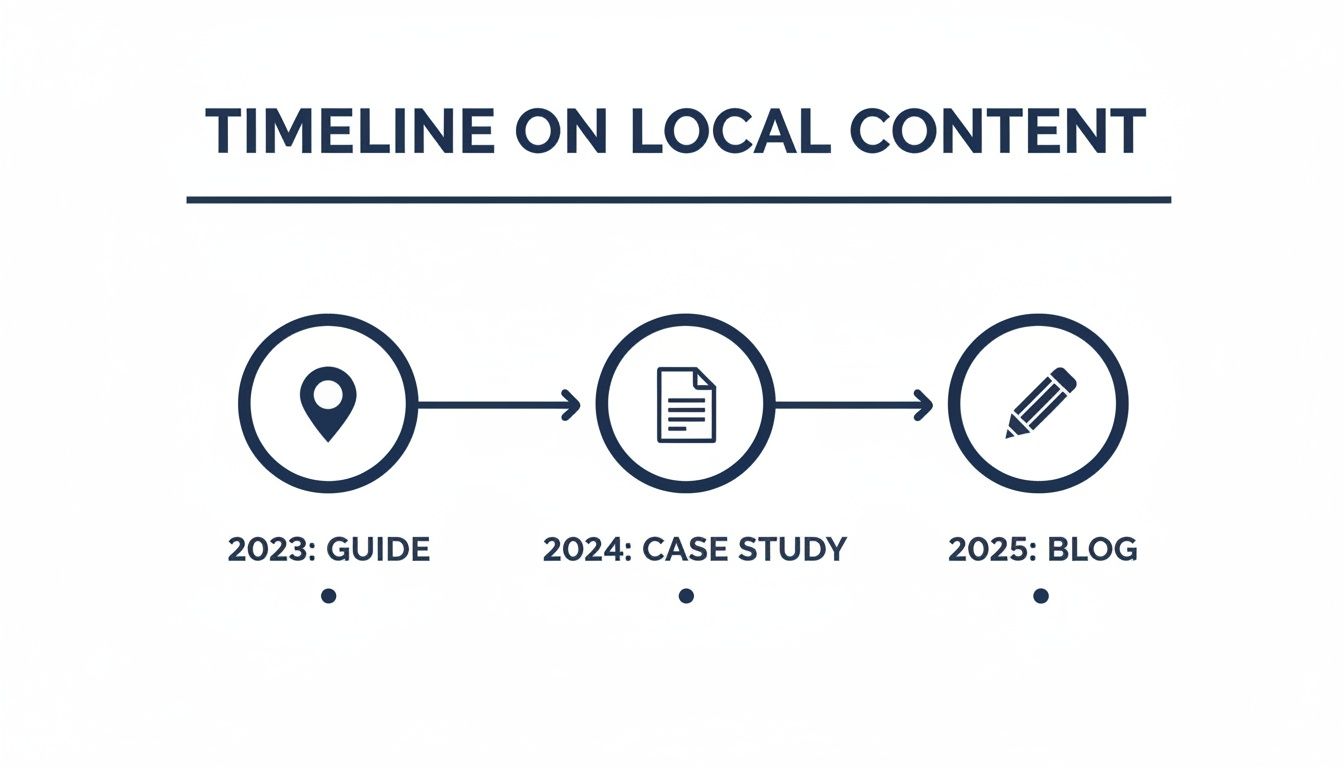
This progression shows a content strategy that builds authority over time. You first establish broad expertise and then deepen it with specific, trust-building examples.
By month three, focus on publishing your first hyper-local blog post—something like a community guide or a case study featuring a local client. At the same time, begin tracking key metrics like phone calls from your GBP and your ranking position in the Local Pack.
To make this even easier, here’s a checklist that breaks down the entire 90-day plan into a clear, prioritised schedule.
90-Day Prioritised Local SEO Checklist
| Month | Key Focus | Actionable Tasks |
|---|---|---|
| 1 | Foundational Setup | GBP: Complete 100% of your profile, upload 10+ photos, add services. Citations: Verify NAP consistency, build on Yell, Yelp, Thomson. |
| 2 | Website & Reputation | On-Page: Optimise title tags/metas with location keywords. Reviews: Set up a system to request reviews, draft response templates. |
| 3 | Growth & Measurement | Content: Publish your first hyper-local blog post. Tracking: Monitor GBP calls, website clicks, and Local Pack rankings. |
Following this structure provides a clear path forward, ensuring you tackle the most impactful tasks first and build a solid base for long-term local SEO success.
Your Local SEO Questions, Answered
Getting started with local SEO always brings up a few common questions. Let's tackle some of the big ones so you can move forward with a clear plan.
How Long Does Local SEO Take to Work?
This is the million-dollar question, isn't it? Local SEO isn't an overnight fix, but you can see some encouraging movement faster than you might think.
Getting the fundamentals right, like fully optimising your Google Business Profile, can start to improve your visibility within a few weeks. For the more competitive stuff—ranking for those high-value local keywords—you should expect to see real, meaningful progress within three to six months of consistent effort. Patience and persistence are key here.
What’s the Difference Between SEO and Local SEO?
Think of it like casting a net. Traditional SEO casts a huge net, trying to rank your website for broad keywords to attract a national or even global audience. It’s all about widespread visibility.
Local SEO, on the other hand, is like precision fishing in your local pond. The whole point is to make your business pop up for customers in a specific geographic area. We're talking about searches with clear local intent, like "plumber near me" or "best coffee in Manchester."
The real difference-maker is intent. General SEO targets anyone, anywhere. A smart local SEO for small business strategy targets customers who are practically on your doorstep and ready to make a purchase.
Can I Do Local SEO Myself?
Absolutely, you can. While bringing in an agency can certainly speed things up, many of the most powerful local SEO tasks are well within the reach of a hands-on business owner.
If you follow the steps we've laid out in this guide—from polishing your Google profile and managing reviews to creating content that speaks to your local community—you can achieve fantastic results. You don't need a massive budget or a degree in computer science to make a real impact.
Ready to turn local searches into loyal customers? The expert team at Amax Marketing creates data-driven local SEO strategies that get you seen by the right people, in the right place, at the right time. Get your free marketing audit and see how we can help your business grow. Visit us at https://amaxmarketing.co.uk.