
Link building is all about getting other websites to link back to yours. Think of these links as votes of confidence. When a respected website links to you, it's essentially telling search engines like Google, "Hey, this site is trustworthy and has great content." The more of these high-quality votes you collect, the more credible your own website becomes.
Why Link Building Is a Pillar of SEO
At its heart, link building is about building your website's online reputation. It’s a lot like getting a recommendation in real life. If you were looking for a great local restaurant, you'd trust a suggestion from a friend who knows food over a random flyer, right? Backlinks work the same way for search engines.
A link from a well-known, reputable site is a powerful signal to Google. It’s a digital endorsement that vouches for your content's quality and relevance, helping Google figure out which pages deserve to be at the top of the search results. A strong backlink profile shows you're a valuable, trusted resource.
Of course, it hasn't always been this way. The game has changed a lot. Old-school, spammy tactics like buying up thousands of cheap links will now get you penalised. Today, it’s all about earning genuine, relevant links that actually help users.
The Shift from Quantity to Quality
In the early days of SEO, it was a numbers game—the more links, the better, no matter where they came from. That approach led to a lot of manipulative practices that Google now actively stamps out. The modern, and far more effective, strategy is all about quality.
A single, powerful backlink from a major authority in your industry is worth more than hundreds of links from irrelevant, low-quality websites. For example, a link from a national news publication or a highly respected industry blog tells Google you're a serious contender in your field. This is how you build what we in the SEO world call "authority." You can dive deeper into this topic by reading up on what authority in SEO really means and how it works.
To put it simply, here’s a quick breakdown of the core ideas.
Link Building Fundamentals at a Glance
| Concept | Simple Analogy | Impact on SEO |
|---|---|---|
| Backlink | A recommendation or referral from another website. | Each quality backlink boosts your site's credibility. |
| Authority | Your website's reputation and expertise. | Higher authority leads to better search rankings. |
| Relevance | How closely related the linking site is to your industry. | Relevant links carry more weight with Google. |
| Quality vs. Quantity | One great recommendation is better than 100 random ones. | Focus on earning links from trusted sources. |
It's a long-term investment, not a quick fix.
The goal is not just to get links, but to earn endorsements. A high-quality backlink profile is a byproduct of great content, strong relationships, and a solid brand reputation. It's a long-term investment in your website's digital presence.
Grasping this fundamental principle is the first step towards building a link building strategy that actually lasts. It’s not about finding loopholes or trying to trick the system. It’s about creating content worth linking to and building real relationships online. This approach doesn't just improve your rankings—it also drives valuable referral traffic and cements your brand's credibility.
The Core Link Building Strategies Explained
So, you get the 'what' of link building, but the 'how' is where the real work begins. Let's be clear: a successful campaign isn’t about just one tactic. It’s a smart mix of different strategies, all working together to earn those precious "votes of confidence" from other websites.
At its heart, the whole system is a hierarchy. Think of it like a pyramid, with Google at the top, your website's overall authority in the middle, and backlinks forming the strong foundation.
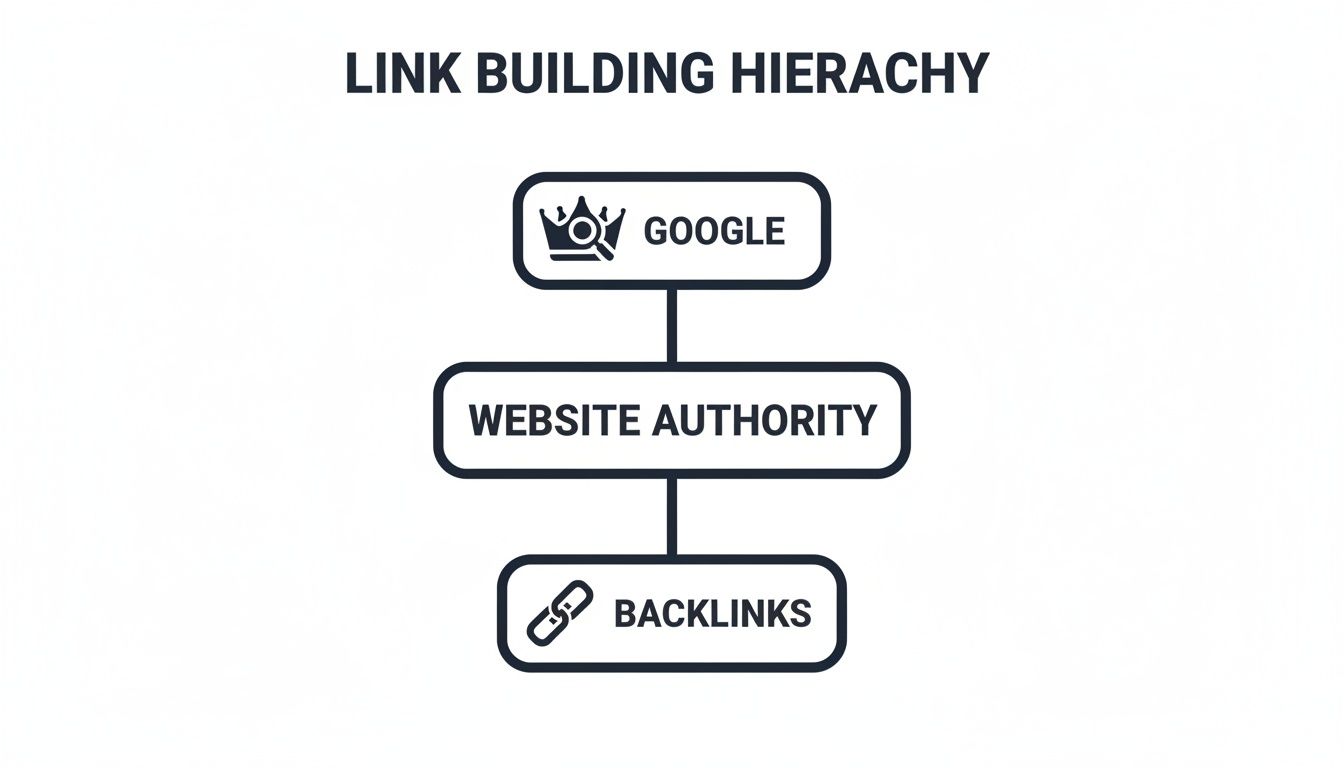
This simple chart nails it: backlinks are what build your authority, and that authority is what gets Google’s attention. Now, let’s look at the different ways you can start building that foundation.
Earning Links Organically
This is the holy grail of link building. Earned links are the ones you get without even asking, simply because you’ve created something so good that people want to share and reference it. It’s pure, digital word-of-mouth.
The secret? You need to create linkable assets. These aren't just blog posts; they're high-value resources designed from the ground up to attract links naturally.
A few classic examples include:
- Original Research: Publishing unique industry studies or survey results that nobody else has.
- Comprehensive Guides: Writing the definitive, go-to guide on a topic that answers every possible question.
- Free Tools and Calculators: Building a simple online tool that solves a common problem for your audience.
- Visual Content: Designing killer infographics or videos that are easy for others to embed on their own sites.
This approach is so powerful because it’s exactly what Google wants to see: incredible content that genuinely helps people. The links you get this way often come from highly respected sources, and they look completely natural.
Building Links Through Outreach
Waiting for links to come to you is great, but sometimes you need to be more proactive. That’s where built links come in. This is all about rolling up your sleeves, finding relevant websites, and reaching out to ask for a link.
But this isn't about blasting out generic emails. It's about building real relationships. A great example of this is guest posting, where you offer to write a high-quality article for another website in your industry. In exchange for your expertise, you get a link back to your own site, usually in the content or your author bio.
Another incredibly effective method is digital PR. In the UK, it’s basically the undisputed champion of link building—a recent survey of 518 SEO experts found that a massive 48.6% believe it's the most effective tactic out there. This involves creating newsworthy content or stories and pitching them to journalists and bloggers to get featured in major publications.
Key Takeaway: Building links takes time and effort, but it puts you in the driver's seat. The trick is to always offer real value, making sure it’s a win-win for both you and the website you’re contacting.
Of course, it's vital to keep your outreach ethical. There's a fine line between smart and spammy, which is why it's so important to understand the difference between good and bad tactics, often called white hat and black hat link building.
Creating Links Manually
The third piece of the puzzle is created links. This is where you manually place links to your website on different online platforms. For new or local businesses, this is often the very first step in building an online footprint.
Common tactics include:
- Business Directories: Listing your business on reputable sites like Yelp or niche-specific directories.
- Social Media Profiles: Making sure your website link is on all your business profiles (LinkedIn, Facebook, X, etc.).
- Local Citations: Getting your business name, address, and phone number (NAP) listed consistently across local directories and sites.
These links don’t usually pack the same SEO punch as earned or built links, but they are absolutely essential for local SEO. They help search engines confirm that your business is legitimate and where it's located. Just be careful—stick to quality directories, as listing on spammy sites can do more harm than good.
Beyond these core methods, don't forget to explore other avenues. For example, podcast guesting as a valuable link building method is a fantastic way to build authority and get your name out there. Ultimately, the best strategy uses a healthy mix of all three approaches.
How to Launch Your First Link Building Campaign
Knowing the theory of link building is one thing, but actually rolling up your sleeves and doing it is another beast entirely. Moving from abstract concepts to getting real clicks requires a solid, step-by-step plan. This guide will walk you through launching your first campaign, taking the mystery out of the process so you can start earning valuable links with confidence.
To keep things grounded, let’s use a real-world example. Imagine you run a small, independent bakery in London called "The Flour Pot." You've just poured your heart into a fantastic blog post titled "The Ultimate Guide to Sourdough for Beginners," complete with a unique recipe and step-by-step photos. This guide is your linkable asset—the brilliant piece of content you'll use to attract links.

Step 1: See What Your Competitors Are Up To
Before you even think about building your own links, you need to understand the playing field. The smartest way to start is by looking at who is already linking to your competitors. This is often called a backlink gap analysis, and it’s like getting a cheat sheet that reveals which websites already find content like yours valuable.
Fire up an SEO tool and pop in the URLs of a few rival bakeries or popular food blogs. The tool will spit out a list of every website linking to them. You're not looking to just copy their every move; you're hunting for patterns and, more importantly, opportunities they might have missed.
For "The Flour Pot," this could uncover links from:
- Local London lifestyle blogs.
- UK-based food and recipe websites.
- Online communities for home bakers.
This initial bit of detective work hands you a ready-made list of potential targets who are already interested in your niche. If you want to go deeper, our guide on how to conduct competitor analysis offers a much more detailed framework for this crucial first step.
Step 2: Hunt for High-Quality Link Prospects
With your competitor insights in hand, it's time to build out your own target list. This process, known as prospecting, is all about finding websites that are genuinely relevant to your topic, have a real audience, and would actually appreciate the value your content provides. Don't just chase the big names; niche blogs and community forums can provide some of the most relevant and powerful links you’ll get.
For "The Flour Pot," your search would involve looking for things like:
- "best UK baking blogs"
- "sourdough recipe roundup"
- "food blogger London"
Get organised from the start with a simple spreadsheet. Log the website URL, a contact name (if you can find one), and a column to track your outreach status. Aim for a solid list of at least 50-100 high-quality prospects before you even think about writing an email.
Step 3: Write an Outreach Email That Doesn’t Suck
This is where so many campaigns fall flat. A generic, copy-and-paste email is the fastest way to get your message ignored and deleted. Your outreach has to be personal, respectful, and laser-focused on providing value to the person you're contacting.
Your email should never, ever sound like you're demanding a link. Instead, you're just offering a helpful suggestion.
Pro Tip: Keep your outreach email short, to the point, and make the "what's in it for them" crystal clear. Show you’ve actually read their stuff and explain exactly why your resource would be a fantastic addition for their specific audience.
A simple, effective structure looks like this:
- Personalised Opener: Mention a specific article they wrote that you genuinely enjoyed.
- The Value Prop: Briefly introduce your "Ultimate Guide to Sourdough" and explain why their readers would find it useful.
- The Gentle Ask: Suggest a specific spot where a link to your guide would make sense on their site (e.g., in their post about essential baking tools).
- A Simple Close: End with a friendly, no-pressure sign-off.
Remember, you're building relationships here, not just collecting links. A single, thoughtful email to the right person is worth a hundred generic ones blasted out into the void.
Step 4: Track Your Progress and Follow Up
Once your emails are sent, your job isn't over. It's vital to track who you've contacted, who has replied, and most importantly, who has actually linked to you. Use that spreadsheet to keep meticulous notes on every single interaction.
Don't be discouraged if you don't hear back right away. Most people won't respond to your first email, and that’s completely normal. A polite, gentle follow-up a week later can work wonders. In fact, one study found that a single follow-up can boost response rates by over 65%.
Your follow-up should be even shorter than your first message. A simple, "Just checking you saw my last email" and a gentle restatement of your suggestion is all you need. If you don't hear back after one follow-up, it’s usually best to move on. Professionalism and respect are everything when it comes to building a good reputation in your industry.
Choosing the Right Tools for Your Link Building Toolkit
Behind every great link building campaign is a set of powerful tools. Think of it this way: trying to build links manually is like trying to build a house with nothing but a hammer. You might get somewhere eventually, but it's going to be a slow, frustrating, and inefficient process. The right toolkit doesn't just save you time; it gives you the data you need to make much smarter decisions.
These tools aren't just a luxury; they're essential if you want to compete. They handle the repetitive, mind-numbing tasks, uncover opportunities you’d never find on your own, and give you a crystal-clear picture of what your competitors are up to.

Core Types of Link Building Tools
Your toolkit can be split into three main categories, each playing a different but crucial role in your campaign.
-
Backlink Analysis Tools: These are your digital spyglasses. Platforms like Ahrefs, Semrush, and Majestic let you dig deep into your own backlink profile and, more importantly, your competitors'. You can see exactly who is linking to them, which of their pages are magnets for links, and spot "link gaps"—opportunities they have that you're missing out on.
-
Outreach and CRM Platforms: Once you’ve identified who you want a link from, you need an organised way to manage the conversation. Tools like Pitchbox, Hunter, or NeverBounce help you find email addresses, send personalised outreach emails at scale, and keep track of all your follow-ups. They stop you from accidentally emailing the same person twice and show you who’s actually opening and reading your messages.
-
Prospecting and Digital PR Tools: These platforms are all about finding fresh, timely opportunities. Services like HARO (Help a Reporter Out) connect you directly with journalists looking for quotes from experts, while other tools can find "unlinked brand mentions"—places where someone has talked about your business online but forgot to add a link. These are often the easiest wins.
Essential Link Building Tool Comparison
To help you get started, here's a look at some of the most popular tools, broken down by what they do best and who should be using them.
| Tool Category | Example Tools | Primary Use | Best For |
|---|---|---|---|
| Backlink Analysis | Ahrefs, Semrush, Majestic | Analysing competitor backlinks, finding link gaps, tracking your own profile. | Everyone from freelancers to large agencies. The foundation of any campaign. |
| Outreach & CRM | Pitchbox, Hunter, Mailshake | Finding contact info, sending and tracking email campaigns, managing relationships. | Anyone doing regular outreach who needs to stay organised and efficient. |
| Digital PR & Prospecting | HARO, BuzzSumo, Muck Rack | Finding journalist requests, discovering content trends, identifying unlinked mentions. | Businesses looking to earn high-authority media links and build brand presence. |
This table is just a starting point. The real magic happens when you integrate these tools into a smooth, repeatable workflow that fits your specific strategy.
Matching Tools to Your Goals
The tools you pick should always match your specific goals and budget. A solo entrepreneur might just need a free backlink checker and a simple spreadsheet to get started. A large agency, on the other hand, will probably invest in a full suite of enterprise-level software. The key is to understand what each tool does and how it slots into your process.
Recent industry research uncovered a really interesting fact. The top-ranking pages in the UK have 3.8x more backlinks than pages ranking in positions 2-10. Yet, only 43% of SEO professionals use search rankings as their main measure of success. Instead, they focus on metrics like organic traffic and the quality of linking domains, which shows a sophisticated understanding that not all links are created equal. This is precisely where your tools become invaluable, helping you focus on quality over sheer quantity.
Don't get overwhelmed by feeling like you need every tool from day one. Start with one solid backlink analysis tool and really master competitor research. As your campaigns get bigger and more complex, you can then add outreach and prospecting tools to help you scale up. Your toolkit should grow and evolve right alongside your strategy.
Common Link Building Mistakes and How to Avoid Them
Getting link building right is one thing, but knowing what not to do is just as important. I’ve seen countless promising SEO campaigns completely unravel because of a few common, easily avoidable mistakes. These slip-ups can stunt your growth, damage your rankings, or even land you a dreaded penalty from Google.
Let’s walk through the biggest pitfalls so you can build a backlink profile that’s not just strong, but also built to last. Most of these errors come from an outdated mindset—treating link building like a numbers game instead of the relationship-driven marketing it is today.
Chasing Quantity Over Quality
If there’s one mistake that sums up the old, broken way of doing things, it's this: focusing on the sheer volume of links instead of their quality. It’s a relic from a different era of SEO, and it simply doesn't work anymore.
Honestly, a single, powerful link from a respected website in your industry is worth more than hundreds of cheap, spammy links from irrelevant domains. Google’s algorithms are now incredibly sophisticated at telling the difference between a genuine recommendation and a clumsy attempt to manipulate rankings.
Remember this: Your backlink profile is a direct reflection of your online reputation. Every link should be an endorsement you're genuinely proud of. When you prioritise quality, you're building a solid foundation that can weather any algorithm update.
This isn’t just my opinion; it’s a non-negotiable standard in the industry. A recent survey showed that 89% of SEO specialists would reject a link if the site had a spammy outbound link profile. On top of that, 86.3% would turn down links from sites with poor content. If you're curious, you can discover more insights about link building standards and see just how seriously the pros take quality.
Getting Links from Irrelevant Websites
Context is everything. The value of a backlink is tied directly to how relevant the linking website is to your own.
Think about it. If you run a self-storage business in London, a link from a popular London property blog is a fantastic signal of authority. But a link from a random blog about exotic pets? It makes no sense. It’s worthless in Google’s eyes because it doesn't provide a logical "vote of confidence."
Irrelevant links just confuse search engines and offer zero value to users. Always ask yourself, "Does this link make sense for a real person reading this page?" If the answer is no, it’s not a link you should be chasing.
Over-Optimising Your Anchor Text
Anchor text—the clickable text in a link—is a powerful signal. It helps tell Google what the page you're linking to is all about. However, aggressively stuffing the exact same keyword into every single anchor text is a massive red flag for search engines. This is called over-optimisation, and it looks completely unnatural.
A healthy backlink profile has a diverse mix of anchor text types.
- Branded anchors: "Amax Marketing"
- Naked URLs: "https://amaxmarketing.co.uk"
- Generic anchors: "click here" or "read more"
- Partial match keywords: "digital marketing agency in London"
You should be aiming for a blend that feels organic. Most of your anchors should be branded or generic. Keyword-rich anchors should be used sparingly and only when they fit perfectly and naturally into the surrounding text. This shows Google your links were earned, not artificially engineered to cheat the system.
Forgetting About Internal Linking
So much energy goes into earning external links that it’s easy to forget about the links you have complete control over: internal links. These are the hyperlinks that connect one page on your website to another, and ignoring them is a huge missed opportunity.
A smart internal linking strategy does a few brilliant things. First, it helps search engines crawl your site more efficiently, discovering and indexing all your important pages. Second, it strategically passes authority (often called "link juice") from your most powerful pages, like your homepage, to other pages you want to boost.
And finally, it massively improves the user experience by guiding your visitors to related content, keeping them engaged and on your site for longer. Make it a habit to look for opportunities to link between your relevant blog posts and service pages. It’s one of the easiest SEO wins out there.
The Future of Link Building Is Building Your Brand
If you're wondering where link building is headed, look no further than your own brand. The old days of treating link building as a separate, technical SEO task are long gone. Today, it’s becoming a core part of digital public relations, where the lines between the two are blurring completely.
Search engines are getting smarter every year. As they do, the focus shifts more and more towards earning links from high-authority sources that genuinely vouch for your expertise. It's about building a brand that people actually want to talk about, reference, and link back to. A backlink isn't just a link anymore; think of it as a vote of confidence in your brand's reputation.
Investing in Your Brand's Authority
This shift in thinking also changes how we should view the budget for it. Link building isn't just another line item cost; it's a fundamental marketing investment. The return on that investment comes from long-term organic traffic and a stronger brand that people recognise and trust.
And it seems the rest of the industry agrees. Confidence is high, with 61% of UK link builders planning to spend more in the coming year. That fits right in with the 64% of SEOs who expect their overall budgets to grow, too. This tells us that quality backlinks are seen as essential for staying competitive. You can dive deeper into the numbers by checking out the full research on link building investment trends.
The ultimate goal is to build a brand so reputable that it earns links without even asking. Every piece of content, every outreach email, and every digital PR campaign should contribute to building a stronger, more visible brand that search engines and users trust implicitly.
This modern approach isn't just a defensive move against the next Google update. It’s about building a digital presence that can stand the test of time. When you focus on brand-led link building, you kickstart a powerful cycle: a strong brand attracts high-quality links, and those links, in turn, make your brand even more authoritative. That’s how you future-proof your SEO.
Got Questions About Link Building? We’ve Got Answers.
As you start to get your head around link building, a few questions always seem to come up. It's completely normal. Let's run through some of the most common ones to help clear things up and set some realistic expectations for what’s ahead.
How Long Until I See Results from Link Building?
This is the big one, isn't it? Everyone wants to know when the magic happens. While you might notice a small uptick in a few weeks, proper link building is a long game, not a quick win. You have to be patient.
How fast a new backlink makes a difference depends on things like the linking site's authority and how quickly Google gets around to crawling it. Honestly, you should be prepared to wait a few months before you see a real, noticeable jump in your rankings and traffic.
Research backs this up. A huge 83.2% of SEO pros report that the effects of a new backlink don't even start to show for two weeks or more. So, that idea of instant results? It’s a myth. If you want to dive deeper into the data, you can explore more link building statistics that paint a clearer picture of the typical timelines.
So, Is It Okay to Just Buy Backlinks?
This is a really important distinction to get right. Directly paying someone to place a link on their site just to boost your rankings is a big no-no. It’s a classic "black-hat" tactic that goes against Google's guidelines, and if you get caught, the penalties can be severe. Just don't do it.
However, that’s completely different from investing in the work required to earn links. Things like paying a digital PR agency for their expertise, putting a budget towards creating genuinely brilliant content, or even sponsoring a local community event are all perfectly legitimate ways to earn high-quality backlinks.
How Many Backlinks Do I Actually Need to Rank?
There’s no magic number here. The question isn't "how many?" but "what kind?" When it comes to links, quality and relevance will always beat sheer quantity.
Think about it: one single, powerful link from a major voice in your industry is worth more than a hundred links from spammy, irrelevant websites. The best way to get a feel for what you need is to look at who's already winning. Analyse the backlink profiles of your top competitors. See what kind of links they have and how many. That gives you a realistic benchmark to aim for, and then your job is to build a profile that's not just bigger, but better.
Ready to build a powerful link profile that drives real results? Amax Marketing has over a decade of experience creating bespoke SEO strategies that boost authority and generate leads. Start with our complimentary marketing audit to uncover your biggest opportunities. Discover how we can help at https://amaxmarketing.co.uk.