For small businesses, social media isn't just about posting pretty pictures. It's a powerful way to connect directly with your customers, build a real community around your brand, and ultimately, drive sales. Forget old-school advertising—platforms like Facebook and Instagram let you have genuine conversations with the people who matter most to your business.
Building Your Foundation for Social Media Success
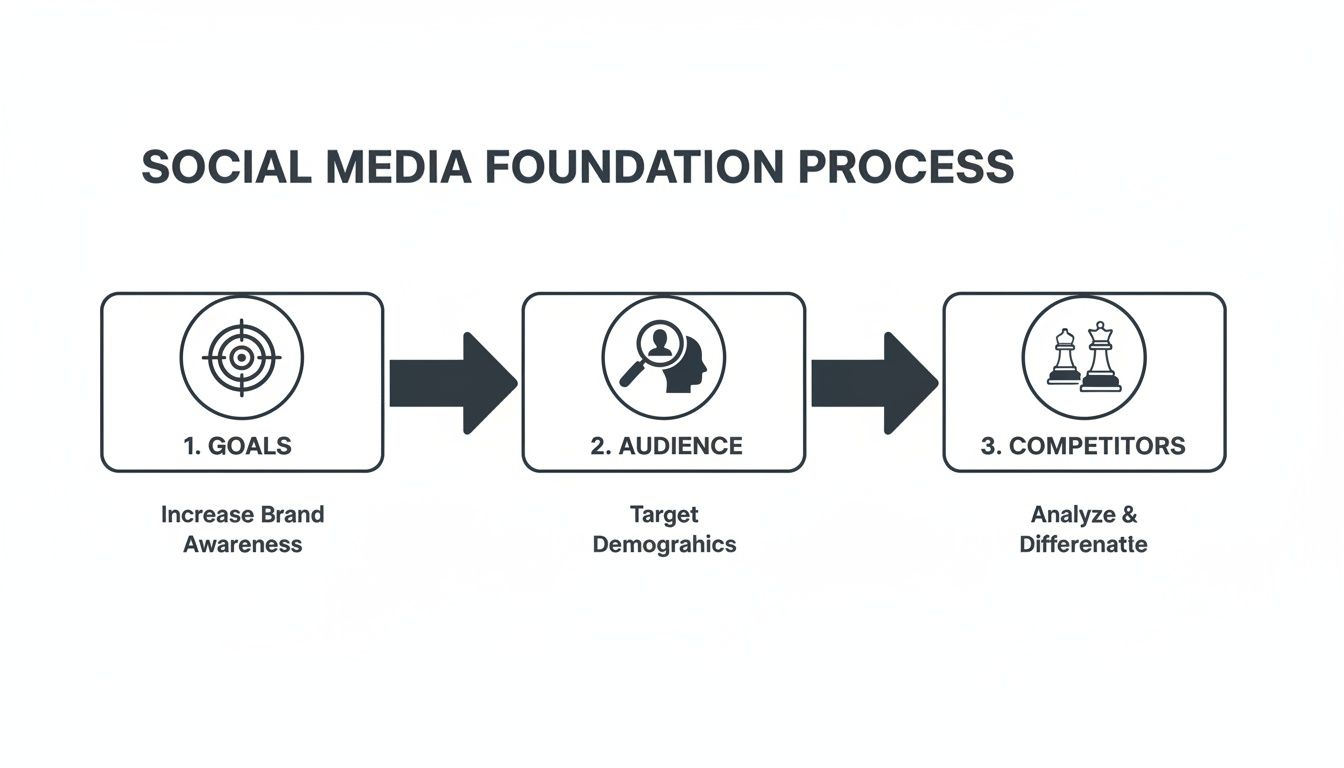
Before you even think about your first post, we need to lay some groundwork. Diving into social media without a plan is like setting off on a road trip with no map. You'll be busy, sure, but you won't get anywhere meaningful. A strong social media strategy for small business is built on three pillars: clear goals, a deep understanding of your audience, and a sneaky look at what your competitors are up to.
Getting this foundation right is non-negotiable. It makes sure every bit of content you create and every penny you spend has a purpose and pushes you closer to your business goals.
Set Clear Business Goals
Likes and shares are nice, but they don't pay the bills. Your social media activity needs to have a real, tangible purpose. Forget vague ambitions like "more brand awareness" and get specific.
Think about it from the perspective of a self-storage business. Their goals could look like this:
- Generate 20 qualified leads per month through our Facebook contact form.
- Increase website clicks from social media by 15% over the next three months.
- Get 10% more brand mentions in local community Facebook groups.
See the difference? These are concrete, measurable targets that have a direct impact on the business. Every decision from here on out—which platforms to use, what to post—should tie back to hitting these numbers.
Understand Your Ideal Customer
You can't sell to someone you don't know. The key is to stop thinking about a generic "audience" and start thinking about a specific person. Go beyond the basics of age and location and really get inside their head.
Ask yourself these kinds of questions:
- Who are they, really? (Job, family situation, where they live in town.)
- What keeps them up at night? (What problems are they facing that you can solve?)
- Where do they hang out online? (Are they scrolling Instagram Reels for fun, asking for recommendations in local Facebook groups, or networking on LinkedIn?)
- What kind of content actually grabs their attention? (Do they want quick how-to videos, customer stories, or a behind-the-scenes look at your business?)
When you know the answers, you can show up in the right place with the right message. Your marketing starts to feel genuinely helpful, not just like another ad.
Analyse Your Competitors
Finally, it's time to see what everyone else is doing. This isn't about copying them—it's about finding the gaps. In the UK, small business social media is buzzing; 76% use Facebook and 63% are on Instagram. That’s a massive market, especially with Facebook reaching 38.3 million users in the UK alone.
Look at your competitors' pages. What are they doing well? More importantly, what are they not doing? Maybe their videos are boring, or they take forever to reply to comments. These are your opportunities to shine and stand out from the crowd. If you're looking for a professional deep-dive, our own social media services can handle this kind of analysis for you.
Choosing the Right Social Media Platform for Your Business
Not all platforms are created equal, and as a small business, your time is precious. You need to focus your energy where it will have the most impact. This table breaks down the main players for UK businesses to help you decide where you belong.
| Platform | Primary UK Audience | Best For | Example Use Case (Self-Storage) |
|---|---|---|---|
| Broad (25-55+), strong local community presence. | Building local community, lead generation, customer service, targeted local ads. | Running a targeted ad for "student storage" to people aged 18-22 within a 5-mile radius of local universities. | |
| Younger demographic (18-35), visually driven. | Showcasing products/services visually, building brand personality, behind-the-scenes content. | Creating an Instagram Reel showing a time-lapse of a cluttered garage being cleared out and moved into a clean storage unit. | |
| Professionals, B2B decision-makers. | B2B networking, establishing industry authority, company news, recruitment. | Connecting with local estate agents and removal companies to create a referral partnership for people moving house. | |
| X (Twitter) | News-focused, real-time engagement (25-49). | Quick updates, customer service conversations, joining trending topics. | Sharing live updates on unit availability during a busy moving season, like "Only 3 medium units left for August!" |
| TikTok | Gen Z and Millennials (16-34), trend-driven. | Fun, creative, and viral-potential video content that shows personality. | A short, satisfying video of perfectly organising items inside a storage unit with trending music. |
| Predominantly female (25-45), inspiration and planning focused. | Visual discovery, driving traffic to blogs/product pages, long-term content lifespan. | Creating a board titled "Decluttering & Home Organisation Hacks" with pins that link back to a blog post on the business's website. |
Choosing one or two platforms to master is far more effective than spreading yourself thinly across all of them. Pick the channels where your ideal customer is already spending their time, and you'll be on the right track from day one.
Developing a Content Strategy That Actually Converts
Having a presence on social media is one thing, but making it work for your business is another game entirely. If you're just posting on the fly without a plan, you're essentially shouting into the wind. The real goal is to create a steady rhythm of content that doesn't just get likes, but methodically turns casual scrollers into paying customers.
This is where the idea of content pillars will save you a world of headache. Think of them as three to five core topics that you'll talk about again and again. These pillars are the foundation of your strategy, making sure every single post is relevant to your audience and reinforces who you are as a brand.

Defining Your Core Content Pillars
So what does this look like in the real world? Let’s stick with our local self-storage business. Their content pillars could easily be:
- Decluttering & Organisation Tips: Offering genuine advice that helps people solve a real, nagging problem. This builds authority and goodwill.
- Customer Success Stories: Showcasing how real people have used your storage units. Nothing builds trust faster than seeing someone else's positive experience.
- Behind-the-Scenes: People buy from people. Humanise your business by showing your team, the cleanliness of your facilities, and a peek into daily operations.
- Community Spotlight: Position yourself as a local hub by shouting out other local businesses or promoting community events.
With these pillars in place, you’ve got a framework to guide your brainstorming. It puts an end to that dreaded "what on earth do I post today?" panic, because every idea now has a home.
Creating a Balanced Content Mix
Once your pillars are set, we need to think about the flavour of your content. A classic mistake I see small businesses make is going too hard on the sales pitch. Let's be honest, nobody opens Instagram hoping to see an advert; they're there to be entertained, learn something new, or feel inspired.
A brilliant guiding principle here is the 80/20 rule.
Aim for 80% of your content to be purely valuable, engaging, and helpful. The other 20%? That’s your window to post direct promotions—your special offers, calls to book, or service highlights.
Key Takeaway: Your social media feed should feel like a valuable resource or a fun magazine, not a non-stop sales catalogue. When you consistently give value, you earn the right to ask for the sale.
This balanced approach is a trust-building machine. When you finally do post that offer, your audience is far more likely to listen because you’ve already given them so much for free.
Planning with a Simple Content Calendar
To make this all happen, you need to be consistent. The algorithms love it, and your audience learns to expect it. A content calendar is your best friend for staying organised and on track. It doesn't have to be some complex, expensive software—a simple spreadsheet is often all you need to get started.
Here’s a basic layout you can adapt:
| Post Date | Platform(s) | Content Pillar | Content Type | Caption/Copy | Visual | Status |
|---|---|---|---|---|---|---|
| Monday | Facebook/Insta | Decluttering | Quick Tip (Carousel) | "3 hacks to organise your garage this weekend…" | Graphic | Scheduled |
| Wednesday | Behind-the-Scenes | Reel Video | "Meet Sarah, our facility manager!" | Video | To Film | |
| Friday | Community | Shared Post | "Shoutout to The Corner Cafe for the best coffee…" | Photo | Posted |
Even just planning one or two weeks ahead can slash your stress levels and seriously improve the quality of what you post. It’s the difference between reactive panic-posting and proactive, strategic content.
The Power of Repurposing Content
As a small business owner, time is your most precious commodity. That's why you need to get into the habit of repurposing content. It’s the art of working smarter, not harder. You take one solid piece of content and chop it up into several smaller posts for different platforms.
Think about it: a single blog post on your website can be a goldmine. For businesses exploring https://amaxmarketing.co.uk/content-marketing-for-ecommerce/, one in-depth article can fuel social media for weeks.
Here’s a practical example of how it works:
- The Core Idea: You write a blog post: "5 Ways to Prepare Your Home for Sale."
- The Video Version: Film a short, snappy YouTube Short or Instagram Reel summarising the five tips.
- The Carousel: Design a simple five-slide carousel for Instagram, dedicating one slide to each tip.
- The Bite-Sized Graphics: Create five separate graphics, one for each tip, and schedule them out on Facebook and X (formerly Twitter) over a week.
- The Insider Look: Post an Instagram Story of you filming the video or writing the blog post to show the process.
Suddenly, one idea has spawned a whole week's worth of varied, engaging content. This approach saves an incredible amount of time and reinforces your message across different platforms. And don't forget to mix things up! Dropping in some relevant marketing memes can add a dose of personality and keep your feed from feeling too corporate.
How to Grow Your Audience Organically
You don't need a massive budget to start building a loyal following. Some of the most powerful growth tactics cost nothing but your time and a bit of creativity. When it comes to organic growth, the secret isn't a single viral post; it's about the consistent, smart effort that builds momentum day after day.
This means you have to work with the platform algorithms, not against them. These systems are designed to favour accounts that show up regularly and get people talking. By posting consistently and encouraging interaction, you’re sending a strong signal that your content is valuable, which helps push it out to more of your followers' feeds.
Master the Art of Hashtag Research
Think of hashtags as a clever filing system for the entire social media world. Using them correctly is one of the fastest ways to get your content discovered by people who don't follow you yet. But just slapping #smallbusiness on every post and calling it a day won't move the needle. A truly effective hashtag strategy is a mix of art and science.
Your goal is to use a thoughtful blend of different hashtag types to cast the widest, most relevant net. Here’s a simple framework I always recommend:
- Broad Industry Tags: These are the big ones, like
#SelfStorageor#UKBusiness. They get a huge amount of traffic, but your post can get lost in the crowd. - Niche-Specific Tags: Time to get more focused. Think
#StorageSolutionsor#DeclutterYourLife. The audience is smaller, but they’re far more likely to be interested in what you do. - Location-Based Tags: For any business with a physical location, these are pure gold. Using tags like
#StorageLondonor#ManchesterSmallBizhelps you pop up in front of actual potential customers in your area.
A good rule of thumb is to sprinkle a mix of all three types into your posts. On Instagram, aim for around 10-15 well-researched hashtags. For platforms like LinkedIn or X (formerly Twitter), keep it tight with just two or three highly relevant tags.
Build a Community Through Authentic Engagement
Organic growth is really just a by-product of real conversations. Too many businesses treat social media like a megaphone when it’s actually a telephone. You have to listen and respond just as much as you broadcast. This is where so many businesses drop the ball, giving you a brilliant opportunity to stand out.
Pro Tip: Make it a non-negotiable rule to respond to every single comment you get. Even a simple "Thanks!" shows people you're paying attention and makes them more likely to engage with you again.
Don't just wait for comments to come to you—go out and start the conversation. Run polls in your Instagram Stories to get quick feedback. Ask open-ended questions in your captions that invite more than a one-word answer. For example, a self-storage business could ask, "What's the one item you find hardest to part with when you're decluttering?" This sparks genuine discussion and, as a bonus, gives you incredible insight into your customers' mindsets. This hands-on approach is just one of many digital marketing tips for new businesses that can make a huge difference.
Collaborate with Other Local Businesses
One of the most underused growth hacks for local businesses is simply teaming up. Find other, non-competing businesses in your patch that serve a similar type of customer and work together. It’s a fantastic way to cross-promote and get your brand in front of a completely new—but highly relevant—audience.
Here are a few practical ideas to get you started:
- Run a Joint Giveaway: A local estate agent and a self-storage facility could partner up to offer a "New Home Starter Pack" as a prize.
- Do an Instagram 'Takeover': Let a local professional organiser take over your Instagram Stories for a day to share their best decluttering tips.
- Give Each Other Shout-Outs: Sometimes it’s as simple as sharing a post from a local café you love. It builds brilliant goodwill and they’ll often return the favour.
For a service business like a self-storage facility, this collaborative spirit can also extend to online communities. Becoming a genuinely helpful member of local Facebook groups can be incredibly powerful. Instead of spamming links, answer questions about moving, offer advice on packing, and establish yourself as a trusted local expert. This builds trust and often leads to direct enquiries without you ever having to do a hard sell.
Using Paid Ads to Amplify Your Reach
Building a community organically is the heart and soul of your social media, but let's be honest, sometimes you need a shortcut. Paid advertising is that shortcut—it's the rocket fuel that gets your message in front of the right people, right now. For a small business, the idea of paying for ads can feel like a big, scary leap, but it’s actually one of the most direct and controllable ways to grow without breaking the bank.
Think of it this way: your organic posts are like having a brilliant shop on a quiet side street. Paid ads are the signposts you put up on the main road, pointing your ideal customers straight to your door. The trick is knowing which signs to use and where to put them.

Boosted Posts vs Ad Campaigns
When you first start exploring, you'll see a big, tempting "Boost Post" button on platforms like Facebook and Instagram. It's an easy entry point, but you need to know how it differs from a proper ad campaign built in a tool like Meta Ads Manager.
Boosted Post: This is the simplest form of advertising. You take an existing post from your page and pay to show it to more people. It’s fantastic for getting more eyeballs on something that’s already doing well, like a glowing customer testimonial or an event announcement.
Ad Campaign: This is a much more powerful approach. It gives you far more control over your goals (like website clicks or lead generation), lets you target specific audiences with incredible detail, and opens up creative options like carousel or video ads.
My Advice: Use boosted posts to amplify content that's already a proven winner with your organic audience. But when you have a specific business goal, like filling a self-storage unit or selling a particular product, you need to build a proper ad campaign.
Your First Local Awareness Campaign
For most small businesses, especially those with a physical location like a shop or a self-storage facility, the first paid campaign should be a local one. The goal is dead simple: make sure everyone within a few miles of you knows you exist.
Setting this up is surprisingly straightforward. In your ads manager, you can literally draw a circle on a map around your business and target everyone within that radius. You can even get more specific by layering on interests. For instance, a self-storage business could target people within a 5-mile radius who have also shown an interest in "moving house" or "home organisation."
You don't need a huge budget to get started. Kick things off with something small, maybe £50-£100, and run the campaign for a week. The aim here isn't to get hundreds of sales overnight; it's about building that crucial local brand recognition.
Here’s what a small starting budget might look like, spread across a month.
Example Starter Paid Social Campaign Budget
| Campaign Goal | Platform | Target Audience | Suggested Monthly Budget |
|---|---|---|---|
| Local Brand Awareness | People within 5 miles of your business | £50 | |
| Drive Website Traffic | People interested in your product/service | £100 | |
| Retarget Website Visitors | Facebook & Instagram | People who visited your website but didn't buy | £50 |
| Total | £200 |
This is just a starting point, of course. You can adjust these figures based on what's working and what your business can comfortably afford.
Harnessing the Power of Custom and Lookalike Audiences
This is where paid social advertising gets seriously clever. Instead of just guessing who your customers are, you can use your own data to find them—and people just like them.
Custom Audiences: These are groups of people who have already engaged with you. You can create audiences of people who have visited your website, interacted with your Instagram profile, or signed up to your email list. This is perfect for retargeting—showing a special offer to someone who looked at your pricing page but didn't quite commit.
Lookalike Audiences: Once you have a strong Custom Audience (like a list of your best customers), you can ask the platform to create a "lookalike." The algorithm analyses the traits of your existing customers and finds thousands of new people who share similar characteristics and behaviours. This is one of the single most effective ways to find new, high-quality leads.
The UK's social media advertising market is set to hit a massive £9.95 billion, and it's tools like these that make it so effective. With 47% of UK marketing professionals using paid social ads, and 71% reporting measurable returns, it's clear that smart targeting is a must. You can dive deeper into these figures by exploring some fantastic insights on UK social media trends.
Understanding Key Metrics for Success
When you run an ad, you're going to get hit with a lot of data. It’s easy to get lost. For a small business, you only need to focus on a few key numbers to know if your money is being well spent.
Here are the metrics that actually matter at the start:
- Reach: How many unique people saw your ad? This tells you about your overall awareness.
- Click-Through Rate (CTR): What percentage of people who saw your ad actually clicked it? A low CTR is a red flag that your creative or copy isn't hitting the mark.
- Cost Per Click (CPC): How much are you paying for each of those clicks? This measures how efficient your ad spend is.
- Conversions: This is the most important one. How many people actually did the thing you wanted them to do (like fill out a form or make a purchase)?
By starting small, targeting intelligently, and keeping a close eye on the right metrics, you can make paid ads a predictable and profitable part of your marketing plan.
Measuring What Matters: How to Track and Optimise Your Social Media
Putting great content out there and watching your follower count tick up is a brilliant start. But if you're not tracking what's actually happening behind the scenes, you’re essentially flying blind. Smart social media marketing isn't about guesswork; it's about using solid data to make better decisions and prove your efforts are paying off.
This is where the rubber meets the road—connecting your posts, stories, and videos to real business results. The first step? Learning to look past the easy numbers.
Moving Beyond Vanity Metrics
We all get a little buzz from seeing a post get a lot of likes. But "vanity metrics" like follower counts and likes don't pay the bills. They feel good, but they don’t tell you if anyone is actually taking action. We need to focus on the numbers that signal genuine interest and intent from your audience.
To really get a grip on what's working, you need to track Key Performance Indicators (KPIs) that link directly back to the business goals you set right at the start. These are the metrics that paint a clear picture of how people are responding to your content.
Here are the KPIs every small business should have their eye on:
Engagement Rate: This one is huge. It’s the percentage of your audience that actually interacts with your posts—through likes, comments, shares, or saves. A healthy engagement rate signals to the platform algorithms that your content is valuable, which helps more people see it. A simple formula is:
(Total Engagements ÷ Total Followers) x 100.Click-Through Rate (CTR): This tells you how many people who saw your post cared enough to click the link you included. A strong CTR is proof that your call-to-action is hitting the mark and your audience wants to know more. It's a vital metric for driving traffic to your website.
Conversions: This is the big one, the ultimate measure of success. A conversion happens when someone does the exact thing you asked them to do, whether that's filling in a contact form, signing up for your newsletter, or buying a product. It’s the clearest link between your social media activity and your bottom line.
My two cents: Stop chasing likes and start tracking actions. A post with 10 thoughtful comments and 5 website clicks is infinitely more valuable than one with 100 likes and zero action. Your real goal is to spark conversations and drive behaviour, not just get a passive nod.
Using the Tools You Already Have
You don't need to splash out on expensive software to get going. Platforms like Facebook and Instagram have incredibly powerful, free analytics tools that are packed with useful information. Here in the UK, where the average person spends nearly 2.5 hours a day on social media, tapping into this data is a game-changer.
Get into the habit of checking your platform’s built-in analytics every week. On Instagram, you’ll find this under "Insights," and for Facebook, it’s all in the "Meta Business Suite."
Inside these dashboards, you’ll uncover a treasure trove of information:
- Who your audience is: See the age, gender, and location of your followers. Are you actually reaching the people you thought you were?
- When they’re online: The platforms tell you the exact days and times your followers are most active. Posting then gives your content the best possible head start.
- What content they love: Easily spot which posts got the most engagement, reach, or clicks. This is your content roadmap, telling you exactly what you should be making more of.
A Simple Framework for Your Monthly Review
Data is only useful if you do something with it. A straightforward monthly review is all it takes to stay on course and keep tweaking your approach for the better. Just open up a spreadsheet and, at the end of each month, jot down the essential KPIs for your main platforms.
Your review should answer three simple questions:
- What Worked? Pinpoint your top 3-5 posts from the month. Did they have something in common—a particular format like a Reel, a specific topic, or a certain tone of voice? Your job is to double down on that.
- What Didn’t Work? Look at the posts that fell flat. Don't be afraid to ditch formats or topics that consistently get a lukewarm response. It's not a failure; it's a lesson.
- What Will We Try Next Month? Based on what you’ve learned, set a small, practical goal. It could be something like, "Create two more 'behind-the-scenes' Reels" or "Experiment with a weekly Q&A in our Stories."
This simple, repeatable process turns measurement from a chore into a powerful tool for improvement. It creates a feedback loop where you listen to your audience, refine your strategy, and steadily get better results, making sure your time on social media delivers a real return.
Your Social Media Marketing Questions Answered
Diving into social media can feel like opening a can of worms. There are so many questions, especially when you're also trying to, you know, run a business. I get it. Let’s tackle some of the most common ones I hear from small business owners to clear things up and get you moving in the right direction.
How Often Should a Small Business Post on Social Media?
This is the big one, isn't it? While there’s no magic number that fits every single business, my golden rule is this: consistency always trumps frequency. Honestly, it's far better to post three genuinely useful, high-quality pieces of content each week than it is to churn out seven low-effort posts just to fill the calendar.
If you’re looking for a solid starting point, here’s what I usually recommend:
- Aim for 3-5 times per week on your main platforms, like Facebook or Instagram.
- Try for 1-3 times per week on secondary channels, such as LinkedIn.
The real goal is to stay on your audience's radar without becoming annoying. A great practical tip is to dive into your platform's analytics. Find out when your followers are most active online and schedule your posts to go live during those peak times. It’s a simple tweak that can make a huge difference to your reach.
Which Platform Is Best for a Local Service Business?
For any local service business – think of a plumber, a hairdresser, or a self-storage facility – Facebook is almost always my top recommendation. Its ad targeting is incredibly powerful, letting you zero in on people within a specific radius of your location. This makes every penny of your marketing budget work that much harder.
Beyond ads, local Facebook Groups are absolute gold for connecting with your community in a real, authentic way. Instagram is a brilliant sidekick, especially for showing off your work visually – think clean, secure storage units or customer success stories shared via Reels and Stories. And don't dismiss platforms like Nextdoor; it can be a surprisingly potent tool for hyper-local marketing and generating powerful word-of-mouth referrals.
The secret is simple: be where your local customers are. Put your energy into the platforms that place you right in front of the people who are actually looking for what you offer.
How Can I Measure ROI Without Selling Online?
This is a common hurdle, but measuring your return on investment (ROI) without an online checkout just means you need to get a bit creative with tracking. The goal is to draw a clear line from your social media activity to a real-world phone call or visit.
Here are a few practical ways to connect the dots:
- Trackable Contact Points: Use a unique phone number (you can get one cheaply online) or a dedicated landing page URL in your social media profiles and ads.
- Just Ask!: Make it a standard part of your onboarding to ask new customers, "How did you hear about us?" You'd be surprised how much you'll learn.
- Exclusive Offers: Run a promotion or offer a discount code that's only available to your social media followers.
- Website Goal Tracking: Set up goals in your website analytics (like Google Analytics 4). You can track how many people arrived from social media and then completed an action, like filling out your contact form or viewing your location page.
By putting these simple tracking methods in place, you can confidently see which social media efforts are bringing in new leads and customers.
What Are Some Quick Content Ideas for Busy Days?
We all have those days when time just disappears. For those moments, you need a stash of high-impact, low-effort content ideas. Remember, you don't always have to create something brand new.
Here are five go-to ideas for when you're short on time:
- Share a Customer Testimonial: Grab a screenshot of a fantastic Google review or a glowing email. Just be sure to ask for their permission first!
- Show Your Team: A quick, candid photo or a short video of your team in action is a brilliant way to humanise your brand.
- Ask a Simple Question: Get a conversation started by asking your audience something related to your industry. For a storage business, it could be, "What's the one thing you can't part with when decluttering?"
- Reshare Relevant Content: Share a helpful article or a tip from another local, non-competing business. It’s a great way to build goodwill in your community.
- Repurpose a Winner: Dive into your analytics, find a post that performed brilliantly in the past, and simply share it again.
Having a list like this in your back pocket is a real lifesaver when you're stretched thin but still need to maintain your presence.
At Amax Marketing, we specialise in building effective digital strategies that deliver real, tangible results for businesses just like yours. If you're ready to stop guessing and start seeing measurable growth from your marketing, we'd love to chat.
Find out how we can help your business thrive by visiting us at https://amaxmarketing.co.uk.