To get more people clicking on your search results, ads, and emails, you need to make them more appealing than everyone else's. It all comes down to optimising the key bits—your page titles, ad copy, and email subject lines—so they really speak to what people are looking for and grab their attention. Nail this, and you'll turn those passive views into active clicks, bringing more of the right kind of traffic to your site.
Establishing Your CTR Baseline
You can't fix what you haven't measured. Before you touch a single headline or tweak any ad copy, you need to figure out where you stand right now. This isn't about finding one magic CTR number; it's about digging into your performance across different channels to spot your biggest opportunities.
Without this baseline, you're just guessing. A proper audit gives you a solid foundation for everything that comes next, turning random stabs in the dark into a smart, data-driven plan.
Pinpointing Your Starting Point
First things first, let's pull the data. Each of your main channels offers a different view of how people are engaging with you before they even land on your website.
- Google Search Console (GSC): This is your go-to for organic search. Jump into the 'Performance' report to see impressions, clicks, and the average CTR for your pages and search queries. It’s a goldmine for finding keywords people see you for but just aren't clicking on.
- Google Ads: Your paid campaign dashboard breaks down CTR at the campaign, ad group, and individual ad level. This is vital for judging how well your ad copy is working and how it's affecting your Quality Score.
- Email Marketing Platform: Whether it’s Mailchimp, Klaviyo, or something else, your campaign reports will show open rates and click-through rates. This tells you if your subject lines are doing their job and if your email content is compelling enough to click.
For your organic CTR audit, there's no better place to start than the Google Search Console dashboard.

You can quickly spot pages that get a lot of eyeballs (high impressions) but have a disappointing CTR. These are your prime targets for optimisation.
Interpreting the Numbers in Context
So, what’s a "good" CTR? It’s completely relative. An organic CTR of 2% could be fantastic for a highly competitive, broad keyword. On the other hand, you might expect a 40% CTR for a branded search where people are looking for your company by name. A self-storage business in Manchester, for example, is playing a very different game to a national e-commerce brand.
Your real goal isn't to hit some vague industry benchmark. It's about setting your own. Calculate your average CTR for each channel, then hunt for the outliers—the pages, ads, or emails that are lagging well behind that average.
Once you know your baseline, it helps to understand the wider benchmarks. For a deeper look, this guide helps answer the question of What Is a Good CTR Rate and How Do You Improve Yours?. It can give you some useful context as you start working on your numbers. If you want to get really granular with performance metrics, you can learn more about https://amaxmarketing.co.uk/mastering-seo-analytics-how-to-leverage-data-for-better-search-results/.
By the time you've finished this audit, you should have a clear, prioritised list. It will point you straight to the pages with weak title tags, the ads with flat copy, and the emails with uninspired subject lines. These are your quick wins—the low-hanging fruit where a small change can make a big difference to your traffic.
Winning the Click on the SERPs
Getting your website onto the first page of Google is a massive win, but honestly, it’s only half the battle. The real victory comes when a searcher scans that page of results and chooses your link over everyone else's. This is the moment you move from just being visible to actively earning valuable traffic.
Think about it: the search engine results page (SERP) is a crowded, competitive space. To win, your listing can't just be relevant. It has to be compelling, trustworthy, and stand out from the noise.

Crafting Irresistible Titles and Descriptions
Your title tag is the single most important element for CTR. It’s the headline, the first impression. It either grabs attention or gets scrolled past without a second thought. Combine that with a persuasive meta description, and you’ve got a powerful one-two punch to attract clicks.
Your meta description is basically a short pitch for your content. It’s your chance to tell the user why they should click your link specifically. A well-written description expands on the title and speaks directly to what the searcher is looking for. For a deeper dive, check out our guide on how to write meta descriptions that really perform.
A great SERP entry makes a promise to the user. It clearly states the value they will get by clicking through, whether that's an answer, a solution, or a product that meets their needs. Fulfilling that promise on the landing page is key to turning that click into a customer.
To make your listings pop, you need to get inside the searcher’s head:
- Use Power Words: Words that spark emotion or curiosity can dramatically increase clicks. Think "Ultimate," "Proven," "Effortless," or "Step-by-Step." They just sound more appealing.
- Include Numbers: Our brains are naturally drawn to numbers. "7 Easy Ways to…" or "Save 25% Today" feel more specific and tangible than vague statements.
- Add the Current Year: Including something like "[2026 Guide]" in your title signals that your content is fresh and up-to-date, which is a major trust factor.
Crafting the perfect title and description is an art, but these on-page elements are your foundational tools for driving more organic clicks. The table below breaks down the key players.
On-Page Elements for Higher Organic CTR
| Element | Purpose | Optimisation Best Practice | Example for Self-Storage |
|---|---|---|---|
| Title Tag | The primary headline in search results. | Front-load your main keyword. Keep it under 60 characters. Use emotional or curiosity-driven words. | Secure Self-Storage in Bristol | Get a Quote in 60 Seconds |
| Meta Description | A short summary appearing under the title. | Expand on the title's promise. Include a clear call-to-action (CTA). Keep it under 160 characters. | Need affordable storage in Bristol? We offer 24/7 access, CCTV security & flexible terms. See our unit sizes and book online today! |
| URL Slug | The part of the URL that identifies the page. | Keep it short, descriptive, and include the primary keyword. Use hyphens to separate words. | /secure-self-storage-bristol |
| Favicon | The small icon that appears next to your URL in the SERP. | Use a clear, simple brand logo that is recognisable even at a small size (e.g., 16×16 pixels). | A simple, recognisable company logo. |
Nailing these fundamentals gives Google exactly what it needs to present your page effectively and gives searchers a compelling reason to choose you.
Expanding Your SERP Real Estate with Schema
Want to physically take up more space on the results page and push your competitors further down? Schema markup is your secret weapon. It’s a bit of code you add to your website that helps search engines understand your content on a deeper level, allowing them to display it as a "rich snippet."
These enhanced listings are far more engaging visually and can give your organic click-through rate a serious boost.
Some of the most effective types of Schema for improving CTR include:
- FAQ Schema: This adds an interactive dropdown of frequently asked questions directly below your main listing. It answers user questions instantly and makes your result much larger and more noticeable.
- Review Schema: Displaying those coveted gold stars gives immediate social proof. It builds trust before the user even clicks. A 4.8-star rating is infinitely more appealing than a plain text listing.
- Product Schema: If you sell products, this schema can pull pricing, availability, and review information right into the SERP, attracting high-intent buyers ready to make a decision.
A self-storage business in London, for instance, could use FAQ Schema to answer questions like "What size storage unit do I need?" or "Do you offer 24-hour access?" right there in the search results. This immediately addresses common concerns and positions them as the expert.
Optimising for SERP Features
Beyond the standard blue links, Google's SERPs are packed with special features you can target. Securing these spots can catapult your visibility and send your clicks through the roof.
The Featured Snippet, often called "position zero," is that box at the very top of the page that directly answers a query. To capture this prime real estate, you need to structure your content to provide clear, concise answers to common questions. Think "What is…" or "How to…" formats.
Similarly, the "People Also Ask" (PAA) boxes are a huge opportunity. By creating content that directly answers these related questions, you can appear multiple times on a single results page. This massively increases your chances of getting a click and is a cornerstone of any effective CTR strategy.
Recent data shows just how critical a strong SERP presence is, especially in the UK. A Q3 2025 analysis found that for mobile searches in the 'Hobbies & Interests' category, the CTR for position one jumped by a massive 2.11 percentage points. For a self-storage business, where 61% of government website visits are now from mobile, this proves that optimising for that top mobile spot is a huge opportunity. You can discover more insights from the UK Google CTR shifts report to see how different industries are performing.
Driving High-Intent Clicks from Paid Ads
When you're running paid search campaigns, your click-through rate isn't just another metric to pop into a report. It's the engine. A healthy CTR directly boosts your Quality Score, which is Google’s way of saying your ad is relevant. The reward? Better ad positions and, crucially, lower costs per click. It’s one of the most direct levers you can pull to improve your return on ad spend.
But getting that click is about more than just throwing money at the right keywords. You’ve got to create an ad experience that perfectly matches what a user is looking for, right at the moment they’re looking for it. This is where you turn raw ad spend into genuinely valuable, high-intent traffic.

Mirroring User Intent with Ad Copy
The absolute bedrock of a great paid ad is getting inside the searcher's head. Your ad copy needs to act like a mirror, reflecting their exact query back at them and instantly confirming you have the answer they need.
This all starts with tightly-themed ad groups. Don't just lump hundreds of keywords into one massive group and hope for the best. Create small, highly specific groups instead. For example, an ad group targeting "secure self-storage London" should have completely different ad copy to one targeting "cheap student storage London," even if the service is fundamentally the same. The first must reassure with words about security, while the second needs to shout about affordability.
Your headline is 80% of the battle. If it doesn't immediately connect with the search query, the rest of your ad copy might as well be invisible. Dynamic Keyword Insertion can be a powerful tool here, but always use it with caution to avoid clunky, unnatural-sounding headlines.
Maximising Your SERP Footprint with Extensions
In my experience, ad extensions are completely non-negotiable for improving paid search CTR. They literally make your ad bigger, more informative, and far more eye-catching than competitors who don't bother using them. Think of them as free real estate in the search results.
By implementing a full suite of relevant extensions, you give people more entry points and more reasons to click your ad over someone else's.
- Sitelink Extensions: These are shortcuts. Guide users to specific pages like "Our Prices," "Unit Sizes," or "Book Online" to shorten their journey and cater to different needs.
- Callout Extensions: Perfect for highlighting key selling points in short, punchy phrases. Think "24/7 CCTV Security" or "Free Van Hire."
- Structured Snippets: Let you group and showcase specific aspects of your service, such as "Types: Personal Storage, Business Storage, Student Storage."
- Price Extensions: Put your pricing front and centre. This is fantastic for attracting users who are ready to make a decision and for filtering out those who aren't a good fit from the get-go.
For the SMEs we work with at Amax Marketing, a full set of extensions can often be the single factor that wins the click against a much larger national brand. If you want to dive deeper into managing your budget, you can read more about understanding Google paid search costs.
A Simple Framework for A/B Testing
You should never just assume you know which ad copy will work best. The only way to find out for sure is to test it. It's easy to set up a simple A/B test: just create two different ads within the same ad group and change only one thing at a time.
Let's take a self-storage facility in London as an example. They could test two very different headlines:
- Headline A (Feature-focused): "Secure Storage Units in London | 24/7 Access"
- Headline B (Benefit-focused): "Free Up Space Today | London Self-Storage"
Run both ads at the same time and let Google's algorithm do the heavy lifting of optimising for clicks. Once you've gathered enough data (I'd recommend at least 100 clicks per ad), you can confidently pick a winner. Then, you simply create a new variation to test against your champion. It’s this constant cycle of refinement that leads to consistent CTR improvements over time.
By combining compelling, intent-driven copy with a solid testing framework and a full suite of ad extensions, you create a powerful system for driving more qualified clicks and making every pound of your ad spend work that much harder.
Getting More Clicks from Your Email Campaigns
Your email list is one of your most valuable assets—a direct line to people who have already shown an interest in what you do. But let's be honest, getting their attention in a jam-packed inbox is tough. A snappy subject line might get them to open the email, but the real win is getting them to click.
Boosting your email CTR isn't about one magic trick. It's about looking at the entire experience from your subscriber's point of view, from the second your name pops up in their inbox to the moment they click through to your site. A few smart tweaks can turn passive readers into genuinely engaged customers.
Look Beyond the Subject Line
You know that little snippet of text you see next to the subject line in your inbox? That's the preheader, and it's prime real estate. So many businesses waste it with generic waffle like "View this email in your browser." That’s a huge missed opportunity.
Think of the preheader as your subject line's trusted partner. Use it to build on the headline, add a compelling reason to open, or even create a bit of urgency.
- Subject: Your Weekend Sale Is On!
- Preheader: Grab 25% off all storage supplies before they're gone.
See how that works? Together, they tell a complete, much more enticing story before the subscriber has even opened the email. It makes clicking feel like the natural next step.
Your preheader should give someone an immediate, crystal-clear reason to open your email. It adds context and value right where they can see it, making all the difference in that split-second decision to engage.
Design with Clicks in Mind
Once they're in, the design of your email takes over. A wall of text is an instant turn-off, especially on a mobile phone, which is where most people check their email these days. Your goal should be a clean, scannable layout that instinctively guides your reader's eye to the most important part: your call-to-action (CTA).
Give your content room to breathe with plenty of white space. Break up long passages of text with clear headings, punchy bullet points, and relevant, high-quality images. Every single element should serve a purpose, leading your subscriber smoothly towards that click.
Make Your Call to Action Impossible to Ignore
Your call-to-action button is the star of the show. Its design, wording, and placement can make or break your click-through rate. A lazy, generic CTA like "Click Here" just doesn't cut it anymore. You need something specific that highlights the benefit for the reader.
Here’s what to focus on for a high-performing CTA:
- Colour: Make it pop. Use a colour that stands out from the rest of the email but still feels on-brand.
- Wording: Ditch passive phrases like "Learn More." Go for action-packed copy like "Get My Free Quote" or "Shop the Sale Now."
- Placement: Put your main CTA "above the fold" so it’s one of the first things people see. If you’ve got a longer email, it's always a good idea to repeat it at the bottom.
Get Personal with Segmentation
Sending the same generic email to your entire list is a recipe for low engagement. This is where segmentation and personalisation come in—they're easily the most powerful tools in your email marketing kit. When you group your audience based on their behaviour, interests, or past purchases, you can send them content that feels like it was made just for them.
For a self-storage business, this could be as simple as sending a special offer on packing boxes to customers who just reserved a unit. For an online shop, you could showcase products related to a customer's last purchase. Emails like this feel less like a sales pitch and more like a genuinely helpful tip, which makes people far more likely to click.
And the data backs this up. The DMA's 2025 Email Benchmarking Report found that UK unique click rates have grown for three years straight, now at 2.3%, even as the number of emails being sent has skyrocketed. But the real story is in the details: top-tier marketers are seeing rates closer to 4.74%. It just goes to show what a massive impact these smarter tactics can have. You can dive into the full email marketing benchmarks to see how you measure up.
Building a System for Continuous CTR Improvement
Improving your click-through rate isn't a one-and-done task. It's an ongoing process of testing, learning, and refining your approach. The moment you stop trying to get better is the moment your competitors start pulling ahead.
The goal is to shift from making educated guesses to building a structured system. Instead of throwing random changes at your headlines and hoping something sticks, you need a reliable framework. This system is what helps you know—not just think—what truly resonates with your audience.
The A/B Testing Framework
A/B testing, also known as split testing, is the engine of continuous CTR improvement. The idea is simple: you create two versions of a single element—an ad, a title tag, an email subject line—and pit them against each other to see which one performs better. Its power lies in the clear, data-backed answers it provides.
To run a meaningful A/B test, you need to stick to a process:
- Isolate One Variable: This is the golden rule of testing. If you change a headline and a description at the same time, you'll never know which change actually made the difference. Test one thing at a time.
- Define Your Success Metric: For our purposes, the main metric is clearly CTR. But it's also smart to keep an eye on secondary metrics, like the conversion rate, to make sure your clicks are actually valuable.
- Let the Test Run: Don't jump to conclusions after a few dozen clicks. You need to gather enough data for the results to be statistically significant, which confirms they aren't just a fluke.
- Implement the Winner (and Test Again): Once you have a clear winner, roll it out. But you're not done. This new version becomes your 'control' for the next test as you chase even better results.
This cycle of testing and iterating is how you achieve steady, incremental gains that add up to a massive performance lift over time.
Looking Beyond the Click
A high CTR is great, but it's only one piece of the puzzle. A click that doesn't lead to a positive outcome for the user is essentially a wasted impression. That's why you have to track what happens after the click to ensure you're not just getting clicks, but getting the right clicks.
A phenomenal CTR paired with a sky-high bounce rate is a huge red flag. It usually means your title, ad, or subject line is writing a cheque that your landing page can't cash. This mismatch frustrates users and signals to search engines that your result isn't a good fit.
To get the full picture, you need to monitor these post-click metrics right alongside your CTR:
- Bounce Rate: What percentage of people hit your page and leave without interacting further? A high bounce rate can point to a disconnect between user expectation and your on-page reality.
- Time on Page: Are people sticking around to read what you've written? Longer session times are a strong indicator of engagement and interest.
- Conversion Rate: This is the bottom line. Are all those clicks turning into leads, sales, or email sign-ups? It’s always better to attract fewer, more qualified clicks than a high volume of irrelevant traffic.
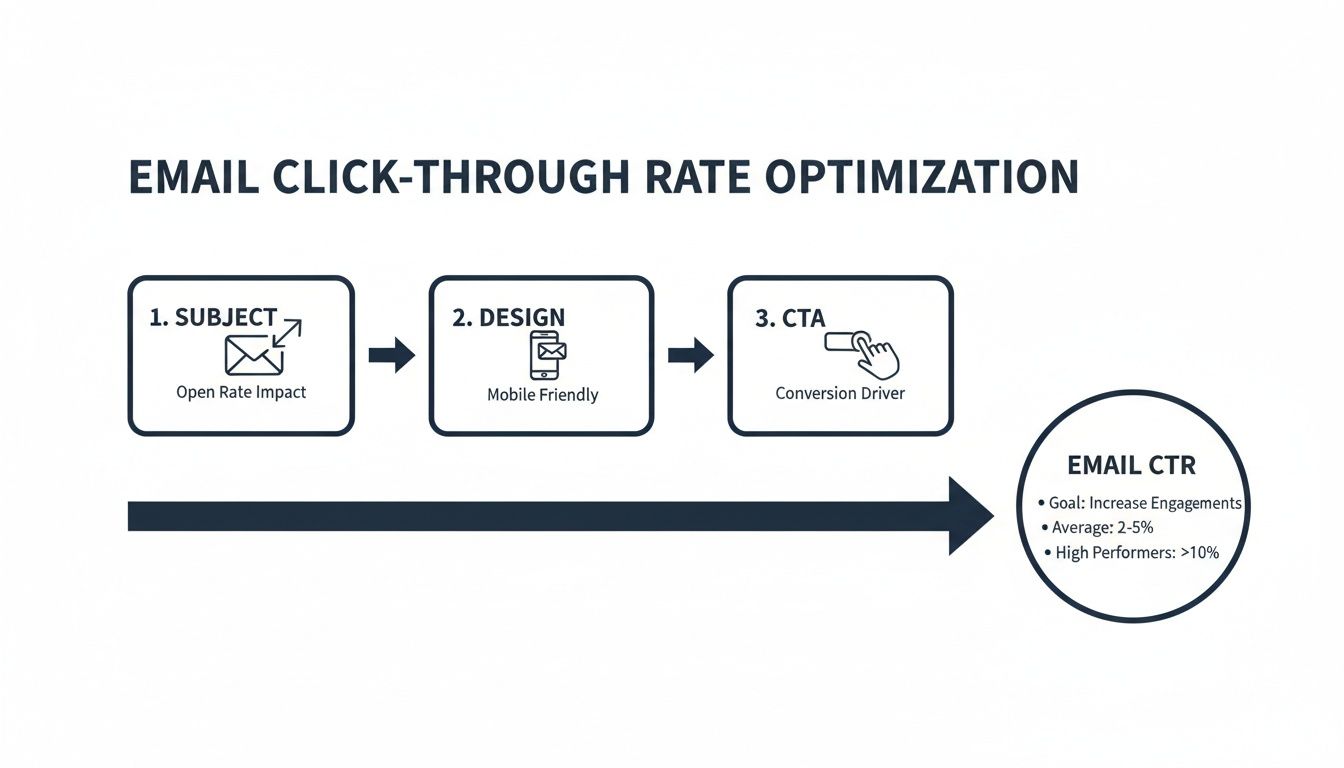
As this process shows, improving email CTR isn't about one magic bullet. It’s about creating a cohesive journey, from an irresistible subject line and a clean mobile design to a clear and compelling call to action.
Balancing Quick Wins with Long-Term Strategy
As you work on improving your click-through rate, it’s useful to think in two buckets: quick wins and long-term strategies. You need a healthy mix of both. Quick wins deliver that immediate feedback and motivation, while the long game builds the kind of deep trust that drives clicks for years to come.
This table breaks down how you can take action today while still planning for future growth.
CTR Tactics Quick Wins vs Long-Term Strategy
| Tactic Category | Quick Win Example (Implement in <1 Hour) | Long-Term Strategy (Implement over Months) |
|---|---|---|
| Organic SEO | Find a high-impression, low-CTR page in Google Search Console and rewrite its title tag and meta description. | Build topical authority by consistently publishing expert content that naturally earns backlinks and trust signals. |
| Paid Ads | Add negative keywords to an ad group to stop your ads from showing for irrelevant searches that drain your budget. | Develop a strong brand reputation that makes users actively look for and trust your ads over competitors. |
| Email Marketing | A/B test two completely different subject lines for your next newsletter on a small segment of your list before sending to everyone. | Implement sophisticated segmentation based on user behaviour, allowing you to send highly personalised and relevant content. |
Quick wins are fantastic for getting an immediate result. Spot a page with thousands of impressions but a dismal 0.5% CTR? Rewriting its title is a no-brainer.
But the long-term work—like a self-storage brand becoming the go-to resource for helpful moving guides—is what builds an unshakeable competitive advantage. Over time, people won't just click on your result because the title is good; they'll click because they recognise and trust your brand name. This blend of tactical optimisation and strategic brand-building is the most powerful path to sustainable CTR success.
Your CTR Questions, Answered
When you start digging into click-through rate optimisation, it’s natural for questions to pop up. Whether you’re a UK business owner just getting started or a seasoned pro, getting straight answers is the only way to make real headway. Here are a few of the most common queries we get from clients.
What Is a Good CTR, Anyway?
This is the big one, and the honest answer is: it really depends. There’s no universal magic number for a "good" CTR. It's completely tied to the channel, your industry, and what the user is actually trying to do.
Think about it this way: a 40% CTR for a branded search term like "Amax Marketing self-storage services" is pretty standard. The person is already looking for you. But for a super-competitive, non-branded term like "secure storage London," a 3% CTR could be a massive win. Context is everything. The best thing you can do is benchmark your own performance and focus on making steady improvements from there.
Forget chasing a vague industry average. A good CTR is simply one that's better than it was last month, bringing more of the right people to your website.
How Long Does It Take to See CTR Improvements?
How quickly you see a change depends entirely on what you're doing. Some tweaks can give you a boost almost overnight, while bigger strategies need a bit more patience.
- Quick Changes (Days to Weeks): If you rewrite a Google Ads headline, test a new email subject line, or adjust the title tag on a page that gets a lot of impressions, you can often see a measurable lift in CTR within a few days or a couple of weeks—just long enough to get solid data.
- Long-Term Efforts (Months): Things like building brand awareness, earning quality backlinks, or snagging a Featured Snippet don't happen overnight. These are the plays that build trust and authority, which then gradually lifts the CTR across your entire site over several months.
Can a High CTR Hurt My SEO?
It sounds a bit backwards, but yes, a high CTR can sometimes be a red flag if the user experience on your site doesn't match the promise. If someone clicks your link and immediately hits the back button to return to Google, that's what we call "pogo-sticking."
It signals to search engines that your title and description were just clickbait. This is why you can't look at CTR in a vacuum. You have to pair it with post-click metrics like bounce rate and time on page. The goal isn’t just to get any click; it’s to attract the right people who will actually find what they're looking for.
What’s the Difference Between an Impression and a Click?
To get a grip on CTR, you first need to be crystal clear on the difference between an impression and a click. These two metrics are the foundation of the whole calculation.
- An impression is counted every single time your ad, search result, or email shows up on someone's screen. Think of it as visibility—the number of times you were seen.
- A click is what happens when someone actually acts on that impression and clicks through to your page.
Your click-through rate is simply the percentage of impressions that turned into clicks. It's the ultimate measure of how persuasive your SERP snippet or ad copy really is.
Should I Focus on CTR for All My Keywords?
It’s tempting to try and fix everything at once, but you’ll get far better results by focusing your efforts where they'll make the biggest difference. The smartest way to prioritise is to log into Google Search Console and hunt for keywords with high impressions but a low CTR.
These are your golden opportunities. High impressions mean you're already visible; Google sees your page as relevant. The low CTR just means your listing isn't doing a good enough job of winning the click. Often, a simple tweak to a title tag or meta description here can deliver a surprisingly big jump in traffic.
Ready to stop guessing and start getting more clicks from your ideal customers? The expert team at Amax Marketing creates data-driven SEO and PPC strategies that turn impressions into valuable traffic. Find out how we can help you by booking your free marketing audit today. Learn more at https://amaxmarketing.co.uk.