
Building a proper SEO strategy really boils down to three key phases: figuring out where you stand right now (auditing), scoping out the terrain (research), and then making your move with a solid plan (execution). This is how you stop guessing and start building a predictable engine for growth.
Your Blueprint for a Winning SEO Strategy
Let's be honest, staring at the mountain of "SEO advice" out there can be completely overwhelming. The key is to cut through the noise and create a structured plan that turns that chaos into a clear path forward. This guide is all about actionable steps that get you real results—moving you from just doing SEO to having a smart, data-backed strategy that actually drives qualified traffic and, more importantly, impacts your bottom line.
At its heart, any good strategy follows a simple, logical flow. You need to know your starting point, understand the competitive landscape, and then execute your optimisations.
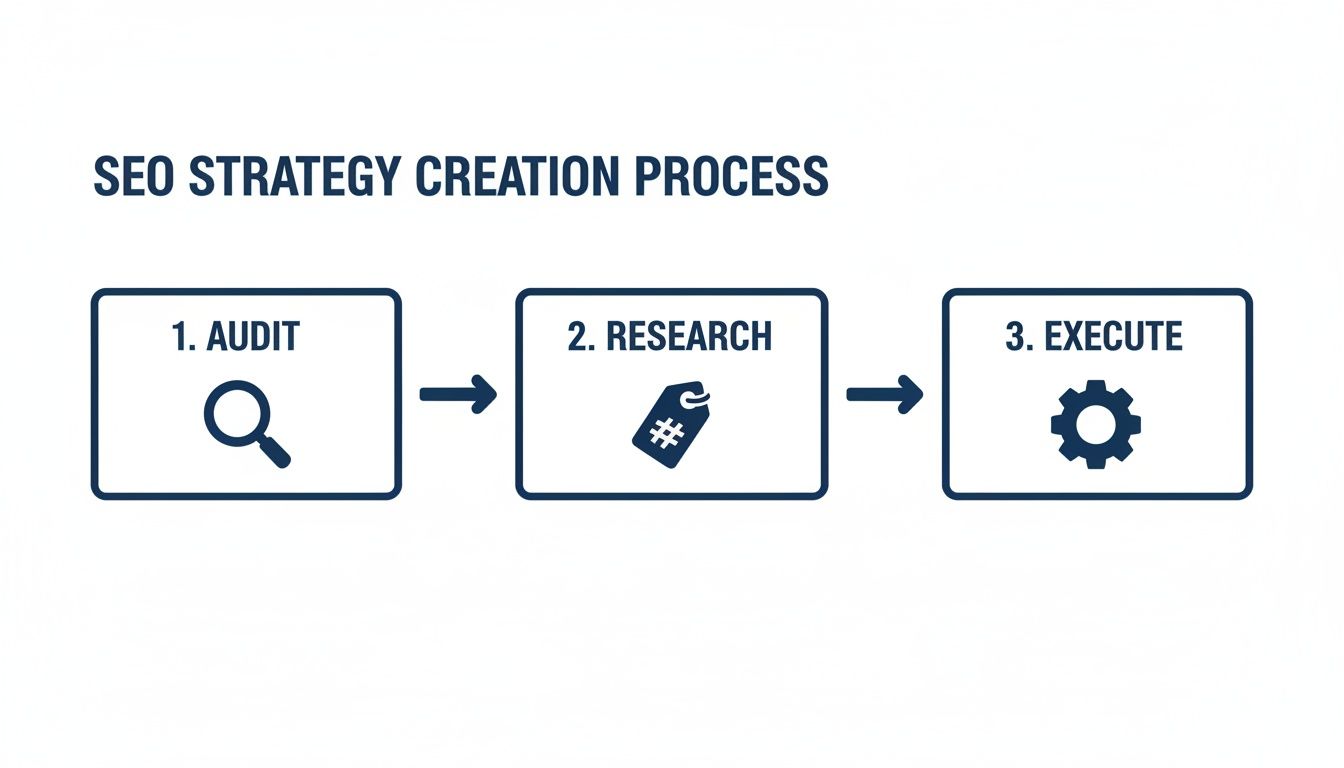
Think of it this way: without a deep-dive audit, your research is flying blind. And without solid research, your execution is just a shot in the dark. It’s a continuous cycle of analysis, investigation, and smart implementation.
Why a Formal Strategy Matters More Than Ever
More and more UK businesses are waking up to the power of a proper plan. The UK SEO market has been growing at a compound annual rate of 11.2% between 2018 and 2023, hitting an estimated value of a whopping £19.2 billion. That’s not just random spending; it shows a real shift from dabbling in tactics to making sustained, strategic investments in SEO.
And when you consider that around 42% of UK consumers head straight to search engines to find what they need, not having a clear strategy means you're leaving a massive audience on the table.
A documented strategy gives every piece of content, every technical fix, and every backlink a clear purpose. It forces you to align all your marketing efforts with your actual business goals, so you stop wasting time and money on things that don't move the needle.
For a closer look at the core components, it's worth understanding what goes into a comprehensive SEO content strategy. At the end of the day, your blueprint should connect every single action to a specific, measurable result.
Get Your Bearings with Audits and Clear Goals
Jumping straight into keyword research without knowing where you stand is like planning a cross-country trip without a map. Before you can map out an effective SEO strategy, you first have to figure out your starting point—what’s working, what’s broken, and where the real opportunities are hiding. This first phase is all about discovery through audits and setting goals that actually mean something.
Think of an audit as a comprehensive health check for your website. You wouldn’t start a new fitness regime without knowing your current stats, right? The same logic applies here. An audit uncovers the foundational issues that could be quietly sabotaging all your hard work.
Uncovering Hidden Technical Gremlins
Technical SEO is the bedrock of your entire strategy. It doesn't matter how brilliant your content is; if search engines can't crawl, index, and understand your site properly, it’s all for nothing. A thorough technical audit isn’t just a nice-to-have; it's non-negotiable.
This means getting under the bonnet of your website to find and fix the things that are holding you back. The usual suspects often include:
- Slow Page Speeds: Even a one-second delay in page load time can slash conversions by a staggering 7%. Your audit should pinpoint what’s slowing you down, whether it's massive image files or clunky code.
- Crawl Errors: These are basically digital roadblocks preventing search engines from accessing your content. A good audit will flag things like broken links (404 errors) or server issues that need sorting out, fast.
- Poor Mobile Usability: With well over half of all web traffic now coming from mobile devices, a site that isn’t mobile-friendly is actively turning away customers. The audit will spot issues like text that’s too small to read or buttons that are too close together on a smaller screen.
By tackling these technical hurdles first, you’re ensuring that any future work is built on a solid, reliable foundation. Honestly, fixing one major crawlability issue can often deliver faster results than publishing ten new blog posts.
An audit isn't about finding fault; it's about finding opportunity. Every error you uncover is a chance to make your website stronger, faster, and more visible to the people who matter most—your customers.
Analysing Your Content and Keywords
Once your technical house is in order, it's time to look at what you’re actually saying. A content and keyword audit is where you get a clear picture of your current performance and spot the gaps in your approach. This isn't just about making a long list of keywords; it’s about properly evaluating the purpose and performance of every single page on your site.
Start by asking some tough questions about your existing content:
- Which pages are actually bringing in the most organic traffic?
- What content is earning valuable backlinks from other websites?
- Are there pages with high impressions but pitiful click-through rates in Google Search Console?
- Do you have multiple pages accidentally competing for the same keywords (a classic case of keyword cannibalisation)?
Let's take a real-world example. A self-storage business in London might discover their blog post on "general packing tips" gets tons of traffic but generates zero leads. At the same time, a much less-visited page on "student summer storage solutions" converts visitors into customers at a ridiculously high rate. That insight is pure gold. It tells you exactly where to focus your energy for real business impact and helps you move from just randomly creating content to a strategic approach where every piece has a clear job to do.
Setting Goals That Actually Matter
With your audit findings in hand, you can finally set some meaningful goals. The single biggest mistake I see businesses make is chasing vanity metrics, like "ranking #1 for X keyword" or getting more traffic just for the sake of it. While these can be positive signals, they aren't the end goal.
Your SEO objectives have to be tied directly to tangible business outcomes. A successful SEO strategy doesn’t just increase traffic; it increases revenue.
Here’s how you can translate your business needs into solid SEO KPIs:
| Business Goal | Primary SEO KPI | Example Scenario |
|---|---|---|
| Increase Leads | Marketing Qualified Leads (MQLs) from organic search | A software company aims for 50 demo requests per month from organic traffic. |
| Boost Sales | Organic revenue and transaction volume | An e-commerce site targets a 20% increase in sales from non-branded organic searches. |
| Improve Local Footfall | Clicks to call, direction requests, local pack visibility | A local plumber wants 15 more phone calls per week from "near me" searches. |
Focusing on these bottom-line metrics from day one keeps your strategy accountable and makes it easy to demonstrate real value. It shifts the entire conversation from "we're getting more visitors" to "we're generating more business," which is, after all, the entire point.
Mastering Keyword Research and Content Mapping

With your audits done, you know where you stand. The next job is to start speaking your customer’s language. Keywords aren't just search terms; they're a direct line into the minds of your audience, revealing their questions, needs, and pain points.
Great keyword research isn't a race to find the highest-volume phrases. The real win is in decoding user intent—the ‘why’ behind every single search. Getting this right is the cornerstone of a content plan that actually works, one that doesn't just pull in traffic but genuinely helps people and guides them to your solution.
Uncovering The Three Flavours of Search Intent
Every time someone types something into Google, their query fits into one of three main buckets. A truly effective SEO strategy needs to serve all of them, catching people at every stage of their journey.
- Informational Intent: This is all about the "how-to," "what is," or "why" questions. Someone searching for "how to pack fragile items for storage" isn't ready to book a unit. They need help first.
- Navigational Intent: Here, the user already knows where they want to go. A search like "Amax Marketing blog" or "Connect Vending login" is a clear signal they’re looking for a specific brand or page.
- Transactional Intent: These keywords are dripping with commercial intent. Think "self-storage prices London" or "buy packing boxes near me." This person has their wallet out and is ready to act.
By identifying and targeting these different intents, you can build a complete content funnel. You'll grab their attention with helpful informational guides, build trust with content about your brand, and then seal the deal with laser-focused service or product pages.
The biggest mistake I see is businesses focusing only on transactional keywords. If you ignore the informational queries, you miss out on becoming a trusted authority early on. You basically hand those potential customers over to a competitor who was willing to help them from the start.
The Art of Content Mapping
Once you’ve got a solid list of keywords, you need to give each one a home. That’s where content mapping comes in. It’s the simple but critical process of assigning a primary keyword (and a handful of related secondary terms) to one specific page on your website.
Without a map, you end up with chaos. Multiple pages end up competing against each other for the same search terms—a frustrating problem we call keyword cannibalisation. Your content map is the blueprint that prevents this, ensuring every page has a unique job and a clear target.
Let’s imagine a London-based running shoe retailer. A disorganised site might have ten blog posts all vaguely targeting "best running shoes." A proper content map, however, would create a much smarter structure:
- Pillar Page: A huge, in-depth guide on "How to Choose the Best Running Shoes for Your Gait," targeting that broad, informational keyword.
- Category Page: This would be optimised for a transactional term, something like "men's trail running shoes."
- Product Page: This gets super specific, targeting a long-tail keyword like "Hoka Speedgoat 5 size 10."
This methodical approach builds what's known as topical authority. By neatly organising and interlinking these pages, you send a powerful signal to Google that you're an expert on running shoes, which helps all those pages rank higher.
In a mature market, this is non-negotiable. The UK’s ecommerce revenue is forecast to hit around £286 billion by 2025, but the explosive growth is levelling off. This shift means that keeping customers and improving conversion rates through a brilliant user journey—which smart content mapping delivers—is just as crucial as attracting new visitors. You can find more insights on what the maturing UK ecommerce landscape means for digital strategies.
Turning Research into a Real Content Plan
Your keyword research and content map are the final pieces of the puzzle. Now you can finally build a content calendar with real purpose. You can stop creating random, ad-hoc blog posts and start developing a proactive plan where every single piece of content is engineered to rank for specific terms and solve a genuine user need.
This is how you turn data into an asset—an engine that consistently drives high-quality, organic traffic to your website.
Putting Your On-Page and Technical SEO Plan into Action
Right, with your audits done and a keyword map in hand, it's time to roll up your sleeves. This is where the strategy moves from paper to practice, where you get hands-on with optimising your website’s pages and shoring up its technical foundation. Think of it as the construction phase that brings your architectural blueprint to life.
Executing the plan means working on two fronts at once: on-page SEO (what your visitors see) and technical SEO (the behind-the-scenes stuff that search engines care about). Both are absolutely critical. Nailing one without the other is like having a beautifully designed shop with a jammed front door.

Optimising Core On-Page Elements
On-page optimisation is all about making it crystal clear to both people and search engines what each page is about. It's the art of weaving your target keywords and related ideas into your content in a way that feels completely natural and genuinely helpful.
Let's ground this with a real-world scenario. Imagine you run a self-storage company in London. Your keyword map has assigned the phrase "secure student storage London" to a specific service page. Now, it's time to meticulously optimise that page.
Here’s a checklist of the most important elements to get right:
- Title Tag: This is your headline in the search results. It has to include your main keyword and be compelling enough to make someone click. A strong example would be: "Secure Student Storage in London | Amax Storage Solutions".
- Meta Description: While not a direct ranking factor, this little summary is your advert in the search results. It massively influences whether people click on your link or a competitor's. Make it a concise pitch that includes the keyword and a call to action.
- Headings (H1, H2, H3): Your H1 is the page's main title and should feature the primary keyword. Use H2s and H3s to break up the content into logical sections. These are perfect spots for secondary keywords and related questions, like "Affordable Summer Storage Options" or "How Our Student Storage Works".
- Image Alt Text: This descriptive text helps search engines "see" your images and is crucial for accessibility. Don't leave an image file as
IMG_1234.jpg. Rename it to something likesecure-student-storage-unit-london.jpgand give it descriptive alt text: "A student placing boxes into a secure storage unit".
On-page SEO isn't about jamming keywords into every available space. It's about creating a clear, logical hierarchy of information that guides the user and signals relevance to search engines. When it's done well, the optimisation is completely invisible to the reader.
As you work through these elements, always keep user experience in mind. For instance, understanding the synergy between SEO and web accessibility can give you a real edge. Simple practices like clear headings and descriptive alt text don't just help all users—they also send strong, positive signals to Google.
Strengthening Your Technical Foundation
While on-page elements are the visible part of your strategy, technical SEO is the engine humming away in the background. A single technical flaw can make even the most perfectly written content invisible to search engines. This is where you'll fix the issues you uncovered in your initial audit.
A solid technical SEO plan really boils down to three core areas: performance, crawlability, and indexability.
Boosting Site Speed and Core Web Vitals
Site speed isn't a "nice-to-have" anymore; it's a cornerstone of good user experience and a confirmed ranking factor. Google's Core Web Vitals are specific metrics that measure how users actually experience the speed, responsiveness, and visual stability of your site.
- Largest Contentful Paint (LCP): How quickly does the main content load?
- First Input Delay (FID): How fast can a user interact with the page?
- Cumulative Layout Shift (CLS): Does the layout jump around annoyingly as it loads?
Improving these scores often comes down to technical tweaks like compressing images, minifying code, and choosing a better web host. Even tiny improvements here can have a noticeable impact on your rankings and, more importantly, your conversion rates.
Enhancing Your Site with Structured Data
Structured data, often called Schema markup, is a piece of code you add to your site to give search engines more context about your content. It’s what powers those "rich results" you see in Google—the eye-catching listings with star ratings, prices, or FAQs baked right in. For a local business, adding LocalBusiness schema can get your opening hours and address to show up, making you stand out in local searches.
Ensuring Clean Crawlability and Indexing
Finally, you need to make it as easy as possible for Google to find and understand your site's content. This means having a clean XML sitemap, using a robots.txt file to block search engines from unimportant pages (like admin logins), and fixing the broken links or messy redirects you found in your audit.
For a more exhaustive list of checks, our comprehensive technical SEO audit checklist provides a step-by-step guide. By managing your crawl budget effectively, you make sure Google spends its precious time crawling the pages that actually matter to your business.
Building Authority with Links and Digital PR

Let's be honest. A technically perfect website with brilliant content is a fantastic start, but it's only half the battle. If you really want to climb the search rankings and stay there, you need to build genuine authority. This is where your off-page SEO strategy kicks in, taking your efforts beyond your own website to build a solid reputation across the web.
Think of backlinks from other reputable sites as votes of confidence. Every high-quality link you get tells Google that your content is trustworthy, credible, and valuable. That signal directly fuels your ranking potential. The key is to earn these links sustainably, not chase them with risky, outdated tactics that could get you penalised.
Earning Links with Valuable Content
By far the most powerful way to attract high-quality links is to create content that people genuinely want to reference and share. We call this a linkable asset. It’s something so uniquely useful or insightful that journalists, bloggers, and industry experts feel compelled to link back to it.
Effective linkable assets usually fall into a few key categories:
- Original Research and Data: Publishing a unique study with compelling statistics is a goldmine for links. Imagine a self-storage company researching "The Average Cost of Moving in London"—they'd quickly become the go-to source for that data.
- Comprehensive Guides: An in-depth, "ultimate" guide on a complex topic can become the definitive resource in your niche. These evergreen pieces attract links for years to come.
- Free Tools and Calculators: A simple tool that solves a common problem, like a "storage space calculator," can generate a steady stream of natural backlinks from people who find it genuinely helpful.
Once you’ve created your asset, the work isn't over. You need to do some targeted outreach, letting relevant journalists and bloggers know that your resource exists. The goal isn't to beg for links; it's to show them how your content can add real value to an article they're already working on.
Forget begging for links. The modern approach is to create something so good that other sites want to link to it. Your outreach then becomes a helpful heads-up, not a desperate plea.
The Power of Digital PR
Digital PR takes this idea to the next level. It’s all about creating newsworthy stories, data, or campaigns that earn media coverage from top-tier publications—think national newspapers and major industry blogs. These campaigns generate some of the most powerful and authoritative backlinks you can get.
For instance, a campaign revealing a surprising consumer trend could get picked up by journalists, leading to dozens of high-authority links and brand mentions. This creates a powerful flywheel effect, boosting not just your SEO but your overall brand awareness and credibility. For a deeper understanding of the core principles, you might find our guide on what link building is in SEO helpful.
Adopting a Modern SEO Mindset
The way we all approach SEO is changing, too. UK data on technology adoption highlights a massive shift, especially with the rise of AI. A staggering 79% of British professionals now use AI to help them at work, which has dramatically sped up content production, analysis, and optimisation.
The UK SEO software market is booming, with one report projecting revenue to grow from US$5.4 billion in 2024 to a huge US$11.3 billion by 2030. Businesses that treat SEO as a structured, AI-assisted programme—rather than a one-off project—are the ones best positioned for growth. You can discover more insights about the strategic trends in the UK SEO market on prsync.com.
This all means that a successful off-page strategy isn't just about link volume anymore. It’s about building a diverse, authoritative link profile that signals genuine expertise to search engines and users alike.
Measuring Success and Refining Your Roadmap
An SEO strategy is never really ‘done’. Think of it less as a static document and more as a living roadmap. It has to adapt to performance data, algorithm updates, and whatever the market throws at you.
This is where the real work begins. We need to create a constant feedback loop: measure what matters, report on it clearly, and use those insights to make the plan better. It’s this iterative process that separates campaigns that fizzle out from those that deliver sustained, long-term growth.
Your two best friends here are Google Analytics 4 (GA4) and Google Search Console. They give you the raw data needed to see the genuine impact of your work. Don’t get lost in a sea of metrics; stay focused on the key performance indicators (KPIs) you identified right at the start.
Building Your SEO Dashboard
A good SEO dashboard should be your single source of truth. Its job is to turn complex data into a simple story about what’s working and what needs attention. Forget vanity metrics like total traffic—we need a dashboard that reports on the outcomes that actually move the needle for your business.
At a minimum, your dashboard should track:
- Organic Traffic Growth: Keep an eye on sessions and users from organic search, but don’t stop there. Segment this data to see how much traffic is landing on your most important service or product pages.
- Keyword Ranking Performance: Track your position for those high-intent, bottom-of-the-funnel keywords. These are the terms directly tied to your primary business goals.
- Conversion Rate from Organic Search: This is arguably the most critical metric. How many of your organic visitors are actually completing a goal, like filling out a contact form or buying something?
- Organic Revenue: For any e-commerce site, this is the ultimate measure of success. It connects your SEO efforts directly to the bottom line.
Your data tells a story. A sudden drop in rankings for a key term might point to a new competitor, while a high bounce rate on a top-performing page could signal a user experience issue. The goal is to ask "why" behind every number.
Interpreting this data is what allows you to make smart, agile decisions. If a new blog post is bringing in heaps of traffic but zero conversions, it's time to rethink the call-to-action. If a technical fix led to a rankings boost, you know to prioritise similar optimisations in the future.
For a much deeper look, our guide on mastering SEO analytics shows how to leverage data for better search results. This continuous loop of analysis and refinement is the engine that drives a truly successful SEO strategy.
We often get asked the same sorts of questions when we’re talking to clients about building out a new SEO strategy. To help clear things up, here are some quick answers to the most common queries we see.
Common SEO Strategy Questions Answered
| Question | Answer |
|---|---|
| How long does it take to see results from an SEO strategy? | SEO is a long-term investment. While you might see some initial improvements in a few weeks, significant results in terms of traffic and rankings typically take 4 to 12 months. The timeline depends on your website's age, industry competitiveness, and the resources you dedicate. Consistency is key. |
| What is the most important part of an SEO strategy? | There isn't one single 'most important' part; a successful strategy is holistic. However, the foundation is a deep understanding of your audience and comprehensive keyword research. Without knowing what your customers search for and why, your technical optimisations and link-building efforts won't attract the right traffic. |
| Can I do SEO myself or should I hire an agency? | You can definitely start building an SEO strategy yourself using the steps in this guide. However, SEO is complex and ever-changing. An agency brings specialised expertise, advanced tools, and experience that can accelerate results, help you avoid costly mistakes, and allow you to focus on your business. |
Hopefully, that gives you a clearer picture of what to expect when you're getting started. SEO isn't an overnight fix, but with the right approach, it becomes one of the most powerful and sustainable ways to grow your business.
Ready to build an SEO strategy that delivers real business growth? The team at Amax Marketing has over a decade of experience creating bespoke plans that increase visibility and drive leads. Get your complimentary marketing audit today.